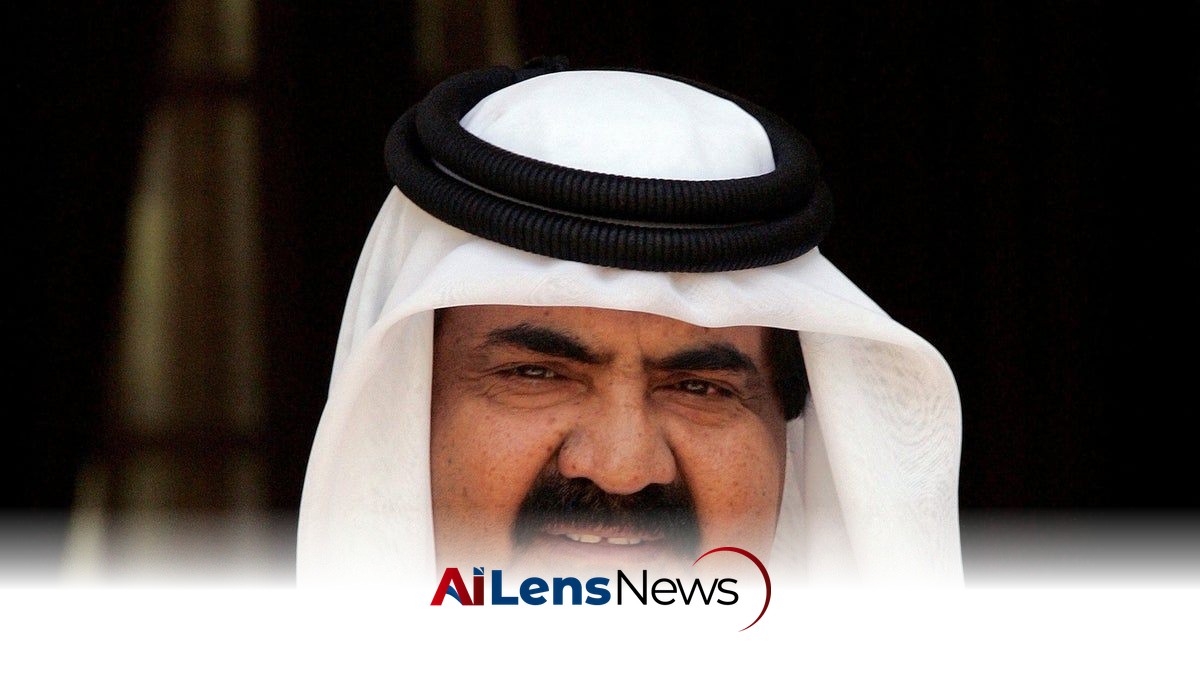


Sheikh Hamad bin Khalifa Al Thani, who transformed Qatar into a global powerhouse, has passed away at the age of 74, marking the end of an influential era.
London, United Kingdom Jul 12, 2026 ALN: Sheikh Hamad bin Khalifa Al Thani, the former ruler of Qatar who dramatically reshaped the tiny Persian Gulf nation into a global powerhouse before making the unprecedented move of voluntarily abdicating, has died at the age of 74. State media confirmed his passing, though no cause was specified.
Sheikh Hamad's 18-year reign, which concluded in June 2013, was marked by significant transformations that propelled Qatar from a relatively obscure state into a prominent player on the international stage. His leadership saw the nation capitalize on its abundant natural gas and oil reserves, which provided the economic foundation for ambitious development projects and strategic investments across various sectors. This transformation was not merely economic; it also involved a redefinition of Qatar's role in regional and global politics.
Under Sheikh Hamad's guidance, Qatar acquired prestigious assets, including London’s Harrods department store, which symbolized the nation’s growing wealth and international stature. Furthermore, he established the groundbreaking Al Jazeera satellite news network in 1996, which became a major force in global media. Al Jazeera's establishment marked a significant shift in the Arab media landscape, providing a platform for diverse voices and perspectives, albeit not without controversy. Its reporting often challenged the status quo and drew both praise and criticism for its editorial choices, particularly regarding sensitive regional issues.
The diplomatic and political reach of Qatar expanded significantly during Sheikh Hamad's rule. The nation cultivated relationships that stretched from North Africa to Afghanistan, illustrating his ambitious vision for Qatar as a mediator and influencer in international affairs. This culminated in Qatar’s hosting of the 2022 FIFA World Cup, an event that underscored the country’s aspirations to be recognized as a global hub for sports and culture. Sheikh Hamad received thunderous applause from Qataris attending the opening match, reflecting the national pride in the achievements of the nation he had helped to build, despite having been out of power for several years.
However, Qatar's rapid ascent and forward-thinking policies often placed it at odds with both regional and Western allies. Sheikh Hamad's government fostered close ties with Shia powerhouse Iran, the Palestinian militant group Hamas, and Egypt’s outlawed Muslim Brotherhood. These relationships frequently strained Qatar’s connections with traditional partners, particularly Saudi Arabia and the United Arab Emirates, who viewed such alliances with suspicion. Al Jazeera, while widely praised for its departure from the traditionally deferential habits of Arab media, also faced criticism and accusations of slanting coverage to align with the viewpoints of Qatar’s rulers, further complicating the nation’s diplomatic standing.
In a highly unusual move for the region, Sheikh Hamad announced his abdication in 2013, handing power to his British-educated son, Sheikh Tamim bin Hamad Al Thani, who was then just 33 years old. In his abdication speech, Sheikh Hamad declared: "The future lies ahead of you, the children of this homeland, as you usher into a new era where young leadership hoists the banner." This peaceful, voluntary transfer of power was a significant departure from the typical patterns of succession in the Arab world, where leadership changes often occur through force or coercion.
The abdication was widely interpreted as Qatar’s strategic attempt to preempt Arab Spring-inspired calls for reforms and to present a leadership more attuned to the region’s large and powerful young population. Sheikh Hamad's decision to step aside may also have been influenced by concerns over his health; he had undergone surgery in Switzerland in 2015 for a leg injury, which may have prompted considerations about the future leadership of the country.
Sheikh Hamad was educated at Britain’s Sandhurst military academy, where he developed a strong foundation in leadership and military strategy. He rose through the ranks of Qatar’s armed forces, becoming commander and later defense minister. His early experiences laid the groundwork for his future policies, particularly regarding national security and defense, which became increasingly important as Qatar sought to assert its independence and influence in a volatile region.
After seizing power in a bloodless palace coup in 1995, Sheikh Hamad swiftly moved to open his inward-looking nation to outside influences. His government’s approach to media and diplomacy often angered other Arab leaders, sometimes leading to severe diplomatic rifts. Notably, Al Jazeera's airing of statements from the terror network al-Qaeda created tensions with the United States, even as Qatar simultaneously hosted a key Pentagon logistical hub following the 9/11 attacks.
Sheikh Hamad aggressively pursued international prestige through sports, securing the World Cup bid amidst allegations that Qatar leveraged its immense wealth to garner support from poorer nations. The nation’s brand remains prominent across the sporting world, exemplified by sponsorship deals with top-tier football clubs, including a notable partnership with Spanish football giant Barcelona and a majority stake in the French club Paris Saint-Germain. Additionally, he oversaw the expansion of Qatar Airways into a major international carrier and the construction of the $15 billion Doha international airport, which bears his name, further enhancing the country’s global connectivity.
Sheikh Hamad harbored wide-ranging visions for Qatar’s role as a diplomatic broker. Over the years, the nation engaged in various mediation efforts, including conflicts in Sudan’s western Darfur region, Lebanese factional feuding, and the rift between the Palestinian factions of Hamas and Fatah. In October 2012, he made history as the first head of state to visit the Gaza Strip since Hamas seized control five years prior, pledging $400 million in projects and investments aimed at rebuilding and supporting the region.
While Qatar maintained its distance from Israel, unlike neighboring Bahrain and the United Arab Emirates, Sheikh Hamad did meet with Israel’s then-foreign minister, Tzipi Livni, at the UN General Assembly in 2007. An Israeli trade office operated in Doha until it was ordered closed in response to Israel’s military actions in Gaza in late 2008, reflecting the complex and often contradictory nature of Qatar’s foreign policy.
During the Arab Spring, Qatar played a proactive role by sending warplanes to NATO-led missions in Libya against Moammar Gadhafi’s forces and providing crucial military and financial aid to the successful Libyan rebels. In Syria, Qatar emerged as a principal political sponsor of the opposition to then-President Bashar Assad, actively advocating for increased support and the flow of weapons to Syrian rebels, further entrenching its position as a key player in regional geopolitics.
However, Sheikh Hamad's backing of Islamist groups like the Muslim Brotherhood created deep rifts with other nations in the region. These tensions culminated under Sheikh Tamim's leadership, when Bahrain, Egypt, Saudi Arabia, and the UAE launched a years-long boycott of Qatar, partly due to the policies initiated by Sheikh Hamad that continued during his son's rule. This blockade not only strained Qatar's economy but also challenged its diplomatic relationships and forced the nation to seek new alliances.
In one of his final initiatives before abdicating, Qatar formally opened an office for Afghanistan’s Taliban, which set the stage for talks between the United States and the Taliban that ultimately led to NATO and America’s chaotic withdrawal from Afghanistan in 2021. This move underscored Qatar's growing role as a mediator in international conflicts, a legacy that Sheikh Hamad leaves behind as a testament to his complex and multifaceted leadership.
Sheikh Hamad bin Khalifa Al Thani's death marks the end of an era for Qatar, and his legacy will continue to shape the nation’s policies and international standing for years to come. As the country navigates the challenges of the future, it will undoubtedly reflect on the transformative impact of his leadership and the path he forged for subsequent generations.
To learn more about the latest developments in Regions & Countries, stay updated with our exclusive reports and analyses on AiLensNews.

