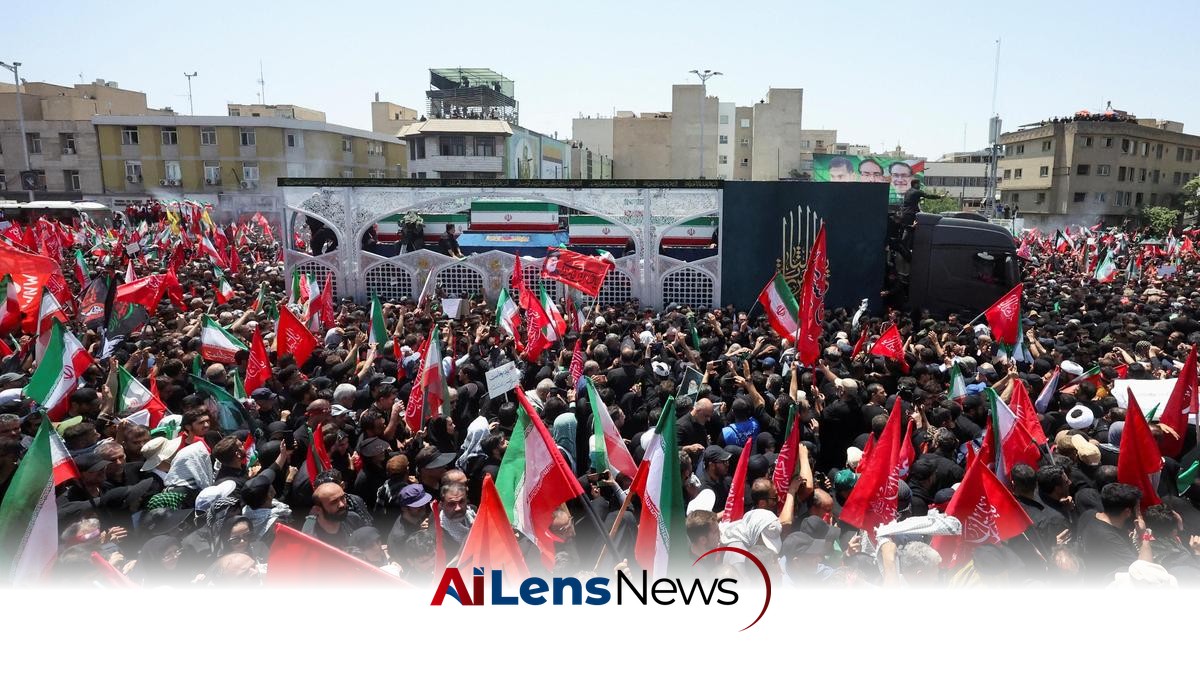


Massive crowds in Tehran mourn the death of Ayatollah Ali Khamenei, showcasing the influence of Iran's clerical leaders amid escalating tensions with the U.S.
Tehran, Iran Jul 6, 2026 ALN: Crowds of Iranians marched through the streets of Tehran on Monday in a funeral procession for slain leader Ayatollah Ali Khamenei. This event marked the largest gathering yet in a week filled with memorial ceremonies, highlighting the enduring influence of the clerical leadership in Iran. Khamenei, who had served as the Supreme Leader since 1989, was a pivotal figure in shaping Iran's political landscape and its relations with the rest of the . His death has prompted a wave of mourning and reflection across the country, with many viewing him as a father figure and a symbol of resistance against perceived Western aggression.
The atmosphere during the procession was charged with emotion, as mourners expressed their anger by hurling stones at a billboard depicting U.S. President Donald Trump with a bullet aimed at his head. The billboard bore the message, “The U.S. killed our father. We won’t let you go!” This sentiment resonated deeply among the demonstrators, who set fire to U.S. and British flags, actions that signified a long-standing animosity towards these nations, rooted in decades of geopolitical conflict and sanctions. The burning of flags is a traditional form of protest in Iran, often employed to express discontent with foreign policies that are perceived as hostile.
Women clad in black chadors held aloft red placards emblazoned with the words “KILL TRUMP” in bold letters. This call to violence, while extreme, reflects the heightened emotions surrounding Khamenei's death and the broader context of U.S.-Iran relations. Others displayed posters featuring the faces of prominent U.S. officials, including Vice President J.D. Vance, Defense Secretary Pete Hegseth, and Israeli Prime Minister Benjamin Netanyahu. Each figure was depicted in the crosshairs of a gunsight, accompanied by the ominous phrase, “There will be blood.” Such imagery and rhetoric are indicative of the deep-seated grievances that many Iranians harbor towards these leaders, associated with policies that many believe have contributed to their nation's suffering.
The larger crowds waved Iranian flags and red banners, chanting slogans calling for the “avengers of Khamenei.” This phrase draws from a significant concept in Shi’ite Islam, rooted in the historical context of the grandson of the Prophet Muhammad, who was killed in battle during the seventh century. This historical reference serves to galvanize the public, invoking a sense of martyrdom and a call for justice that resonates deeply within the cultural and religious fabric of Iran. The invocation of such themes during the funeral procession highlights the intertwining of faith and nationalism in Iranian society, particularly in times of crisis.
The funeral procession not only reflects the deep-seated emotions surrounding Khamenei's death but also underscores the ongoing tensions between Iran and the West, particularly the United States. Khamenei's leadership was characterized by a staunch opposition to U.S. influence in the region, and his passing raises questions about how Iran will navigate its foreign policy in the coming years. As the nation grapples with its leadership transition, the events surrounding Khamenei's funeral may have lasting implications for Iran's domestic and foreign policies.
As the situation unfolds, observers are keenly watching how Iran will navigate its future under the leadership of Mojtaba Khamenei, Ayatollah Khamenei's successor. Mojtaba, who has been groomed for leadership within the clerical establishment, is expected to maintain many of his father’s policies, particularly regarding resistance to U.S. intervention and support for regional allies like Hezbollah and the Assad regime in Syria. However, the younger Khamenei's ability to unite the various factions within Iran's complex political landscape will be crucial in determining the stability of his leadership and the direction of the country.
The implications of Khamenei's death extend beyond Iran's borders, as regional dynamics are also at stake. Neighboring countries, particularly those in the Gulf Cooperation Council, are closely monitoring Iran's next steps, fearing that a power vacuum could lead to increased instability. Additionally, the ongoing conflict in Syria, the situation in Iraq, and Iran's nuclear program remain critical points of concern for both regional and international stakeholders. The potential for escalated tensions or even conflict cannot be discounted, especially if Iran perceives threats to its sovereignty or national interests.
In conclusion, the funeral of Ayatollah Ali Khamenei serves as a pivotal moment in Iran's history, reflecting both the nation's grief and its ongoing struggle with external pressures. The coming days will be crucial in determining the direction Iran will take under new leadership. As the nation mourns, the watches closely, aware that the decisions made in the aftermath of Khamenei's death could reshape the geopolitical landscape of West Asia for years to come.
Ayatollah Ali Khamenei's reign as Supreme Leader was marked by significant events that shaped not only Iran but also the broader Middle Eastern region. His tenure saw the rise of various militant groups, the intensification of sectarian conflicts, and the ongoing struggle between Iran and its regional rivals, particularly Saudi Arabia and Israel. Khamenei's support for groups like Hezbollah and the Houthis in Yemen was part of a broader strategy to extend Iran's influence across the region, often leading to proxy conflicts.
Furthermore, Khamenei's leadership was characterized by a complex relationship with the United States. The 1979 Iranian Revolution, which led to the establishment of the Islamic Republic, was a direct response to U.S. involvement in Iranian affairs, particularly the 1953 coup that overthrew Prime Minister Mohammad Mossadegh. This historical backdrop has fueled anti-American sentiment in Iran and shaped Khamenei's view. His rhetoric often emphasized resistance to U.S. hegemony, and he portrayed Iran as a bastion of anti-imperialism.
In recent years, the U.S.-Iran relationship deteriorated further, particularly with the withdrawal of the United States from the Joint Comprehensive Plan of Action (JCPOA) in 2018 and the subsequent re-imposition of sanctions. These developments exacerbated economic difficulties in Iran and led to widespread protests against the government, reflecting public discontent with the economic situation. Khamenei's response to these protests was typically to emphasize the need for unity and to blame foreign adversaries for Iran's challenges.
As Iran transitions to new leadership, the question of how to address these economic challenges while maintaining a firm stance against perceived external threats will be a critical test for Mojtaba Khamenei. The younger Khamenei will need to navigate the delicate balance between appeasing hardliners and addressing the demands of a populace that has grown increasingly frustrated with the status quo.
Moreover, the international community will be watching closely to see how Iran's new leadership approaches negotiations regarding its nuclear program. The potential for renewed talks with the United States and other powers could emerge, but it will largely depend on the political climate within Iran and the willingness of the new leadership to engage in diplomacy while maintaining their ideological stance.
The ramifications of Khamenei's death will likely extend well beyond Iran's borders, influencing the geopolitical landscape of the Middle East. As various factions within Iran jockey for power and influence, regional players will be assessing how to position themselves in light of the evolving dynamics. The potential for increased instability in Iraq, Syria, and Lebanon could arise if Iran's internal power struggles lead to shifts in its foreign policy or military engagements.
In summary, the funeral of Ayatollah Ali Khamenei marks not only a moment of national mourning but also a critical juncture in Iran's political trajectory. The interplay of domestic and international factors will shape the future of Iran under new leadership, and the decisions made in the coming days and months will have far-reaching consequences for the region and beyond.
To learn more about the latest developments in Regions & Countries, stay updated with our exclusive reports and analyses on AiLensNews.

