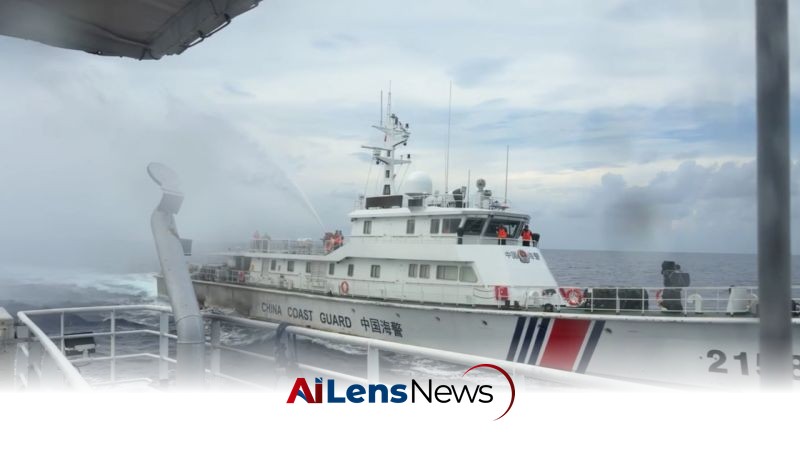


In a recent confrontation in the South China Sea, Chinese ships fired water cannons at Philippine vessels, including one carrying a CNN crew, escalating tensions in the disputed waters.
Washington DC, United States Jul 25, 2026 ALN: On Friday, a significant confrontation unfolded in the South China Sea when Chinese ships fired water cannons at Philippine vessels, including one carrying a CNN crew. This incident marked the third tense encounter of the week in these contested waters, highlighting the ongoing geopolitical tensions in the region.
The South China Sea is a critical maritime area, home to rich fishing grounds and vital shipping lanes. It is also a flashpoint for international conflict due to overlapping territorial claims from multiple nations, including China, the Philippines, and Taiwan. The Scarborough Shoal, where the recent incident occurred, is emblematic of these disputes. While it may appear as just another uninhabited sandbar, its strategic importance cannot be overstated. Approximately one-third of global maritime trade transits through these waters, making control over this region a matter of national interest for several countries.
In the latest confrontation, the Philippine Bureau of Fisheries and Aquatic Resources dispatched a vessel to resupply fuel for local fishermen operating near Scarborough Shoal. As the Philippine ships approached, they encountered several larger vessels from the China Coast Guard. The situation escalated when the Chinese Coast Guard issued warnings over a megaphone, demanding the Philippine vessels leave the area. Subsequently, the Chinese ships began to circle the Philippine vessel, deploying water cannons that struck the ship, further escalating the confrontation.
The Philippine ships eventually decided to abandon their mission and return to port, citing the approach of a developing typhoon in the area. After the decision to retreat, the immediate tension subsided, although Chinese Coast Guard ships continued to shadow the Philippine vessels from a distance. Philippine authorities later reported that a total of 15 Chinese vessels were involved in the incident, including those from the Coast Guard and the so-called "maritime militia." In contrast, the Philippines had deployed 10 ships, three of which were from its coast guard, along with a small government propeller plane that flew low over the area.
The Philippine Coast Guard reported that its vessels faced a series of aggressive maneuvers and water cannon attacks from the Chinese vessels. One Chinese ship reportedly came alarmingly close—within seven meters (approximately 23 feet)—to the Philippine vessel carrying the CNN crew, which posed a serious risk of collision. In response to these actions, China's state broadcaster claimed that the coast guard enforced measures against what it described as illegal activities by Philippine vessels in waters that China claims as its jurisdiction around Huangyan Island, the Chinese name for Scarborough Shoal.
Beijing's foreign ministry spokesperson Lin Jian defended the actions of the Chinese Coast Guard, stating that it was legitimate and lawful for China to take necessary measures to uphold its rights and security in the region. This statement underscores China's position in the ongoing territorial disputes, where it has frequently asserted its claims over various features in the South China Sea.
Scarborough Shoal, also known as Bajo de Masinloc in the Philippines, is located about 140 miles (220 kilometers) west of Luzon, the Philippines' main island, and approximately 530 miles from China's Hainan province. The shoal has been under effective Chinese control since 2012, despite competing claims from the Philippines and Taiwan. The lack of a permanent settlement and the presence of both Chinese and Philippine vessels in the area contribute to the persistent tensions.
The incidents in the South China Sea are not isolated. Frictions have been escalating throughout the week, beginning with a confrontation at Second Thomas Shoal, another contested area in the Spratly Islands. The Philippines maintains a small contingent on this rocky outcrop aboard a grounded World War II-era ship, the BRP Sierra Madre. On Monday, a Chinese Coast Guard ship dispatched a smaller boat to approach the Sierra Madre, prompting the Philippine military to launch two rigid-hulled inflatable boats to escort the Chinese vessel away.
Video footage from the scene showed a group of eight Chinese troops in a boat ramming one of the smaller Philippine crafts, resulting in a physical altercation where blows were exchanged using wooden batons and oars. The Philippine military reported that two service members were injured during this encounter and required evacuation for medical treatment. Following the incident, Chinese authorities accused the Philippines of spreading misinformation, claiming that it was the Philippine boats that had rammed and attacked their personnel.
The situation escalated further just days later, when on Thursday, the Chinese Coast Guard reported that it had successfully driven away two Philippine vessels that it accused of intruding into waters near Scarborough Shoal. The Philippine military later stated that Chinese ships had employed water cannon and dangerous navigational tactics to obstruct efforts to resupply local fishermen in the area. Fortunately, no injuries were reported during this encounter, and the Philippine vessels were able to continue their mission.
The United States has taken an active interest in these developments, weighing in on both incidents. After the clash at Second Thomas Shoal, the U.S. State Department condemned China's actions as "dangerous and aggressive." On Thursday, U.S. Secretary of State Marco Rubio reiterated the commitment of the United States to its allies, emphasizing that the U.S. would not abandon its obligations under the mutual defense treaty with the Philippines. This treaty binds the U.S. to assist the Philippines in the event of an attack on its territory, which could extend to Philippine vessels engaged in lawful activities at sea.
The ongoing tensions in the South China Sea illustrate the complex interplay of national interests, regional security, and international law. The presence of multiple claimants and the strategic significance of the waters create a precarious situation where miscalculations could lead to broader conflicts. As nations navigate these disputes, the potential for escalation remains a critical concern for regional stability and international relations.
In summary, the recent incidents involving Chinese and Philippine vessels in the South China Sea serve as a stark reminder of the fragile nature of maritime security in the region. With overlapping claims and the involvement of global powers such as the United States, the situation demands careful diplomacy and adherence to international norms to prevent further escalation and ensure the safety of all vessels operating in these contested waters.
To learn more about the latest developments in Culture & Society, stay updated with our exclusive reports and analyses on AiLensNews.

