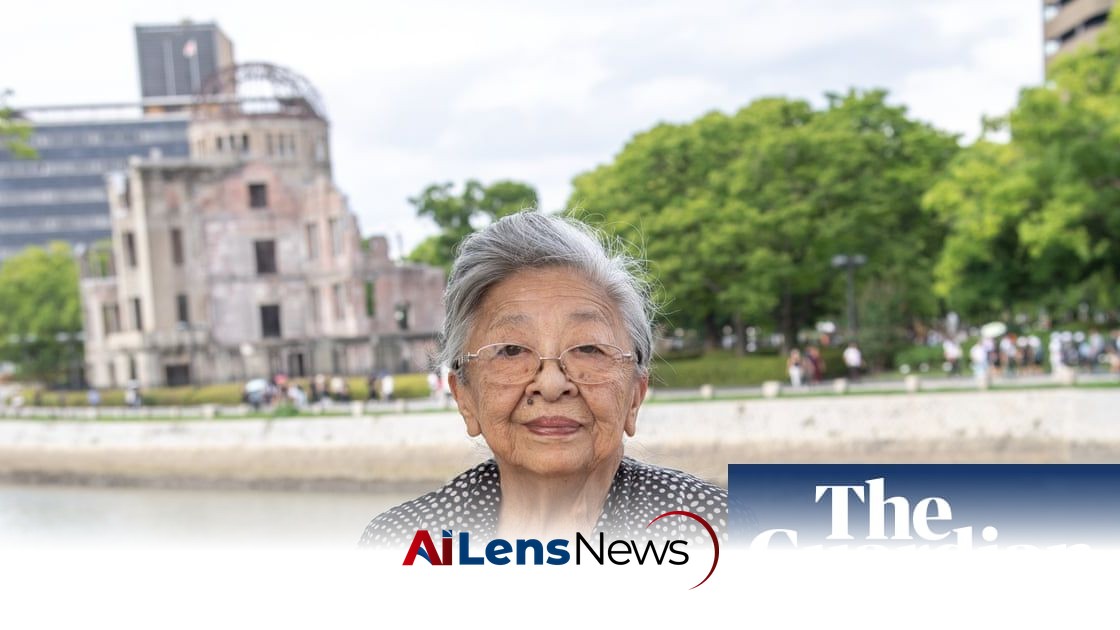


Koko Kondo, a Hiroshima survivor, shares her harrowing story of survival and her father's legacy as a peace campaigner, emphasizing the importance of remembrance.
London, United Kingdom Jul 25, 2026 ALN: Koko Kondo holds up a tiny salmon-pink dress. “This is what I was wearing,” she says. The dress, with its white-ribboned collar, is in perfect condition. A miracle. On 6 August 1945, Koko was eight months old and crawling on a tatami mat at the family parsonage. Mrs. Takaki, a member of the church, had just popped round to have a chat with Chisa, Koko’s mother. Chisa gathered Koko up in her arms so she wouldn’t be a distraction, and they stood by the door. It was 8:15 am; a serene summer day in Hiroshima. That was when the uranium-fuelled atom bomb, named Little Boy by the Americans, was dropped. The most deadly bomb in history. Koko and Chisa were buried in the rubble, unable to move. The parsonage roof had crashed down on them. For 40 years, Chisa couldn’t bear to tell Koko about the day, the pink dress, and how they survived. It was too painful.
Today, 81 years on, Koko is talking to me via video link. She is an elegant woman with a kind face and a vertiginous silver quiff. She speaks quietly in perfect , then surprises you by stamping on a word fiercely to make her point. The virtual background to her screen is the Hiroshima Peace Memorial Park, which was built on ground zero, the point directly underneath where the bomb exploded.
Chisa could not breathe and was on the verge of losing consciousness. Koko’s screams brought her round. Chisa eventually clawed her way out of the rubble, baby in one hand, digging with the other. She made a hole big enough to push Koko through, then crawled out after her. “The whole house crashed. If I had still been crawling on the floor, she probably wouldn’t have been able to find me. Without my mother I wouldn’t be here,” Koko says.
The parsonage and the Hiroshima Methodist church were less than a mile from ground zero. Both were destroyed by the blast and subsequent fires, alongside the other homes in the closely packed residential area. Chisa could find nobody to help Mrs. Takaki, who was also buried in the wreckage. As for Koko’s father, the Rev Kiyoshi Tanimoto, he was in another part of the city at the time, and he also survived. Koko and her parents were lucky. Two days after the bomb, her aunt came to Hiroshima, with her baby daughter Kumiko, to support them. Kumiko suffered radiation sickness and died five months later.
Her father often told Koko she was the only baby in the neighbourhood to survive, and that she had a duty to remind the world what had happened. But for half her life, she turned her back on the enormity of the bomb. Like her mother, she found it too much to bear. So she made a new life for herself away from the carnage.
Tanimoto was one of six survivors featured in a seminal 1946 New Yorker article by John Hersey that revealed the bomb’s true impact on the city. Before that, coverage had been limited and censored. Hersey’s 31,000-word piece filled the whole magazine, which sold out in a few hours. The piece was turned into a bestselling book later that year. It was updated in 1985 when Hersey returned to Hiroshima 40 years on to see what had become of the city and, in particular, the six survivors. In his postscript, he wrote: “What has kept the world safe from the bomb since 1945 has not been deterrence … so much as it’s been memory.”
A few years ago, an astonishing historical document was discovered in Hersey’s archive at Yale University: Tanimoto’s own real-time account of the disaster, and his hellish search for survivors of the Methodist church he ran. Apart from a handful of academics, nobody knew this 230-page diary existed. It is being published in book form, with a moving introduction by Koko. “I am 81 years old now. I am grateful for the life I almost didn’t have, and I love this world. There are not many of us still alive – the hibakusha, as the survivors are called. We are the only people left who experienced an event that remains unique in human history,” she writes. “My father had been a direct witness to a singular event.” And it has taken until now for the world to read this astonishing testimony to our capacity for barbarity and the power of human resilience.
There were about 350,000 people in Japan’s seventh largest city the day it was bombed. The heat after the bomb exploded was 3,000-4,000C (5,400‑7,200F) at ground level. Between 60,000 and 80,000 people died instantly or on the day, and by the end of 1945 the death toll had risen to about 140,000. An estimated 69,000 to 80,000 suffered nonfatal injuries. Of 76,327 buildings, 68% were totally flattened and only 10% were left intact. Three days later, a second atomic bomb hit Nagasaki. Between 40,000 and 75,000 people died on the day, and by the end of the year the Nagasaki death toll had risen to 60,000 to 80,000. The bombs led the Japanese to surrender, but at an obscene cost.
At 8:15 am, Tanimoto was two miles away from ground zero, on the outskirts of the city in the suburb of Koi. He was helping his friend Mr. Matsuo move clothing and furniture to a safer place by pushcart. Its citizens were expecting to be bombed – after all, Hiroshima was home to the headquarters of the country’s second general army, served as a massive embarkation port and had about 43,000 military personnel stationed there. It just wasn’t expecting this kind of bomb.
Tanimoto and his friend Matsuo were at the front door of a large estate in the valley belonging to a wealthy rayon manufacturer, ready to deposit their items in fireproof storage. When Tanimoto saw a sharp flash of light streak out of a brown cloud, he dropped to the ground on his belly between two large decorative granite rocks in the garden. (Matsuo ran into the house to hide. Although the building collapsed, he survived.) The rocks shielded Tanimoto from the heat and flying debris. When he stood up a few seconds later, day had turned into night, and drops of rain, the size and colour of blackberries, fell out of the sky. He ran up Mount Mitake, the hillside overlooking the Koi district, for a better viewpoint. Hiroshima was a sea of flames.
An old woman with a little boy approached Tanimoto and said she was injured. He put the boy on his back and took him to a school already acting as a first-aid station. But all he could think about was Chisa, Koko and his church members. He sprinted through the devastation over dead bodies and injured people. To his shame, he continued running, ignoring their cries.
“So many people asked for help,” Koko says today. “Help! Help! Help! But people were caught under houses and he couldn’t pull bodies from out of there, so he said, ‘I’m sorry, I’m sorry, please forgive me!’ He said to me, on that day I only thought about what’s happened to my daughter and wife.” He felt guilty? “Yes, and when I heard that, I thought, ‘OK, Dad, you did a good job’.”
Remarkably, Tanimoto came across the blood-stained Chisa and Koko near a Shinto shrine. They were too traumatised to embrace. Tanimoto simply acknowledged that they were safe, and they parted. Chisa and Koko went to shelter in the suburb of Ushita, and he continued running into the city to help others.
Tanimoto’s fame spread from Hiroshima through Japan and on to the US, where he toured tirelessly, asking for money to rebuild his church and the city, and to create a peace centre. He told anybody who’d listen about what he’d seen, preached Christian pacifism and argued for the elimination of all nuclear weapons.
Perhaps he was best known for featuring in Hersey’s Hiroshima. Hersey, then aged 31 and already an experienced war reporter and Pulitzer prize-winning novelist, told the story of the bomb and its aftermath by piecing together the lives of the survivors. It was one of the first examples of what became known as new journalism, where reporters used creative storytelling techniques associated with fiction to create compelling narratives rather than simply reporting cold facts. In 1999, the article was ranked as the finest piece of American journalism of the 20th century by a panel of experts assembled by New York University’s journalism department.
Tanimoto’s account, based on his diaries, is the perfect complement to Hersey’s Hiroshima. Whereas Hersey tells the story through supremely crafted, understated reportage, Tanimoto’s version is a gripping real-time search for life and hope. Everything he sees is meticulously recorded: the flesh of the injured stripped away or hanging loose; survivors walking silent and expressionless “like a procession of ghosts”; houses looking “like toy buildings crushed by a hammer”. He describes soaking scattered cushions in a water tank, holding them against himself then running through fire. Victims are incinerated to white ash. A skeleton hangs on to the door of a street car.
At its most dramatic, he comes across as the haunted hero of an apocalyptic action movie (which his story is being turned into). Tanimoto hauls five dead men out of a boat, says a short prayer for them, then ferries the injured across the Kyobashi River using only a single bamboo pole. He helps put out the blaze when trees catch fire in the Sentei Gardens; steals irradiated pumpkins to feed the sick; takes people by the hand only to find their flesh coming away like cooked fish off a bone. Even when he goes down with radiation sickness, suffering from high fever and violent diarrhoea, he continues until he’s on the verge of death. Tanimoto is as tough on his family as himself. When Chisa tells him that she had escaped without finding out what had happened to Mrs. Takaki, he is indignant. (They later discovered that Mrs. Takaki survived).
Tanimoto had only lived in Hiroshima for two years when it was bombed. He had gone from Japan to the US to study, and graduated with a degree in theology from Emory University in 1940. This is why he still felt such warmth towards the US, despite the bomb, Koko says. I ask her if her father was her hero. “I guess so, because he was so concerned about peace. He loved the United States, he loved Japan, and he wanted to rebuild relationship between them. He so wanted world peace.”
In the book, we travel through the city with Tanimoto, as he tries to account for his flock. He names every victim he finds and tells their story. It’s an extreme act of bearing witness. He prays over the dying Tanaka, a wealthy man who despised him and spread rumours that he was a US spy. We hear about the high-school girls who suffocate in the smoke while singing Kimigayo, the national anthem of Japan; the stench of the dead baby carried by its mother for three days in the hope that her missing husband could see the child a final time. Tanimoto describes the dead floating in the river, and his attempts to row past them. “I had no more human feelings,” he writes. “Pushing aside the dead, I propelled my boat.”
There are moments of hope. Flowers and vegetables start to grow instantly out of the ruins. The radiation has somehow encouraged new life. He visits a woman whose eyeballs had been removed because of her injuries, and gifts her an aubergine, saying: “I hope you can overcome the atomic bomb as this plant has done.” Perhaps the greatest hope lies in the possibility of rebirth. Today’s Hiroshima is a vibrant, urbane city with a population of more than 1 million.
As Koko grew up, her father reminded her that as the youngest survivor in their neighbourhood, it was her duty to work for Hiroshima and world peace. But she wasn’t having any of it. “‘No, sir,’ I told him. ‘Not me.’ I didn’t want to share in the trauma, or make it mine,” she says today. She refused to take her friends to talks he gave about the bomb.
But its impact was there for her to see in everyday life. The parsonage played host to older, disfigured girls she regarded as sisters. Eyelids were stuck to foreheads, lips to chins, fingers were fused together. For a long time, she didn’t realise the girls were orphans. Other disfigured children just hid at home. “Girls stayed inside a big mosquito net so nobody could see them. Many families broke every mirror they had because otherwise the children who were disfigured would see their faces.”
As soon as she discovered this had all been caused by the American atom bomb dropped from a B-29 aircraft, she swore revenge. “I said, when I’m a grownup I’m going to find the people who flew the B-29 Enola Gay and I’m going to give them a punch or bite or kick.” Incredibly, she got the opportunity to do so.
Ten years on from the bomb, Tanimoto was famous in the US for his work on behalf of Hiroshima. At the time, he had taken 25 disfigured young women, known as the Hiroshima Maidens, from the city for reconstructive surgery at Mount Sinai hospital in New York. The US version of the TV series This Is Your Life surprised him one day. He thought he was going to give yet another interview about Hiroshima, but in fact he was the subject of the show. That particular episode gained notoriety as one of the most shocking, tasteless and strangely moving TV programmes ever.
In between promotions for Hazel Bishop nail varnish, the presenter Ralph Edwards told the story of Tanimoto and Hiroshima. Behind a curtain, in shadow, a surprise guest said: “Looking down from thousands of feet over Hiroshima, all I could think of was, my God, what have we done?” Tanimoto was frozen in shock when Edwards introduced the guest – Capt. Robert Lewis, co-pilot of the Enola Gay. The tiny Tanimoto and the huge, bull-necked Lewis shook hands in bewildered silence. Koko was in the audience, and the show changed her life.
“I will never forget that day,” she tells me. “I was just staring at him. He’s a bad one. But, after he said that, I saw the tears coming down from his eye. I was so surprised. I thought he was a bad one, but he was crying. I thought, maybe he is a good person after all.”
To learn more about the latest developments in Culture & Society, stay updated with our exclusive reports and analyses on AiLensNews.

