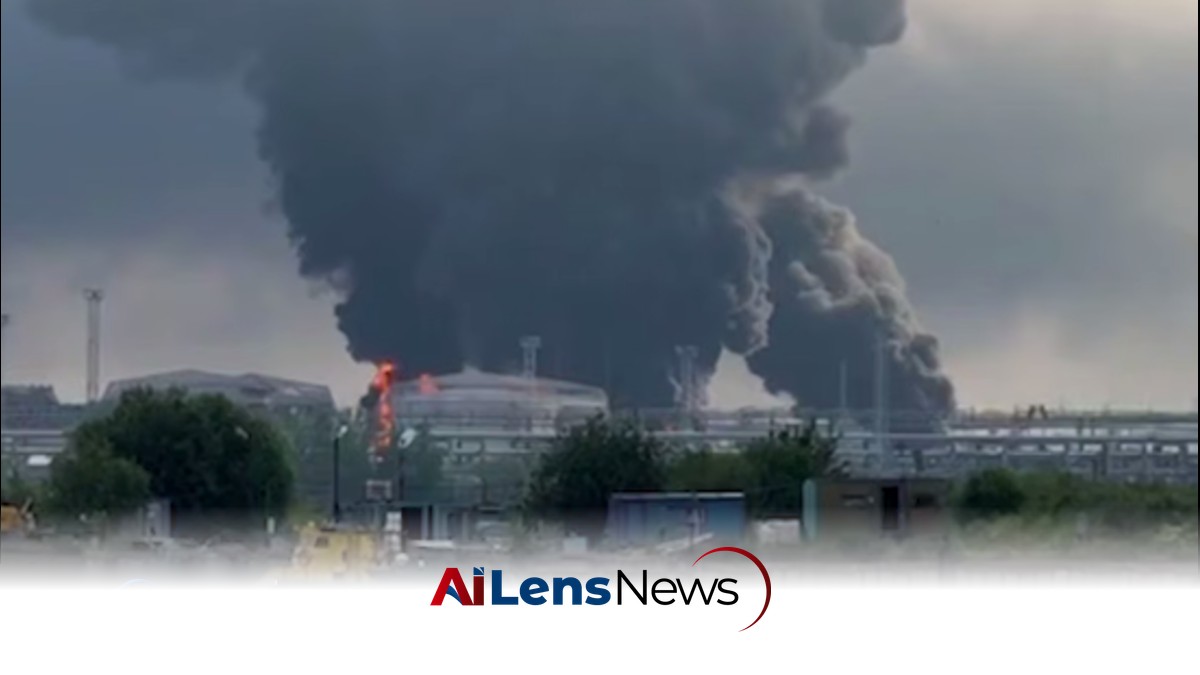


Ukrainian President Volodymyr Zelensky confirms a strike on a key oil terminal in St Petersburg, targeting infrastructure vital to Russia's war efforts.
New Delhi, India Jul 5, 2026 ALN: A major oil terminal in Russia's second city of St Petersburg in the north-west was struck overnight by Ukraine, President Volodymyr Zelensky has said.
He described it as key "infrastructure that generates revenue for Russia's war". Ukraine also said a major Russian naval base in the region was hit. This marks a significant escalation in Ukraine's ongoing campaign against Russian military and logistical capabilities, particularly as the conflict continues to evolve since the full-scale invasion launched by Russia in February 2022.
St Petersburg Governor Aleksandr Beglov reported that the city was under a "massive" drone attack, admitting the oil terminal was hit. He stated that there were no casualties, which is a notable aspect in the context of such military operations, as civilian safety is often a concern in areas affected by strikes. The use of drones in warfare has become increasingly prevalent, and their effectiveness in targeting critical infrastructure is a focal point of modern military strategies.
Ukraine has recently intensified its long-range drone attacks on Russia's critical energy infrastructure, causing widespread fuel shortages. Kyiv claims that nearly 43% of Russia's oil refining capacity has been "disabled" as a result. These claims, while not independently verified, highlight the strategic importance Ukraine places on targeting Russia's energy sector, which is a significant source of revenue for the Russian government. The ongoing conflict has seen both sides adapt their military strategies, with Ukraine seeking to undermine Russia's logistical capabilities while also boosting its own defensive and offensive operations.
Ukraine argues that Russian oil and gas facilities are legitimate targets as Moscow relies heavily on fossil fuel exports to sustain its war effort. This assertion is grounded in the belief that disrupting Russia's energy supply chain will weaken its military operations and overall economic stability. The implications of such attacks extend beyond immediate military gains, potentially affecting global energy markets and international relations, particularly with nations that depend on Russian oil and gas.
Russian President Vladimir Putin, who last week acknowledged fuel shortages caused by Ukrainian attacks, signed a bill aimed at boosting supplies to the domestic fuel market. This move underscores the challenges facing Russia as it grapples with the consequences of ongoing hostilities and the impact of international sanctions aimed at crippling its economy. The Kremlin's response to Ukraine's strikes may involve increased military expenditures and efforts to enhance domestic production capabilities in the energy sector.
Zelensky noted that the targets hit in St Petersburg and the surrounding region were approximately 850km (528 miles) from Ukraine's border. This distance indicates a significant capability for Ukraine to project power deep into Russian territory, which could alter the strategic calculus for both sides. The extent of the damage was not immediately clear, but a video posted by the Ukrainian president showed a drone flying towards a target and a significant column of black smoke billowing from the area after the strike.
The BBC later verified that St Petersburg's oil terminal was indeed hit. Ukraine's military described the terminal as "one of the largest" in Russia, capable of producing 12.5 million tonnes of petroleum products per year. The operational capacity of such facilities is critical for Russia, and damage to them could have far-reaching consequences for its military logistics and economic stability.
The military also reported that a key naval base of the Russian Baltic Fleet in Kronstadt was struck. This base is strategically important for Russia's naval operations in the Baltic Sea region, and its targeting signifies Ukraine's intent to disrupt Russian maritime capabilities. Such actions could provoke a stronger military response from Russia, as it seeks to safeguard its naval assets.
Russia has not publicly commented on these claims. The lack of a swift official response may suggest an attempt to assess the damage and formulate a strategic counter-response. Governor Beglov stated that 72 Ukrainian drones were shot down over St Petersburg and the wider Leningrad region. He urged city residents to stay indoors until the drone threat was lifted, warning that mobile internet services might also be disrupted. More than five million people live in St Petersburg, making it a densely populated urban area where civilian safety is paramount during military engagements.
In a separate development, Ukraine's military denied that the key eastern Ukrainian town of Kostyantynivka was now under full Russian control. Military spokesman Maj Andriy Kovalyov told the BBC that "Kostyantynivka remains under the control of the Defence Forces of Ukraine". He acknowledged that there were "cases of infiltration by small infantry groups deep into the combat formations of our forces", but added that those groups were being identified and neutralized. This situation illustrates the ongoing struggles for control in contested areas, where both Ukrainian and Russian forces are vying for dominance.
His comments followed Putin's assertion that Russian control had been established over the town of Kostyantynivka in June. The Kremlin leader provided no evidence to support his claim, which reflects the often contentious nature of information warfare in the conflict. Both sides frequently issue statements regarding territorial control, sometimes without the backing of verifiable evidence, complicating the understanding of the ground situation.
Later, Zelensky wrote on Telegram: "If Kostyantynivka is now under Russian control, then Putin will probably have no problem meeting me there and finding diplomatic solutions to finally end the war. But still, he will not cross the front line: the truth is very different from Putin's words." This statement underscores the deep mistrust that characterizes the relationship between the two leaders and their respective nations, as well as the broader geopolitical implications of the conflict.
Kostyantynivka is one of several heavily fortified towns that comprise Ukraine's "fortress belt" in the Donetsk region, most of which is occupied by Russia. The strategic importance of these towns cannot be overstated, as they serve as critical defensive positions for Ukrainian forces against Russian advances. The ongoing battles in this region have significant implications for the overall trajectory of the conflict, with both sides seeking to solidify their control over key territories.
In its latest operational bulletin, the Russian defense ministry claimed to have shot down more than 500 Ukrainian drones and missiles launched overnight and in the morning. It characterized the Ukrainian attacks as an attempt by Zelensky to "distract the attention" of Ukrainians and "foreign sponsors" from the consequences of one of the largest and deadliest Russian strikes on Ukraine's capital Kyiv on July 2, as well as a "catastrophic failure" of Ukrainian forces in Kostyantynivka. This narrative reflects the ongoing information warfare, where both sides seek to frame the conflict in a manner that supports their strategic objectives.
Ukrainian attacks on Russian civilian facilities "will not go unanswered", the ministry stated. This statement indicates a potential escalation in military responses from Russia, as it seeks to deter further Ukrainian offensives. Both sides appear to be vying for the upper hand ahead of next week's NATO summit in Turkey, where discussions regarding military support and strategic alliances are likely to be on the agenda.
On Saturday, Putin sent President Donald Trump a congratulatory note to mark the 4th of July celebrations in the US, calling for "constructive relations" between their countries. This gesture highlights the complex geopolitical landscape, where alliances and enmities can shift rapidly based on the evolving conflict in Ukraine.
On Friday, the Russian leader visited commanders in military fatigues, where he made claims about capturing Kostyantynivka. Zelensky accused Putin of lying about the situation on the front. This remains a war of words as well as missiles, with both sides engaging in a battle for public perception and legitimacy on the international stage.
To learn more about the latest developments in Wars & Conflicts, stay updated with our exclusive reports and analyses on AiLensNews.

