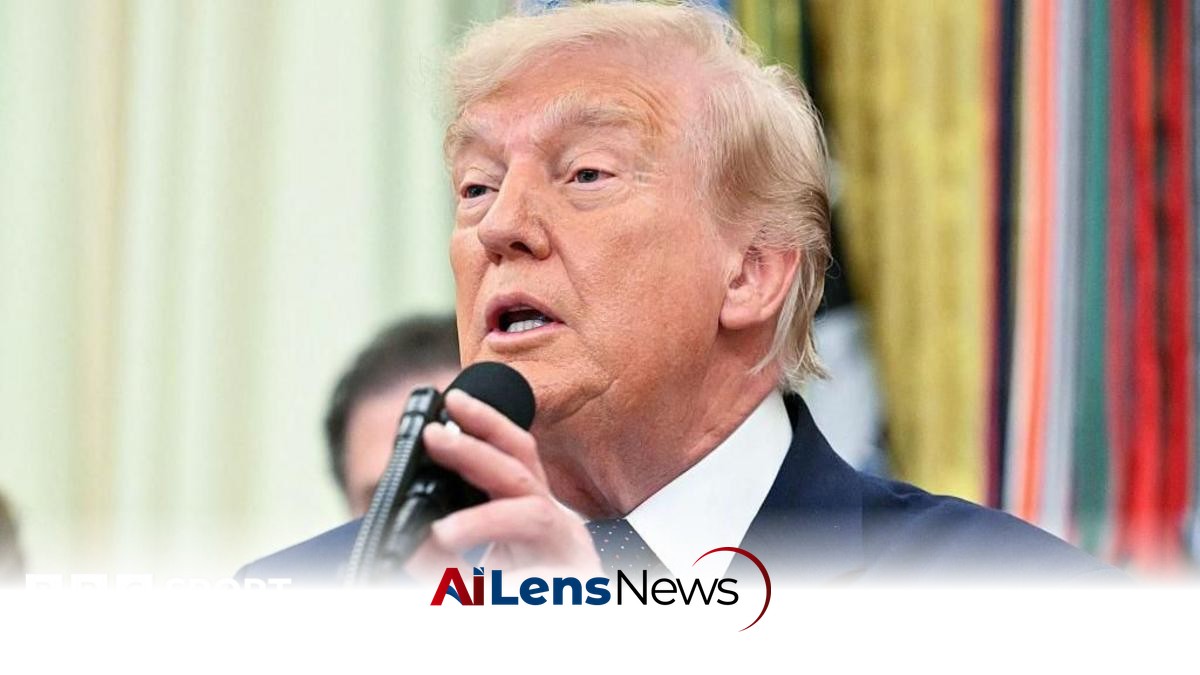


President Donald Trump has confirmed his request to FIFA to review the one-match suspension of US striker Folarin Balogun, who was set to miss a crucial match against Belgium.
New Delhi, India Jul 7, 2026 ALN: President Donald Trump has confirmed he asked FIFA to review United States striker Folarin Balogun's one-match suspension at the Cup.
Balogun, 25, was set to miss his side's last-16 tie against Belgium after being shown a straight red card for a foul on Bosnia-Herzegovina defender Tarik Muharemovic in the previous round. The incident, which occurred during a tense match, drew immediate attention and sparked debate over the appropriateness of the referee's decision. Balogun's red card was controversial, as many felt the foul did not warrant such a severe punishment. This incident not only affected Balogun's participation but also raised questions about the consistency and fairness of officiating in high-stakes matches.
However, FIFA made the surprising decision to suspend the automatic one-match ban for 12 months, leading to widespread criticism, including from UEFA, Belgium, and England boss Thomas Tuchel. This unprecedented move allowed US forward Balogun, who has scored three goals at this summer's tournament, to be selected for the match in Seattle, which kicks off at 17:00 local time (01:00 BST on Tuesday). The decision to delay the ban has been seen by many as a significant deviation from the norm, particularly in a tournament setting where player discipline is critical to maintaining the integrity of the competition.
The Royal Belgian Football Association (RBFA) expressed its astonishment at the move and informed the United States Soccer Federation that it contests Balogun's eligibility to play in the tie after its appeal against the decision was dismissed. This has led to a tense atmosphere between the two federations, with Belgium feeling disadvantaged by the ruling, which they argue undermines the principles of fair play and competition.
Trump stated that football's governing body "made the right decision," adding that implementing the ban would have left a "big stain" on the tournament. His involvement in the matter highlights the intersection of politics and sports, particularly in high-profile international competitions where national pride is at stake. Speaking at the White House, Trump mentioned that he asked FIFA to review the decision because he "didn't think it was a foul." He confirmed that he spoke to FIFA president Gianni Infantino but clarified that he only requested a review and did not instruct Infantino to suspend Balogun's ban. This distinction is important, as it suggests that while Trump sought to influence the outcome, he did not directly intervene in FIFA's judicial processes.
Trump added: "I think it [the suspension] would have left a big stain. I can't tell them what to do. I don't believe they made the decision; I believe it was the commission that made the decision. And it was the right decision." His comments reflect a broader concern about the integrity of the tournament and the image of American soccer on the global stage. The U.S. has been striving to establish itself as a competitive force in international football, and Balogun's contributions have been significant in this regard.
However, UEFA stated that the integrity of football is at stake. The governing body of European football has consistently advocated for strict adherence to disciplinary measures, arguing that any leniency undermines the rules that govern the sport. Trump's intervention has raised eyebrows within UEFA, as officials fear it could set a precedent for political interference in sports governance.
Trump also criticized referee Raphael Claus' decision to send off Balogun, calling it "horrible" and suggesting that the Brazilian referee was "a little bit suspect." In response, the Brazilian Football Confederation (CBF) defended Claus' integrity, stating: "There is nothing in his record that discredits him or gives grounds for any suspicion. He is an exemplary professional." This exchange highlights the contentious nature of officiating in football, where referees often face scrutiny from players, coaches, and fans alike. The reliance on VAR technology was meant to mitigate such controversies, yet it has not eliminated disputes regarding referee decisions.
In a statement on X, Infantino mentioned that upon receiving Trump's call, he informed the US President that there was "an ongoing legal process involving FIFA's independent judicial bodies and that the case would be decided in due course by the competent bodies." This statement underscores FIFA's commitment to maintaining the independence of its judicial processes, despite external pressures. The FIFA appeal committee ruled that Belgium is not an interested party as they were not involved in the original decision and are merely the United States' next opponents. This ruling effectively sidelined Belgium's concerns and reinforced the notion that FIFA's internal processes will take precedence over external appeals.
"The request was rendered inadmissible on the grounds that the Belgian FA is not a party to the proceedings and, as such, has no standing to appeal the decision," FIFA stated. This means Balogun will be free to play against Belgium since there is no party appealing the decision. The implications of this ruling extend beyond the match itself, as it raises questions about the future of disciplinary actions in football and the potential for political influence in sporting decisions.
The RBFA stated that it has "still not received any grounds" for the FIFA appeal committee rejecting its appeal and is still awaiting information requested, including the "motivation [for] declaring the player eligible as well as the referee's report." The lack of transparency in FIFA's decision-making process has been a longstanding concern among football associations, particularly when it comes to disciplinary matters. The RBFA added this is a "breach" of FIFA regulations, indicating a potential challenge to FIFA's authority and governance.
When asked about Trump's comments and his view on Claus, FIFA stated it had "nothing more" to add. This response reflects FIFA's reluctance to engage in public disputes with political figures, emphasizing its desire to maintain the integrity of its judicial processes without external influence.
Infantino later reiterated that FIFA's judicial bodies are "independent" and that rulings "must always be respected." He added: "I read the decisions of the FIFA Disciplinary Committee when they are issued. Sometimes I am surprised by them. Sometimes I agree with them, and sometimes I disagree. What I always do, however, is respect those decisions and the autonomy of the bodies that make them. Whether we personally like a decision or not is irrelevant. Respect for independent institutions and the rule of law is what protects the integrity of our competitions and the credibility of FIFA at all times." This statement serves as a reminder of the importance of maintaining the rule of law in sports, particularly in an era where external pressures can threaten the autonomy of governing bodies.
In raising its concerns, the RBFA stated: "Regardless of the sporting outcome of this match, the RBFA is deeply concerned by the course of events and will continue to fight in the coming hours, days, and months in defense of the fundamental principles of ethics, fair competition, and the interests of football as a whole." This commitment to upholding the integrity of the sport is crucial in maintaining trust among fans and stakeholders alike, particularly in a sport as globally significant as football.
England head coach Thomas Tuchel remarked that the ruling sets a dangerous precedent. Tuchel had defender Jarell Quansah sent off in a dramatic 3-2 win over Mexico. "Where to draw the line is the question that I ask," he said. "I have no answer to that. Do we appeal if a yellow card is not a yellow card? Do we think it is not a red card or who thinks it? Where does this start and where does this end? It's my question. I don't have an answer." His comments reflect the uncertainty surrounding officiating and disciplinary decisions, particularly in high-stakes matches where the outcomes can significantly impact teams' fortunes.
UEFA stated that intervening to effectively cancel a suspension at a tournament "crossed a red line." Of the 189 other red cards at the Cup, only once has a player escaped a suspension, which was Brazil's Garrincha in 1962, before automatic bans were in place, and the failure to impose a sanction was shrouded in allegations of political interference. This historical context underscores the rarity of such occurrences and the potential ramifications of FIFA's decision to suspend Balogun's ban.
FIFA cited article 27 of its disciplinary code, which allows for partially suspended disciplinary measures, in announcing that Balogun's one-match ban would be suspended for a probationary period of one year. This provision has raised eyebrows among football officials, as it appears to provide a loophole for players to evade punishment under certain circumstances.
In an 871-word statement released later on Monday, FIFA again outlined the process in which article 27 can be used but provided no further reasoning behind the specific decision to suspend Balogun's one-match ban. The lack of clarity in FIFA's rationale has only fueled speculation about the motivations behind the decision and the potential implications for future disciplinary actions.
The Swiss Football Association, whose side faces Colombia in the last 16 on Tuesday, called the decision "incomprehensible," adding it "raises questions and creates uncertainty, particularly regarding the authority of referees' decisions, especially when the video assistant referee (VAR) is involved." This sentiment echoes the concerns of many within the football community, who fear that the integrity of the sport is being compromised by external influences and inconsistent application of the rules.
To learn more about the latest developments in International Politics, stay updated with our exclusive reports and analyses on AiLensNews.

