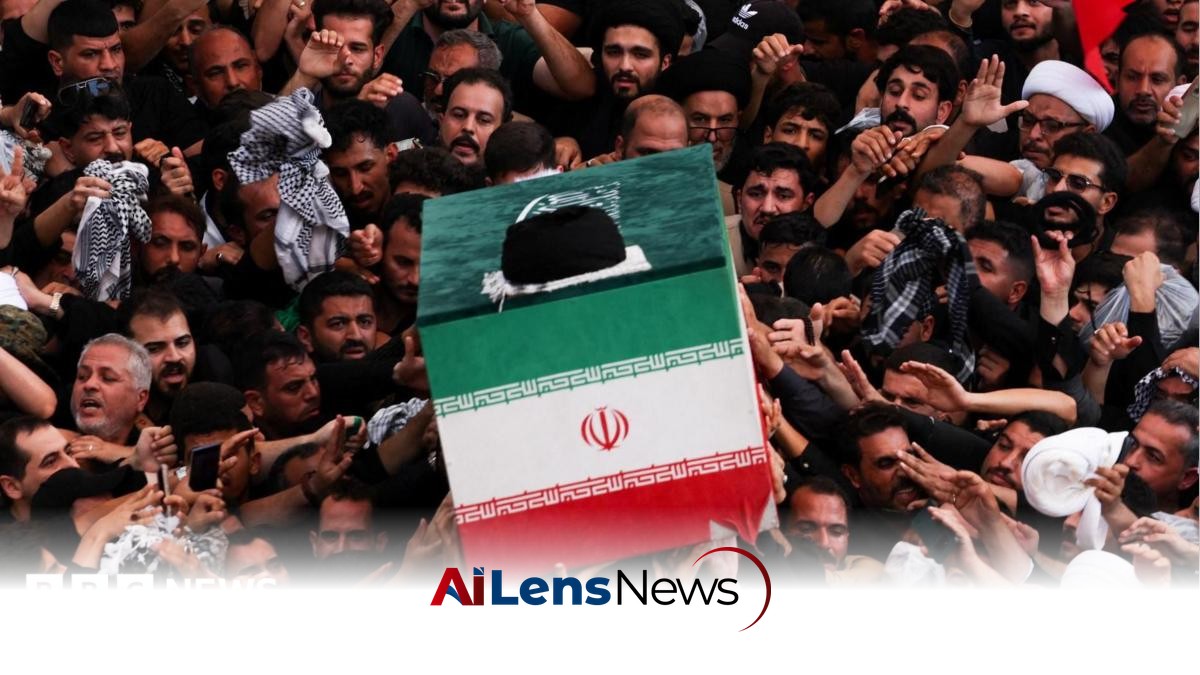


The remains of Iran's late supreme leader are transported to Najaf and Karbala, as funeral ceremonies continue for a fifth day.
New Delhi, India Jul 8, 2026 ALN: The remains of Iran's late supreme leader Ayatollah Ali Khamenei have been carried through two of Shia Islam's holiest shrines in neighbouring Iraq, as funeral ceremonies continue for a fifth day.
The procession commenced in Najaf, a city of profound historical and religious significance for Shia Muslims, where large crowds gathered to pay their respects. The procession culminated at the mausoleum of Imam Ali, who is revered as the first Shia Imam and the son-in-law of the Prophet Muhammad. The mausoleum itself is a site of pilgrimage, drawing millions of visitors annually, and serves as a symbol of Shia identity and faith. Mourners inside the mausoleum jostled to touch Khamenei's coffin, reflecting the deep reverence many hold for him as a leader who significantly influenced Iranian politics and the broader Shia community.
Following the ceremonies in Najaf, Khamenei's remains were flown to Karbala, another pivotal site for Shia Muslims, located approximately 60 kilometers north of Najaf. The city is home to the shrine of Imam Hussein, the grandson of the Prophet Muhammad, whose martyrdom in the 7th Century is commemorated annually during Ashura and symbolizes the struggle against oppression. As Khamenei's coffin was processed through the streets of Karbala, crowds again gathered, chanting slogans such as "Death to America" and "Death to Israel," which underscore the ongoing tensions between Iran and these nations and reflect Khamenei's legacy of resistance against perceived Western imperialism.
Khamenei's death occurred during a time of heightened conflict, specifically on the first day of a war involving Iran, the United States, and Israel. His leadership spanned decades, during which he became a prominent figure in the resistance against Western influence in the region. His passing is not only a moment of mourning for many Iranians but also a significant event in the geopolitical landscape of the Middle East. Khamenei’s funeral rites are emblematic of the deep-rooted ties between Iran and Iraq, particularly among Shia communities, and highlight the shared religious and political narratives that bind these nations.
Among the mourners in Najaf was Mohammed al-Bayati, a 30-year-old who expressed the sentiment that participating in Khamenei's funeral was a unique opportunity to honor a leader who opposed American and Israeli power. This sentiment resonates with many in the region who view Khamenei as a symbol of resistance and a champion of Shia Islam against foreign intervention.
The funeral processions were marked by moments of intense emotion, as video footage captured mourners pushing and shoving to get closer to the casket. This physical manifestation of grief and reverence was accompanied by prayers led by a senior cleric from Najaf's Shia seminaries, further solidifying the religious significance of the event.
On the evening prior to the ceremonies, Iranian President Masoud Pezeshkian, along with other senior Iranian officials, traveled to Iraq to participate in the mourning events. Their presence underscored the importance of Iraq as a neighbor and ally to Iran, particularly in the context of shared religious beliefs and political interests. The Iraqi government, led by Prime Minister al-Zaidi, declared Wednesday a public holiday in honor of Khamenei, further illustrating the respect afforded to him in Iraq, where Shia Islam is the dominant sect.
In a notable absence, Iran's new Supreme Leader Mojtaba Khamenei, who succeeded his father, did not appear during the ceremonies. His absence is particularly striking given the circumstances surrounding Khamenei's death, as Mojtaba was reportedly seriously wounded in the same Israeli air strike in Tehran that also killed his father, his wife, and several other family members. This has raised questions about the stability of leadership in Iran and the future direction of its political landscape.
Following the funeral ceremonies, President Pezeshkian reportedly returned to Tehran early on Wednesday amidst escalating tensions between the US and Iran. The backdrop of these events includes a series of retaliatory strikes following attacks on multiple tankers in the strategically vital Strait of Hormuz, a key maritime route for global oil and gas shipments. The US has attributed these attacks to Iran, leading to military responses targeting Iranian military installations. In a further escalation, Iran retaliated by attacking US military facilities in Bahrain and Kuwait.
President Donald Trump characterized the preliminary agreement between the US and Iran to end hostilities as "over," indicating a significant deterioration in diplomatic relations. This statement is reflective of the broader geopolitical dynamics at play, as both nations navigate a complex web of interests and hostilities. Iranian Parliamentary Speaker and chief negotiator Mohammad Bagher Ghalibaf criticized the US for violating the terms of the agreement, asserting that Iran would not capitulate under pressure.
The memorandum of understanding that had been signed by President Trump and President Pezeshkian aimed to facilitate the reopening of the Strait of Hormuz and establish a framework for a comprehensive deal addressing Iran's nuclear program, US sanctions, and a permanent ceasefire. However, the recent escalation of violence raises significant doubts about the feasibility of reaching a lasting agreement.
In the days leading up to Khamenei's funeral, there were indications of progress in indirect negotiations between Iranian and US officials in Doha, mediated by Qatar. Following a series of military exchanges, both sides had reportedly made strides towards dialogue, with plans for further discussions scheduled to commence after the conclusion of Khamenei's funeral ceremonies. The outcome of these talks remains uncertain, particularly in light of the heightened tensions and the symbolic weight of Khamenei's death in the context of Iran's political landscape.
As the region continues to grapple with the implications of Khamenei's death and the ongoing conflict between the US and Iran, the funeral ceremonies serve as a poignant reminder of the complex interplay between religion, politics, and identity in the Middle East. The mourning of a leader who played a pivotal role in shaping the modern Iranian state and its relationship with the Shia community across the region will likely resonate for years to come, influencing both domestic and international dynamics in a rapidly evolving geopolitical landscape.
To learn more about the latest developments in Culture & Society, stay updated with our exclusive reports and analyses on AiLensNews.

