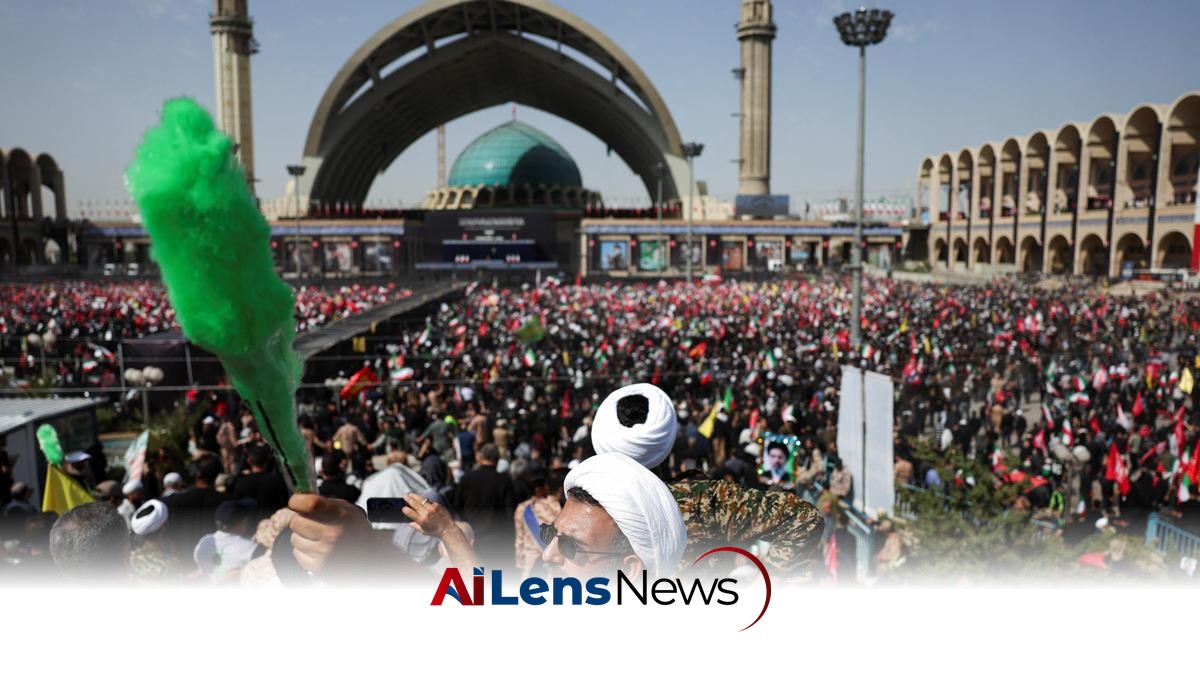


Follow live updates on the historic state funeral of Ayatollah Ali Khamenei, as Iran navigates its transition under Mojtaba Khamenei.
Tehran, Iran Jul 4, 2026 ALN: The state funeral for late Supreme Leader Ayatollah Ali Khamenei has commenced in Iran, marking a significant moment in the nation's history. Khamenei, who served as the Supreme Leader since 1989, was a pivotal figure in shaping Iran's domestic and foreign policies. His death has not only left a void in the leadership of the Islamic Republic but has also raised questions about the future direction of the country, particularly under the leadership of his son, Mojtaba Khamenei.
The atmosphere surrounding the funeral is charged with both mourning and anticipation for the future. Thousands of Iranians have gathered to pay their respects, reflecting the deep-seated loyalty that many felt towards Khamenei. His tenure was marked by a staunch commitment to the principles of the Islamic Revolution, which included opposition to Western influence, particularly that of the United States and Israel. As the nation mourns, the implications of his passing are felt across various sectors, from politics to economics.
Khamenei's leadership was characterized by a hardline stance against the West, and his policies were often rooted in the revolutionary ideals established in 1979. He was instrumental in promoting a vision of Iran as a regional power that could resist foreign hegemony, particularly that of the U.S. and its allies. His approach to foreign policy was often described as confrontational, with a focus on supporting groups and movements across the Middle East that opposed U.S. interests, including Hezbollah in Lebanon and various factions in Iraq and Syria. The implications of his passing are profound, as they could signal a shift in Iran's approach to these relationships.
In a recent statement, Iranian Parliament Speaker Mohammad Bagher Ghalibaf emphasized the need for the United States to acknowledge the changing realities in the region, particularly in light of the ongoing Israeli-U.S. conflict with Iran. Ghalibaf's remarks come at a time when the geopolitical landscape in the Middle East is shifting, with various countries reassessing their alliances and strategies. During a meeting with Uzbekistan’s Speaker of Parliament, Ghalibaf remarked, “Conditions have improved compared to the past, and post-war developments have caused Americans to accept existing realities.” This statement reflects a growing sentiment in Iran that the U.S. may be compelled to adapt to a new regional order, one where Iran plays a more significant role.
Ghalibaf expressed optimism about the potential for expanding trade relations, stating, “In such an environment, trade relations can be expanded further, and we hope that the groundwork for lifting sanctions will also be prepared.” His comments highlight a broader sentiment within Iran regarding the shifting geopolitical landscape. The Iranian economy has faced severe challenges due to international sanctions, particularly those imposed by the U.S. following its withdrawal from the Joint Comprehensive Plan of Action (JCPOA) in 2018. As the country navigates this transitional period, there is hope that new trade partnerships may alleviate some of the economic pressures.
Furthermore, Ghalibaf highlighted the regional conditions that could foster new opportunities for transit and trade cooperation. He noted, “With the joint management of Iran and Oman in the Persian Gulf and the Strait of Hormuz and the reduction of American mischief in the region, better opportunities will be created for the development of transit cooperation.” The Strait of Hormuz is a critical chokepoint for global oil shipments, and Iran's strategic position in this region has always been a point of leverage in its foreign policy. The potential for increased collaboration with neighboring countries like Oman could signify a new approach to regional diplomacy, one that seeks to enhance economic ties while reducing reliance on Western powers.
This funeral not only serves as a farewell to a pivotal figure in Iranian politics but also as a potential turning point for the country's foreign relations and economic strategies. As foreign delegates arrive to pay their respects, the watches closely to see how Iran will navigate this transition. The presence of international dignitaries at the funeral may also signal a willingness from some nations to engage with Iran, despite the contentious history. This could indicate a potential thaw in relations that have been strained for decades.
As the ceremony unfolds, updates will continue to provide insights into the proceedings and the implications for Iran's future under Mojtaba Khamenei. The younger Khamenei has been seen as a potential bridge between the hardliners and more moderate factions within Iran, and his leadership style may influence how the country approaches both domestic reforms and foreign policy initiatives. Observers are particularly keen to see how he will handle relations with the United States and its allies, especially in light of the ongoing tensions surrounding Iran's nuclear program and its regional activities. The younger Khamenei's approach may differ from that of his father, potentially opening avenues for dialogue that were previously closed.
The funeral also serves as a reminder of the internal dynamics within Iran. The Islamic Republic has faced significant challenges in recent years, including widespread protests, economic difficulties, and a changing demographic landscape. The youth of Iran, who make up a substantial portion of the population, have increasingly expressed dissatisfaction with the status quo, calling for greater freedoms and opportunities. These internal pressures are compounded by the economic hardships that have resulted from sanctions and mismanagement. How Mojtaba Khamenei responds to these internal pressures will be crucial in determining the future stability of the regime.
The legacy of Khamenei is complicated; while many revered him for his steadfastness and commitment to the Islamic Revolution, others criticized him for the repressive measures taken against dissent and the lack of political freedoms. The challenge for his successor will be to balance these competing narratives and address the needs of a populace that is increasingly vocal about its demands for change.
In conclusion, the state funeral for Ayatollah Ali Khamenei is not just a moment of mourning but a pivotal event that could shape the trajectory of Iran in the years to come. The transition of power to Mojtaba Khamenei presents both challenges and opportunities, and the international community will be watching closely to see how Iran navigates this complex landscape. As the nation reflects on the legacy of its former leader, the future remains uncertain, with potential for both conflict and cooperation on the horizon. The decisions made in the coming months will be critical in determining whether Iran will continue on a path of confrontation or seek a new direction that could foster stability and economic growth.
To learn more about the latest developments in Regions & Countries, stay updated with our exclusive reports and analyses on AiLensNews.

