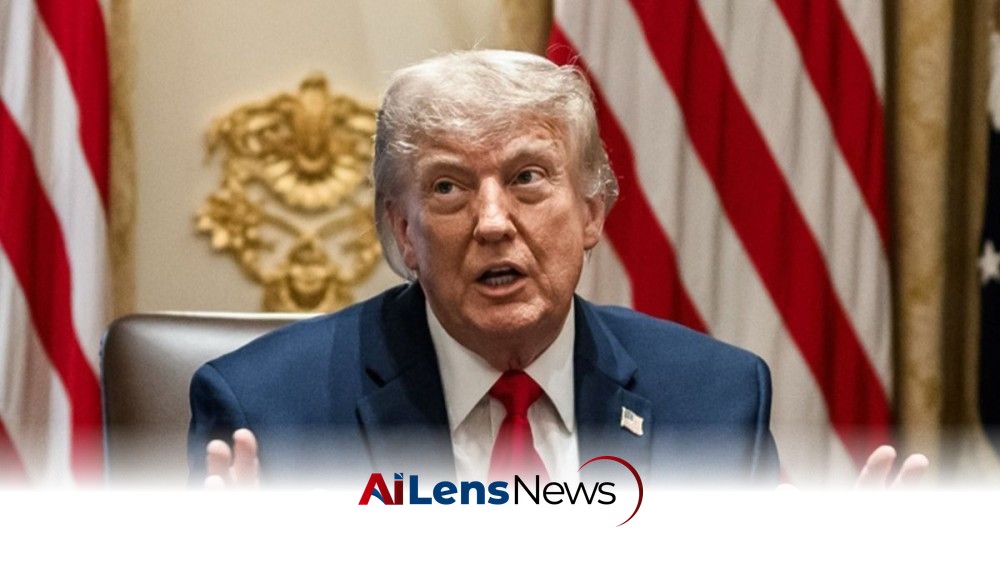


President Trump emphasizes military preparedness while advocating for diplomatic negotiations with Iran regarding its nuclear ambitions.
New Delhi, India Jul 25, 2026 ALN: US President Donald Trump stated that the United States remains "locked and loaded" for potential military action against Iran, while simultaneously emphasizing that his administration is engaged in negotiations, with diplomacy as his preferred option if Tehran abandons its nuclear ambitions.
During a White House event focused on civilian nuclear energy, Trump conveyed that the US is prepared to escalate military operations, expressing optimism that Iran is becoming more serious about reaching an agreement. The context of these statements comes amid heightened tensions between the US and Iran, particularly following the US's withdrawal from the Joint Comprehensive Plan of Action (JCPOA) in 2018, which was an agreement aimed at curbing Iran's nuclear capabilities in exchange for sanctions relief.
"Look, we're talking to them right now," Trump remarked when asked about the possibility of broader military strikes against Iran. "We're locked and loaded and ready to go, but we're talking to them so I think while we're talking, we'll see what comes of it." This duality of military readiness and diplomatic engagement reflects a strategy that has characterized US foreign policy towards Iran for decades, balancing the need for deterrence with the potential for negotiation.
The President outlined two potential paths: "There's a military exit where we just keep going just the way we are, and we can even make it a heavier dose," he stated. "Or there's a smarter strategy that you make a deal and they want to make a deal. I just don't think they're ready yet." This statement underscores the complexity of the situation, where military action could escalate tensions further, while a diplomatic resolution remains elusive.
Trump noted that Iran has become "by far the most serious" it has ever been in negotiations, but he cautioned that an agreement is not guaranteed. "I think they're being serious. I think they are being by far the most serious that we've seen them, but that doesn't mean we get there. We'll see what happens," he added. This sentiment reflects a cautious optimism that has been echoed by various analysts who observe that Iran's economic struggles, exacerbated by US sanctions, may be pushing them towards a more conciliatory approach.
When asked about the message being conveyed to Tehran, Trump reiterated his long-standing position: "They cannot have a nuclear weapon. Very, very simple actually." He warned that if Iran even contemplated acquiring one, the US would escalate its response significantly. "If they have even a thought of a nuclear weapon, we will just continue to go at much higher levels," he said. This firm stance has been a cornerstone of US policy, aimed at preventing Iran from achieving nuclear capability, which many in the US government believe could destabilize the already volatile Middle East region.
Trump mentioned that Vice President JD Vance, Secretary of State Marco Rubio, and other senior officials are engaged in discussions with Iranian representatives. "JD and Marco and a lot of people are talking to a lot of people," he noted. The involvement of high-ranking officials in these negotiations indicates the seriousness with which the Trump administration is approaching the situation, particularly as they seek to unify their strategy in light of Iran's complex political landscape.
The President also claimed that Iran's military capabilities have been significantly degraded. "We've taken out their first level of leadership. We've then taken out their second level of leadership. We've taken out some of the third level, and we're negotiating with the rest," he stated. This assertion reflects a broader narrative within the Trump administration that military action has effectively diminished Iran's ability to project power in the region. However, critics argue that such claims may overlook the resilience of Iran's military and its ability to adapt.
He argued that the pressure campaign has fundamentally altered the strategic balance in the region, asserting that Iran "sort of has to make a deal." This perspective suggests that the economic and military pressures exerted by the US have created a scenario in which Iran may feel compelled to negotiate, despite its historical resistance to external pressures.
In response to questions regarding whether Russia and China are assisting Iran, Trump indicated that both countries have refrained from significant involvement thus far. "I will tell you that President Xi said he will not partake and President Putin said the same thing," he said. "I trust them." While this statement may reflect Trump's optimistic view of US relations with these nations, it does not fully account for the complexities of international relations, particularly given the strategic interests that both Russia and China have in the Middle East.
While acknowledging Iran's historical relationships with both nations, Trump added, "Thus far at least, it has not been major." This comment illustrates the ongoing geopolitical dynamics at play, where Iran's alliances are often tested against the backdrop of its contentious relationship with the US.
Trump defended his administration's previous military actions against Iran, arguing they have prevented Tehran from obtaining a nuclear weapon. "If I wasn't elected, Israel would, in my opinion, not be around anymore," he claimed. This assertion highlights the administration's framing of its foreign policy as a protective measure for US allies, particularly Israel, which has long viewed a nuclear-armed Iran as an existential threat.
He praised the US military's use of B-2 bombers, stating that strikes have destroyed critical Iranian facilities. "If that didn't happen, they would have had a nuclear weapon and there would be no Israel," he asserted. This narrative serves to reinforce the administration's justification for its military actions, portraying them as essential to maintaining regional stability.
Furthermore, Trump claimed that Iran's conventional military capabilities have been severely weakened. "They have no Navy, no air force, no anti-aircraft, no radar, no nothing," he said. This characterization of Iran's military capabilities reflects a broader trend in US discourse that emphasizes the effectiveness of its military strategies in countering Iranian influence.
Despite repeated warnings that military options remain available, Trump maintained that negotiations remain his preferred course. "I always prefer that alternative," he said, referring to diplomacy. This statement underscores the delicate balance the administration seeks to maintain between demonstrating military readiness and pursuing diplomatic solutions.
The Trump administration has consistently asserted that preventing Iran from acquiring a nuclear weapon is a central US national security objective. Washington has alternated between economic pressure, military deterrence, and diplomatic engagement across successive administrations, while Iran has consistently maintained that its nuclear program is intended for peaceful purposes, despite longstanding concerns raised by the United States and several Western allies. The implications of this ongoing standoff are profound, affecting not only US-Iran relations but also the broader geopolitical landscape in the Middle East, where numerous countries remain vigilant about the potential for conflict and instability.
To learn more about the latest developments in Culture & Society, stay updated with our exclusive reports and analyses on AiLensNews.

