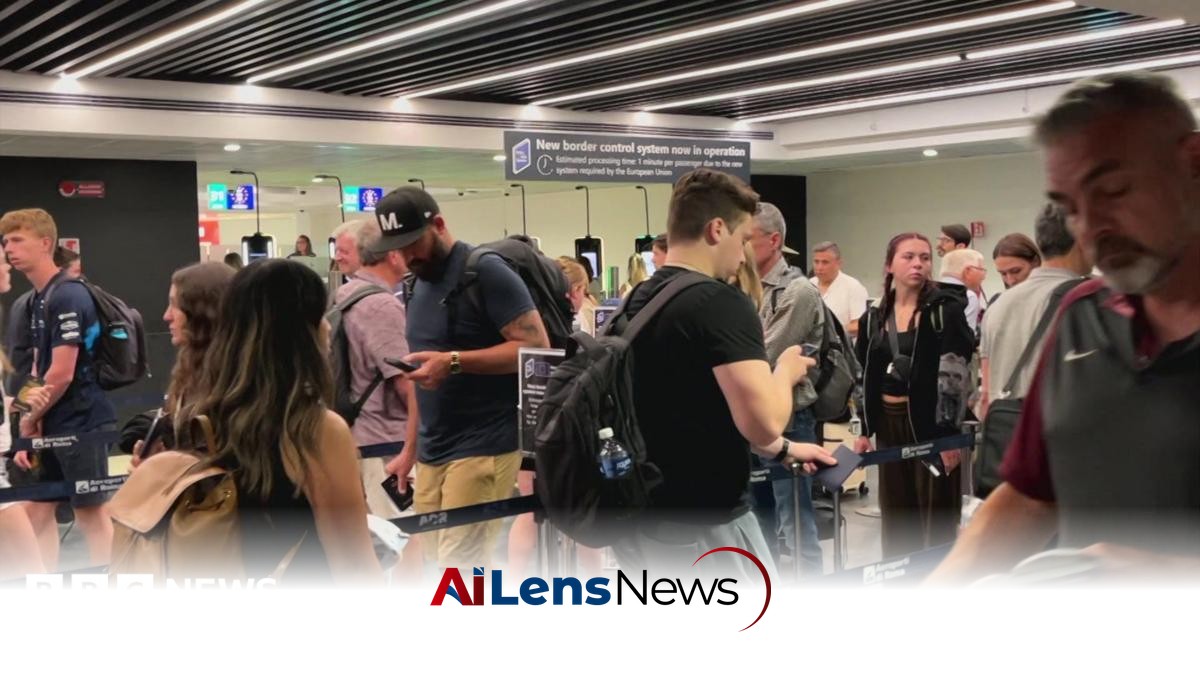


The EU's new Entry Exit System has tripled passport control times for travelers, prompting warnings from airlines about extended waits this summer.
New Delhi, India Jul 19, 2026 ALN: The EU's new border system has nearly tripled the time it's taking for Brits to get through passport control even after improvements have been made, a boss at Rome's main airport has said.
As the summer travel season approaches, concerns regarding the efficiency of the European Union's new border control system have intensified. Ryanair has issued warnings to passengers traveling to Europe this summer, advising them to prepare for extended waits at passport control. The airline's caution is echoed by reports from various airports across Europe, including Portugal’s Faro airport, where border police have acknowledged issues with the Entry Exit System (EES) technology, citing bugs that have led to delays.
The European Commission (EC) has responded to these concerns, stating that in most EU airports, disruption remains limited. Furthermore, the EC has pledged to continue supporting member states in the implementation of the EES, emphasizing its commitment to resolving the issues that have arisen since the system's rollout. The Commission stated, "This support will continue to the fullest extent possible," indicating a proactive approach to addressing the challenges faced by travelers.
The Entry Exit System (EES) is a digital border control system that requires non-EU citizens entering the Schengen area—comprising 29 European countries—to register their fingerprints and a photograph upon arrival. This biometric data is then checked when passengers leave the area. The system is designed to enhance security and streamline the border control process, but its rollout has been met with significant challenges.
Automated machines, referred to as "kiosks," have been introduced to facilitate this process, allowing travelers to self-register their biometric information. However, in certain cases, border officers are still required to assist, particularly for children under the age of 12. The phased implementation of this new system began in October, but many airports have reported that the transition has not gone as smoothly as anticipated, leading to hours-long queues at passport control.
Reports from travelers indicate that some have experienced delays so severe that they missed their flights home. For instance, passengers arriving in Rome have shared their experiences of lengthy waits at passport control. Carl, traveling from Yorkshire, described a two-hour wait from the time he disembarked the plane until he passed through customs, a situation made even more challenging with children in tow. Similarly, David, a visitor from the US, recounted how an hour-long wait caused him to miss his pre-arranged transportation.
Others have reported similar experiences at various airports, including Barcelona, where Barry and Sarah, two travelers from Bracknell, described waits of 45 to 50 minutes and nearly an hour, respectively. Such delays have sparked frustration among travelers, many of whom had anticipated a more efficient process due to the introduction of the EES.
At Rome's Fiumicino airport, the challenges posed by the new system have led officials to reassess the practicality of relying on self-service kiosks for large volumes of passengers. Despite the significant investment of €12 million (approximately $13.7 million, £10.2 million) in these machines, the airport's Chief Aviation Officer, Ivan Bassato, acknowledged that the integration with e-gates has not yet achieved the desired efficiency. He reported that the time taken for UK nationals to pass through border control has increased from an average of seven minutes to 20 minutes since the EES was implemented. Bassato expressed concern over the current state of the system, stating, "We are not at the point where you have the same quality of the process [as] before the EES," and emphasized the need for urgent fixes to various aspects of the system.
Portugal's Faro airport has also reported challenges linked to the EES. Superintendent Pedro Oliveira, who oversees border control at the airport, noted that what used to be a 10-minute wait could now extend to over 30 minutes due to the new system. While he acknowledged that the high number of UK passengers contributes to the delays, he reassured travelers that they should not be overly concerned, as the queues would eventually move quickly. However, he also indicated that waits exceeding an hour, while rare, could occur if multiple flights arrived simultaneously.
Superintendent Oliveira highlighted that the reliance on technology has made the border control process vulnerable to bugs and system failures. He explained, "[EES] makes us very dependent on the technology…. servers often are intertwined and connected, so sometimes something that happens in Warsaw affects our system here." He elaborated on the challenges faced by border control, noting that simultaneous crashes across member states can disrupt operations, necessitating time to reboot the system. While he reported that such incidents are occurring less frequently, the potential for technological glitches remains a concern.
In response to the ongoing issues, more border officers have been recruited to help manage the flow of passengers. In Portugal, children under the age of 16 are required to have their biometric information recorded by a member of the border police staff rather than using the automated machines. This adjustment aims to streamline the process for families traveling with young children.
Member states have the authority to suspend the EES under exceptional circumstances, a measure that airports and airlines have advocated for ahead of particularly busy travel periods. However, a recent meeting between airport officials and the European Commission did not yield any changes to the current protocol, leaving travelers to navigate the complexities of the EES as they plan their journeys this summer.
The implications of the EES rollout extend beyond mere inconvenience for travelers. The delays and frustrations experienced at airports may impact the overall perception of travel within the Schengen area, particularly for those who may be deterred from visiting due to the potential for lengthy waits at border control. As tourism is a significant contributor to the economies of many European countries, it is crucial for authorities to address these challenges promptly to ensure a smooth travel experience for all individuals entering and exiting the region.
As the summer travel season approaches, it remains to be seen how effectively the EU and member states will address the ongoing issues associated with the EES. With the potential for increased travel demand and the complexities of implementing a new border control system, the pressure is on to improve efficiency and restore confidence in the travel experience across Europe.
To learn more about the latest developments in Regions & Countries, stay updated with our exclusive reports and analyses on AiLensNews.

