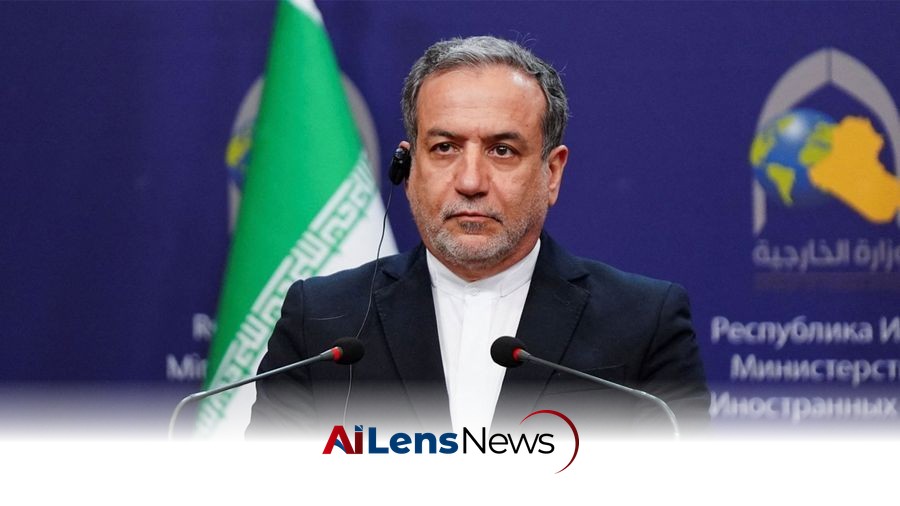


At the SCO summit, Iranian Foreign Minister Abbas Araghchi firmly stated that Iran will not yield to US intimidation, emphasizing the nation's commitment to its principles and interests.
New Delhi, India Jul 25, 2026 ALN: Iranian Foreign Minister Abbas Araghchi reaffirmed that Tehran will refuse to cave to American pressure or intimidation, asserting that the country will not submit to coercion or force. His comments came during a press conference following a meeting of the Shanghai Cooperation Organization (SCO) Council of Foreign Ministers in Cholpon-Ata, Kyrgyzstan, where discussions centered on diplomatic channels and regional security issues.
In the context of Iran's ongoing tensions with the United States, Araghchi emphasized that the principal barrier between Tehran and Washington is not a lack of communication pathways, but rather the United States' persistent reliance on "bullying and coercion." This statement reflects a broader narrative within Iranian political discourse, where the U.S. is often portrayed as an aggressor that undermines Iran's sovereignty and regional stability.
"Iran has shown that it will not bow to US bullying and will under no circumstances respond to the language of force, pressure, and threats," Araghchi stressed. This assertion is consistent with Iran's long-standing policy of resisting external pressures, particularly from the United States, which has imposed a series of economic sanctions aimed at crippling the Iranian economy since the U.S. withdrew from the Joint Comprehensive Plan of Action (JCPOA) in 2018.
In his remarks, Araghchi also highlighted the importance of protecting Iranian interests, particularly in the strategically vital Strait of Hormuz, through which a significant portion of the world's oil supply passes. He noted that holding talks with Pakistan, which serves as a mediating party, concerning various proposals was a natural step in Iran's diplomatic efforts. This underscores Iran's strategy of seeking regional allies and partners to counterbalance U.S. influence.
"As long as the rightful objectives and demands of the Iranian people are not realized, we will naturally continue our path," he stated, adding, "We are not afraid of threats, nor will we succumb to pressure, and we do not tolerate the language of threats." This rhetoric serves to galvanize domestic support within Iran, portraying the government as a defender against foreign encroachment.
Araghchi observed that Iran's armed forces on the front lines and its diplomats on the international stage are executing complementary roles in service of the nation. This dual approach—military readiness coupled with diplomatic engagement—reflects Iran’s comprehensive strategy to safeguard its national interests while navigating a complex geopolitical landscape.
He urged member states of the SCO, which he characterized as a "progressive organization," to counter the unilateralist agenda of Washington and Western bodies seeking to dominate international relations. The SCO, which includes China, Russia, and several Central Asian nations, has increasingly positioned itself as a counterweight to Western influence, advocating for a multipolar world order.
During the summit, Araghchi met with his counterparts from Kyrgyzstan, Russia, Pakistan, Egypt, Uzbekistan, and China on the sidelines. He noted holding "detailed" talks with Chinese Foreign Minister Wang Yi and Russian Foreign Minister Sergei Lavrov, confirming that Tehran maintains ongoing coordination with Beijing and Moscow. This partnership highlights Iran's pivot towards Eastern powers as it seeks to mitigate the impact of Western sanctions and isolation.
In his main address, Araghchi called on the SCO to take a strong stance against unilateralism, champion international law, and advocate for state sovereignty. Such calls resonate with many member states that have their own grievances against Western policies and interventions, fostering a sense of solidarity among nations that view U.S. actions as hegemonic.
Araghchi's remarks come as the U.S. military has conducted air raids across the region for 13 consecutive nights. According to an informed official cited by Fars news agency, the U.S. military targeted an LPG tanker entering from the direction of the Sea of Oman by launching two missiles, believing the vessel was attempting to transfer Iranian gas. This incident underscores the volatile nature of U.S.-Iran relations, where military actions can escalate tensions rapidly.
Meanwhile, Fars reported that the U.S. Ali Al-Salem Air Base in Kuwait was struck by a drone, and the headquarters of separatist groups in Erbil, Iraq, were targeted by several airstrikes. These developments indicate a broader pattern of conflict in the region, where various actors are engaged in a complex web of hostilities, often fueled by external interventions.
Additionally, Press TV reported that three explosions rocked the U.S.-run al-Juffair military base in Bahrain. Such incidents reflect the heightened risks faced by U.S. forces in the region, prompting concerns about the potential for a wider conflict that could draw in multiple countries.
Meanwhile, issuing a stern warning, Major General Abdollahi, commander of Iran's Khatam Al-Anbiya Central Headquarters, stated that from this moment onward, for every Iranian martyred, one American soldier will be targeted, adding, "We have prepared free and direct tickets to hell for you." This statement exemplifies the intense rhetoric that often accompanies military confrontations, as both sides seek to assert their resolve and deter further aggression.
This comes as American military posture in the region remains active. On Thursday, CENTCOM said that its forces "successfully completed" another round of strikes against Iran targeting its military assets, marking the 13th consecutive night of operations, while injuring at least two people in the Bandar Abbas region of the Islamic Republic. The ongoing military actions by both the U.S. and Iran underscore the precarious nature of the situation, with each side seeking to assert its power while avoiding a full-scale conflict.
In retaliation, the Iranian Army on Friday carried out a fresh wave of drone strikes targeting U.S. military bases in Kuwait, Bahrain, and Jordan under its ongoing "Operation Lightning." This operation signifies Iran's willingness to respond militarily to perceived threats, further complicating the already tense dynamics in the region. The situation remains fluid, with potential implications for regional security and international relations as both sides navigate their respective strategies in response to ongoing provocations.
To learn more about the latest developments in Culture & Society, stay updated with our exclusive reports and analyses on AiLensNews.

