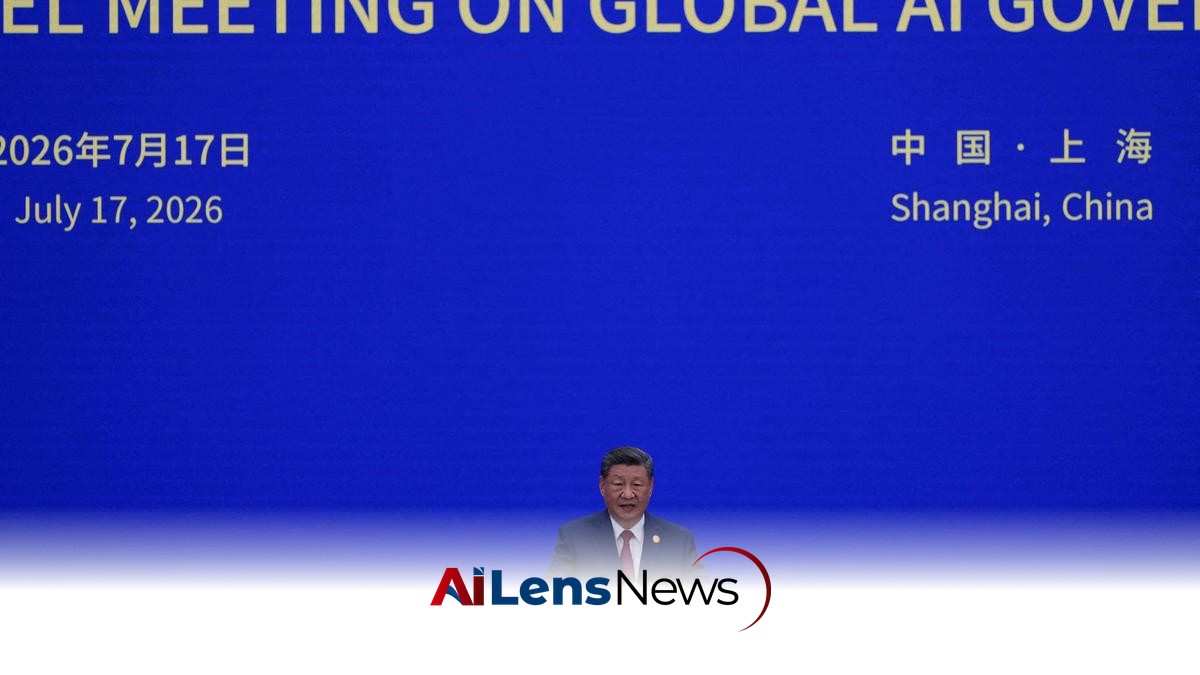


At the 2026 AI Conference, Xi Jinping promotes a new AI governance model aimed at fostering collaboration among developing nations.
New Delhi, India Jul 18, 2026 ALN: It is the clearest signal yet of China’s global leadership ambitions in Artificial Intelligence (AI). On Friday (July 17, 2026), Chinese President Xi Jinping unveiled a new initiative on global AI governance, pitched largely at the Global South and developing countries. China, along with 29 other countries mostly from Asia, Africa, and Latin America, has established an Artificial Intelligence Cooperation Organisation (WAICO) based in Shanghai.
India, present at the Shanghai summit with a Joint Secretary-level delegation, is the only founding BRICS country missing from WAICO. This absence raises questions about India's strategic positioning in the evolving landscape of global AI governance and its implications for the BRICS alliance.
| What is Kimi K3, China’s first open AI model to reach 2.8 trillion parameters?
Mr. Xi described the effort as “a major move by China to answer the call of the Global South and unite the international community together to promote vigorously AI development and governance.” He announced that in the next five years, China would provide developing countries “with 5,000 opportunities in AI training and seminar programmes”, as well as set up joint AI application cooperation centres with various international organizations, including ASEAN, the League of Arab States, the African Union, the Community of Latin American and Caribbean States, the Shanghai Cooperation Organisation, and BRICS.
The broader context is China’s push to both develop its alternatives to Western AI models and to offer them to developing countries. Beijing is concerned about the security implications of relying on models based in the West, such as OpenAI’s ChatGPT and Anthropic’s Claude. These concerns are not merely about technological supremacy; they also encompass national security, data sovereignty, and the economic implications of AI technology.
Mr. Xi hinted at these concerns in his speech, saying countries “should jointly oppose overstretching the national security concept in the field of AI and placing one country’s security over that of others.” He did not name the U.S., but Chinese officials have previously criticized Washington for what they have described as the securitisation of technologies, including AI. The implications of this stance are significant; it suggests a potential bifurcation in global AI standards and practices, with countries aligning themselves either with Western models or with those promoted by China.
A day before the launch of WAICO, Chinese AI firm Moonshot announced its latest Kimi K3 model that has surprised Western analysts with its capabilities. Chinese companies like Moonshot and DeepSeek are offering open-source models, which Beijing sees as giving them an edge in developing countries seeking technology for AI adoption. Mr. Xi stated that China would “encourage open source, openness, collaboration and sharing.” This commitment to open-source technology is particularly appealing to developing nations that may lack the resources to develop their own AI systems.
If security implications of using Western AI models are one concern, ideology is another. Chinese officials have also spoken of what they see as an “infiltration” of Western values through AI platforms and an erosion of sovereignty. This ideological perspective resonates with many developing countries that have historically been wary of Western influence and intervention. The narrative that AI technologies from the West could impose foreign values on local cultures is a powerful one, and Beijing is keen to position itself as a champion of a multipolar where diverse civilizations can coexist without dominance from a single power.
“We should tend to the garden of civilisations with great care to ensure that the beauty of each civilisation is appreciated and shared,” Mr. Xi said. “We often say in China, ‘A single string cannot make music, and a single tree does not make a forest.’ AI development should not be a solo performance by a single country, but a symphony of international cooperation.” This metaphor underscores China's desire to foster a collaborative approach to AI governance that respects the unique contexts of different nations while promoting shared technological advancements.
Among the nations signed on to WAICO are Brazil, Russia, South Africa, Indonesia, Kazakhstan, Kenya, Malaysia, Pakistan, Uzbekistan, and Venezuela. The inclusion of such a diverse group of countries highlights China's strategy to build a coalition of like-minded nations that can collectively challenge the dominance of Western technologies and ideologies in the AI sector. However, India’s absence as the only founding BRICS country missing from WAICO is noteworthy. It raises questions about India's future role in global AI governance and its potential alignment with either Western or Chinese-led initiatives.
The establishment of WAICO marks a significant shift in the landscape of global AI governance. As countries increasingly recognize the importance of AI in economic development, national security, and global competitiveness, the frameworks and standards governing AI technologies are becoming critical. China's initiative could lead to the development of alternative standards that diverge from those established by Western nations, potentially creating a fragmented global AI ecosystem.
This fragmentation could have far-reaching implications for international cooperation, trade, and security. For developing countries, aligning with WAICO may provide access to AI technologies and resources that they may not otherwise have, but it could also mean adopting a framework that aligns more closely with China's interests than their own. As nations navigate these complex dynamics, the choices they make will likely shape the future of AI governance and the balance of power in the global technology landscape.
In conclusion, China's launch of the AI Governance Initiative through WAICO represents a strategic move to assert its influence in the Global South while addressing concerns about Western AI models. As the initiative unfolds, the responses from countries like India and others will be critical in determining the future trajectory of AI governance on a global scale. The implications of this initiative extend beyond technology, touching upon issues of sovereignty, ideology, and international cooperation that will shape the geopolitical landscape for years to come.
To learn more about the latest developments in International Organizations, stay updated with our exclusive reports and analyses on AiLensNews.

