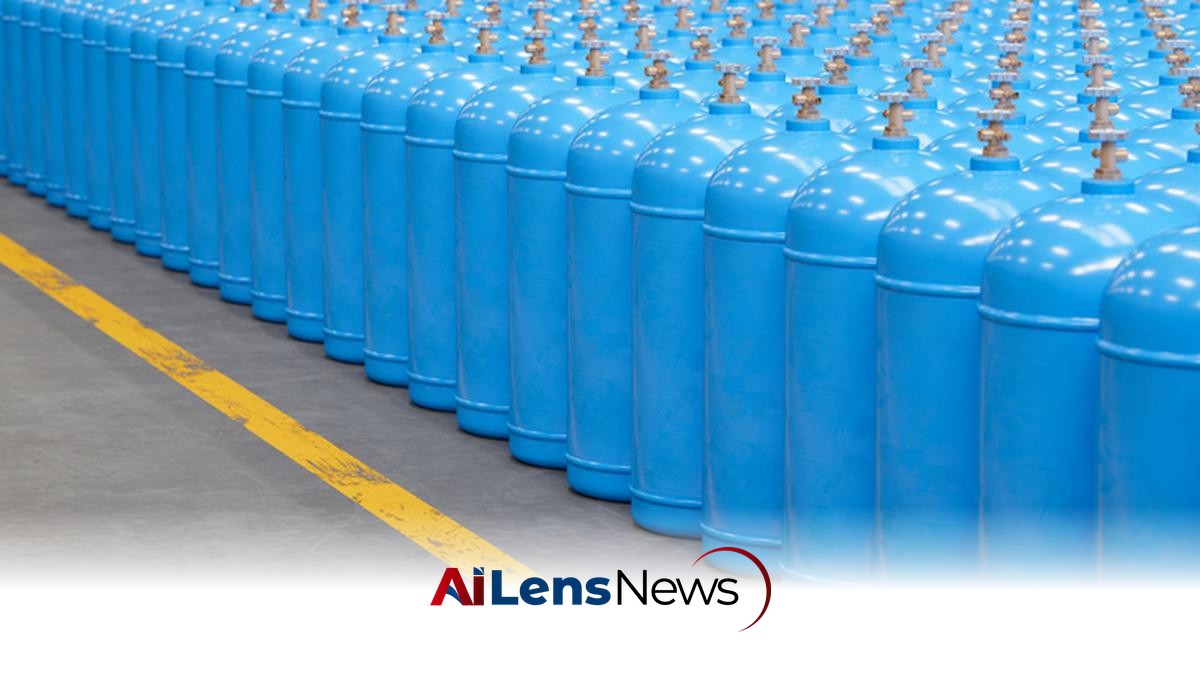


China's temporary helium export ban raises concerns over global supply amid geopolitical tensions and domestic demand.
New Delhi, India Jul 11, 2026 ALN: The story so far: On July 10, the Ministry of Commerce and General Administration of Customs in China announced an immediate and temporary ban on helium exports. As of 4:30 PM IST on the same day, no further information had been released regarding the reasons for this decision or its scope. This unexpected move has raised eyebrows in the global market, particularly among industries reliant on helium, which is a critical resource used in various high-tech applications.
China imports over 80% of its helium requirements but produces only about 1.6% of the global supply. This export ban comes in the wake of ongoing supply issues exacerbated by Russia's restrictions on helium exports, which require approval from the Prime Minister for shipments through 2027. Additionally, geopolitical tensions in West Asia have raised further concerns about supply stability. The situation is further complicated by the fact that helium is a non-renewable resource, making its availability a pressing issue for nations and industries that rely on it.
The primary helium producers globally include the United States, which accounts for 43% of total supply, followed by Qatar, Russia, Canada, and Algeria. The U.S. plays a pivotal role in the global helium market, and its recent privatization of the Federal Helium Reserve has led to concerns about the U.S. no longer being able to buffer against supply shocks, such as those arising from the U.S.-Iran conflict. This situation raises the possibility of retaliatory measures, which could be a factor behind China's recent export ban.
After the U.S., Qatar supplies 33% of helium demand, particularly in Asia. Following the escalation of tensions with Iran, medical chemist and Science columnist Derek Lowe noted that “one-third of global helium production is now literally bottled up behind the Strait of Hormuz, a much higher percentage than oil production.” In this context, China's export restriction may aim to secure helium supplies for its domestic chip manufacturers and medical sector, both of which are critical to China's ambitions in technology and healthcare.
Helium is the second-lightest element after hydrogen and cannot be manufactured. It is a non-renewable resource formed deep within the Earth's crust through the radioactive decay of uranium and thorium. Over millions of years, helium migrates into natural gas reservoirs, where it is extracted alongside natural gas. Helium is only isolated from natural gas when it constitutes at least 0.3% of the gas mixture. This natural process makes helium extraction not only complex but also dependent on geological factors that are often beyond human control.
Once this threshold is reached, helium is separated based on its distinct boiling point. Some helium is also recovered from liquefied natural gas (LNG) plants and from the atmosphere, but these quantities are insufficient to meet global demand. Commercial helium is typically at least 99.997% pure, which is essential for its various high-tech and medical applications. The processes involved in extracting and purifying helium are energy-intensive and require significant investment in technology and infrastructure.
Helium has an extremely low boiling point of -269°C and is chemically inert, making it an ideal coolant for various applications. It is used to cool the magnets in MRI machines, silicon wafers in semiconductor manufacturing, and increasingly in quantum computing devices. Due to its small atomic size, helium can also be used as a leak detector, which is crucial in many industrial applications where maintaining a vacuum or inert atmosphere is necessary.
Additionally, helium plays a crucial role in drawing optical fibers by rapidly cooling molten glass and displacing oxygen or nitrogen to prevent bubble formation. Space agencies like ISRO, NASA, and SpaceX utilize helium to pressurize fuel tanks in rockets. The gas is also popular in the tourism sector for inflating balloons and airships, showcasing its versatility across different industries. According to the U.S. Geological Survey, laboratory applications account for 22% of helium demand, followed by controlled atmospheres and semiconductors (17%), lifting gas (17%), MRI scanners (15%), aerospace (9%), and leak detection (5%). This diverse range of applications underscores the significance of helium in modern technology and healthcare.
In June 2026, the spot price for highly pure helium in Northeast Asia surged to $150-205 per thousand cubic feet, nearly double the price from late 2025. Some suppliers, such as the U.S.-based Airgas, have invoked force majeure and added surcharges to existing contracts due to the rising costs. The price volatility in the helium market is indicative of the broader supply chain issues that have emerged in recent years, influenced by geopolitical tensions and natural resource management.
Storing and transporting liquid helium is inherently expensive, as it requires temperatures of -269°C. The entire helium supply chain is cost-intensive, with purification, storage, and transport being technically complex and expensive processes. A mid- to large-scale purification and liquefaction facility can exceed $100 million in costs, while smaller facilities may require around $10 million. Helium can be stored in underground salt caverns, which significantly reduce leaks, but developing such formations can cost over $200 million. Helium can also be stored as compressed gas or cryogenic liquid, with varying costs based on capacity.
Finally, helium must be transported in vacuum-jacketed stainless steel vessels, which are produced by a limited number of manufacturers, including several in China. The contractor responsible for transporting these containers must ensure timely delivery, as helium will begin to boil off into the atmosphere once the holding time expires. The logistics of helium transportation further complicate its availability and contribute to the overall cost, making the recent export ban by China a significant concern for industries reliant on this essential gas.
In conclusion, China's temporary export ban on helium highlights the fragility of the global helium supply chain and the intricate web of geopolitical factors that influence it. As industries continue to rely on helium for critical applications, the implications of this ban could resonate far beyond China's borders, affecting sectors from healthcare to technology wide. Stakeholders in these industries will need to closely monitor developments in the helium market and consider strategies for mitigating the risks associated with supply disruptions in the future.
To learn more about the latest developments in Global Economy, stay updated with our exclusive reports and analyses on AiLensNews.

