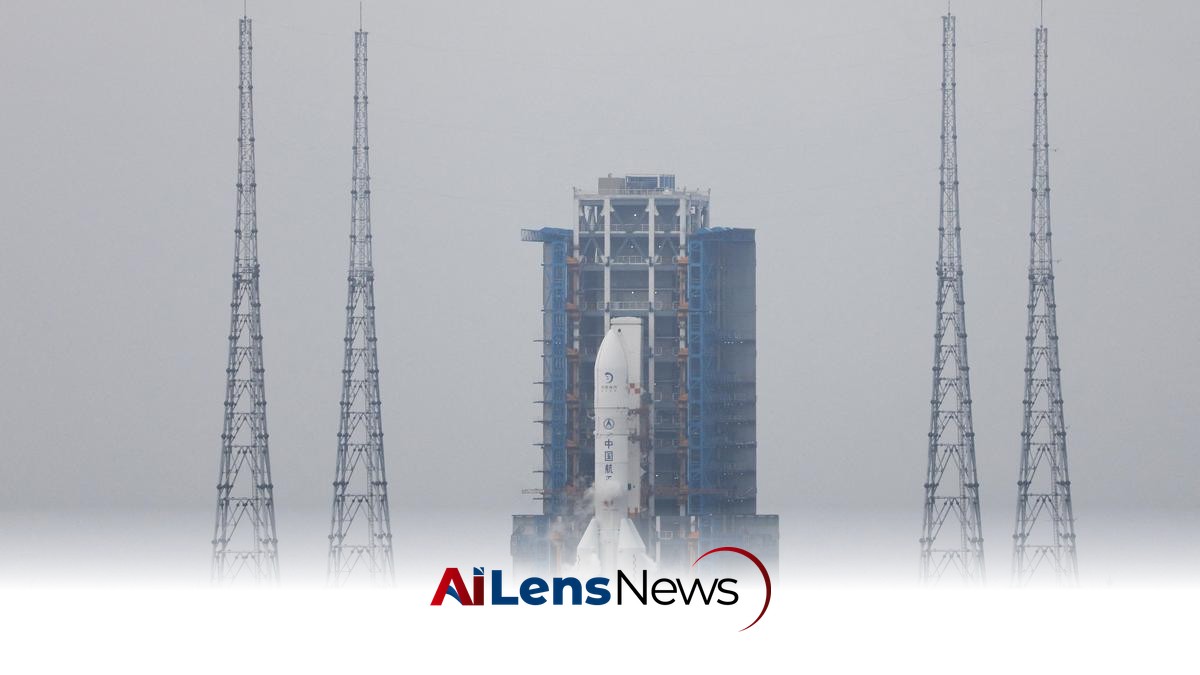


China has achieved a significant milestone in reusable rocket technology by successfully testing a sea-based rocket booster recovery system, challenging U.S. dominance in the field.
China, China Jul 10, 2026 ALN: China has made significant strides in its aerospace capabilities, particularly in the realm of reusable rocket technology. On July 10, 2026, the country successfully tested an experimental rocket retrieval system that utilizes a net attached to a sea platform, as reported by state media. This ambitious endeavor aims to challenge the United States' long-standing dominance in the field of reusable rockets, a technology that has revolutionized space travel and satellite deployment.
The rocket involved in this test, the Long March 10B, was launched from the Hainan commercial space launch site located in southern China. Approximately six minutes post-launch, after the separation of its booster and upper stage, the booster executed a controlled descent and was ultimately recovered on an offshore platform. This achievement marks a significant milestone as it represents China's first successful controlled recovery of a carrier rocket's booster, a feat that underscores the country's growing expertise in aerospace technology.
The implications of this successful test are profound. Following the announcement, shares in several Chinese aerospace firms experienced a notable surge, with companies like China Spacesat and China Satellite Communications reaching their daily trading limits. This reflects not only investor confidence in the potential of China's aerospace sector but also highlights the increasing importance of reusable rocket technology in the global space race.
The Long March 10B has drawn comparisons to SpaceX's Falcon 9, which is recognized as one of the leading medium-lift rockets in operation today. Developed by the China Academy of Launch Vehicle Technology, the Long March 10B is capable of transporting a payload of at least 16 metric tons to low-Earth orbit. This capability positions it competitively within the commercial aerospace market, which has been dominated by established players like SpaceX.
However, there are notable differences in the recovery methods employed by these two rockets. While the Falcon 9 autonomously lands on deployable legs on either a ground pad or a drone ship, the Long March 10B relies on a unique system of "landing hooks" designed to catch a net attached to a sea platform. This method, while innovative, is distinct from the more conventional landing techniques utilized by its competitors and may present both advantages and challenges as China continues to refine its technology.
SpaceX's journey toward reusable rockets began with the successful landing of a Falcon 9 rocket from an orbital flight in December 2015, a pivotal moment that set the stage for the company's subsequent dominance in the launch market. Blue Origin's New Glenn rocket followed suit with its first successful landing in November 2025. Currently, SpaceX conducts around 150 launches annually, averaging approximately three launches per week. The ability to reuse boosters multiple times has significantly reduced launch costs, a key factor in the company's success and one that China is eager to replicate.
The booster stage of a rocket is widely regarded as its most valuable component, which has driven China's extensive investment in reusable rocket technologies over the past decade. The country has progressed from initial low-altitude hover tests to more complex orbital-class booster recovery attempts, indicating a robust commitment to advancing its capabilities in this area.
The development of a system of reusable rockets is expected to have substantial implications for China’s commercial satellite constellations, which are rapidly expanding. The ability to lower launch costs through reusable technology will not only benefit state-run initiatives but will also empower private Chinese firms that are increasingly competing in the global aerospace market. In an effort to facilitate this growth, China has relaxed initial public offering (IPO) rules for companies focused on developing reusable rockets, thereby attracting more investment and fostering innovation.
Despite these advancements, the path has not been entirely smooth. In the previous year, two attempts by private firm LandSpace and the state-owned China Aerospace Science and Technology Corporation to achieve successful landing and booster recovery ended in failure. These setbacks highlight the challenges that still lie ahead for China as it seeks to establish itself as a leader in the aerospace sector.
The Long March 10B is part of the broader Long March 10 family, which is being developed to support China's crewed lunar missions planned for completion before 2030. The successful recovery of the booster not only serves immediate commercial interests but also provides valuable data and validates technologies that are crucial for the nation's lunar program. As China looks to expand its presence in space, the integration of these technologies will play a vital role in ensuring the success of its ambitious lunar exploration objectives.
Looking forward, China has announced intentions to utilize the booster stage of the Long March 10B for another launch by the end of the year. This rapid succession of tests and launches reflects an aggressive strategy aimed at solidifying China’s position in the increasingly competitive landscape of space exploration and satellite deployment. As countries around the race to develop and implement reusable rocket technologies, China's recent success may signify a turning point in the global aerospace industry, with potential ramifications for international partnerships, commercial opportunities, and the future of space exploration.
In the broader context of international space exploration, the advancements made by China in reusable rocket technology are indicative of a shifting balance in global aerospace capabilities. Historically, the United States has been at the forefront of space exploration, with NASA and private companies like SpaceX leading the charge in innovation and technology development. However, as other nations, including China, India, and members of the European Union, ramp up their space programs, the competitive landscape is evolving.
The implications of China's success in reusable rocket technology extend beyond mere competition. The ability to recover and reuse rocket components is crucial in reducing the cost of access to space, which has traditionally been one of the biggest barriers to entry for new players in the aerospace sector. As launch costs decrease, it opens the door for more frequent launches, greater satellite deployment, and the potential for innovative space-based applications, such as global internet coverage and Earth observation technologies.
Furthermore, the geopolitical ramifications of advancements in space technology cannot be overlooked. Space has increasingly become a domain of strategic importance, with nations vying for dominance not only in terms of technological prowess but also in terms of military capabilities and national security. China's progress in developing a reliable and efficient rocket recovery system may enhance its position in international negotiations regarding space treaties and agreements, as well as its ability to influence the future direction of space exploration and utilization.
In conclusion, China's successful test of the Long March 10B's sea-based rocket booster recovery system marks a pivotal moment in its aerospace ambitions. The implications of this achievement are far-reaching, affecting not only China's position in the global space race but also the dynamics of international space exploration and commercial opportunities. As the race for advancements in reusable rocket technology continues, the will undoubtedly be watching closely to see how China and its competitors navigate the challenges and opportunities that lie ahead.
To learn more about the latest developments in International Politics, stay updated with our exclusive reports and analyses on AiLensNews.

