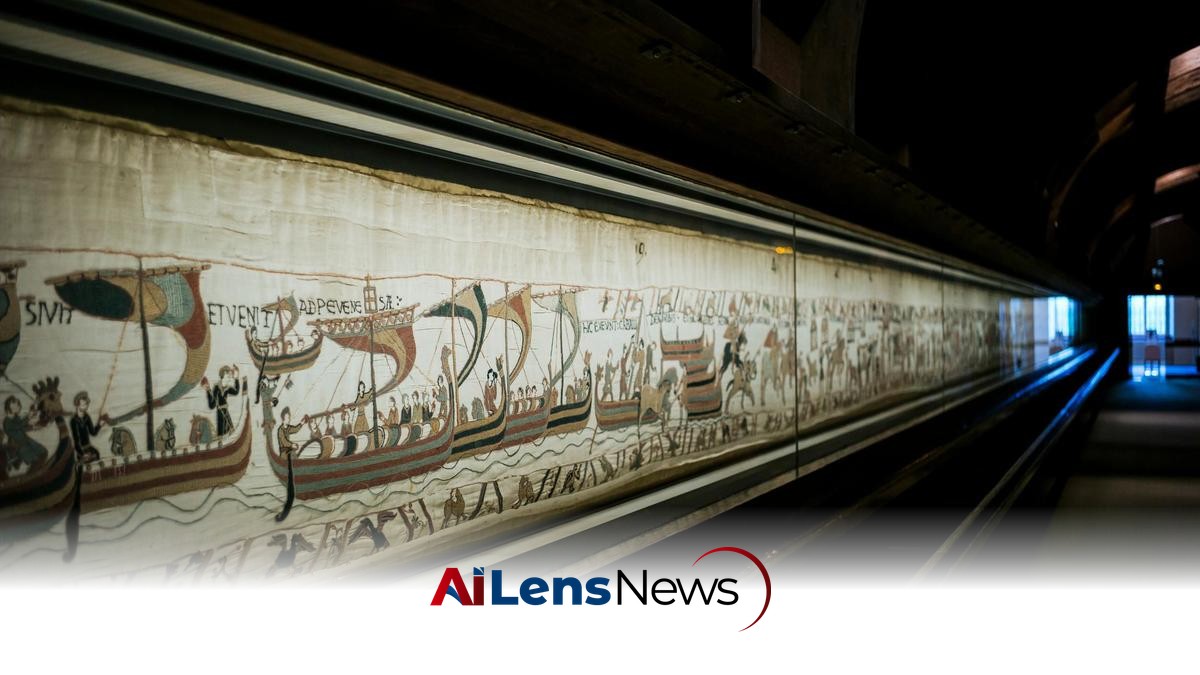


The Bayeux Tapestry makes its historic return to England after 1,000 years, displayed at the British Museum until July 2027.
New Delhi, India Jul 10, 2026 ALN: After almost 1,000 years, the Bayeux Tapestry is back on English soil, marking a significant moment in cultural and historical exchange between France and the United Kingdom. This remarkable piece of medieval art, which has captivated audiences for centuries, was transported in a meticulously planned operation that resembled a heist movie in reverse. The tapestry made its way into the British Museum on Friday, July 10, 2026, under the cover of darkness, following a high-tech, tight-security journey that involved complex logistics and careful handling to prevent any potential damage to the fragile artwork.
The tapestry, which is on loan from its home in Bayeux, France, will be on display at the British Museum from September 10, 2026, until July 2027. This exhibition represents a public homecoming for a vivid visual record of the 1066 Norman invasion, a pivotal event that marked the last successful conquest of England. The anticipation surrounding the tapestry's arrival has been palpable, but due to security concerns, the specifics of its journey were kept confidential until its successful arrival.
British Museum Director Nicholas Cullinan expressed his excitement about the tapestry's arrival, stating, "It feels extraordinary that after so much work and planning and care and thought that it’s actually happening. It’s the first time in 1,000 years that such an important piece of British — French too — history is going to be on these shores. It’s incredibly exciting." This sentiment reflects the tapestry's significance not only as an artistic masterpiece but also as a historical artifact that embodies the complex relationship between the two nations.
The Bayeux Tapestry stretches an impressive 70 meters (230 feet) in length and is composed of wool thread stitched onto linen fabric. It narrates the events leading up to the Battle of Hastings in October 1066, where William, Duke of Normandy, triumphed over King Harold's Anglo-Saxon army. This invasion effectively ended Saxon rule in England and established William the Conqueror as the first Norman king, making the tapestry a crucial document in understanding the historical narrative of England.
Historians believe that the tapestry was commissioned by Bishop Odo of Bayeux, who was William's half-brother. The intricate embroidery is thought to have been crafted by women in England, possibly nuns, before being transported across the English Channel. For the majority of the last millennium, the tapestry has remained in Bayeux, with only two brief periods during which it was displayed at the Louvre in Paris. Its return to England for this exhibition underscores the intertwined histories of France and Britain, as well as the cultural significance of the tapestry itself.
Securing the loan of the Bayeux Tapestry was a high-stakes diplomatic mission, reflecting the importance of cultural heritage in international relations. The loan was announced during a state visit to the U.K. by French President Emmanuel Macron in July 2025, coinciding with renovations at the Bayeux Museum, where the tapestry is housed. In a gesture of reciprocity, the British Museum will lend treasures from the Sutton Hoo hoard, which includes artifacts from a 7th-century Anglo-Saxon ship burial, to museums in Normandy. This exchange highlights the ongoing dialogue between the two countries and their shared historical narratives.
Retired British diplomat Peter Ricketts, who played a crucial role in securing the loan, remarked, "It’s an extraordinary mark of friendship and confidence in the U.K. to entrust this object to us for a year. President Macron, when he offered us the tapestry, I think he understood that it would have far more impact in the U.K. than it does in France, because it’s more fundamental to our national story. Everybody (in Britain) knows 1066." This acknowledgment of the tapestry's significance to British identity further emphasizes the importance of its exhibition in London.
The tapestry itself is a rich tapestry of history, featuring 627 people and 737 animals, and is divided into 58 scenes filled with vivid and often gory detail. These scenes depict the build-up to the Battle of Hastings, including moments of hand-to-hand combat, the aftermath of battle with mutilated bodies, and the infamous image of Harold being struck in the eye by an arrow. Millie Horton-Insch, the project curator for the British Museum exhibition, noted, "It has an emotional richness that is really difficult to get from written sources. It just brings people closer to this history than any other object can. It’s not the same as reading a text. You are looking at something that was handled by the people who lived through it and felt compelled to record these events in this way." This emotional connection to history is one of the reasons the tapestry continues to resonate with audiences today.
Despite its age, the tapestry has survived an incredible 10 centuries, facing numerous threats, including moths, mice, mold, damp, and fire. Horton-Insch described its survival as miraculous, attributing it in part to the humble materials used in its creation. "It’s not really made of any blingy fabric. It’s not gold, it’s not silver. There wasn’t the same temptation to cut it up and make it into vestments or repurpose it for anything," she explained. This durability adds to the tapestry's allure, as it serves as a tangible link to a distant past.
However, not everyone supported the decision to loan the tapestry to the British Museum. Some French cultural figures expressed concerns about the risks associated with moving such a fragile and invaluable piece of art. In response to these concerns, Cullinan emphasized the extensive precautions taken to ensure the tapestry's safety during transport. Expert teams conducted two trial runs of the journey to demonstrate that the tapestry would not endure undue stress during transit. "Such care has gone into it. I can’t think of a level of care for any other museum loan," he stated. "I understand why there are concerns. The tapestry arouses great interest and passion, which is a wonderful thing." This careful consideration highlights the importance of preserving cultural heritage while also facilitating international collaboration and exchange.
As the tapestry prepares for its exhibition at the British Museum, it is expected to draw significant public interest. In fact, approximately 100,000 tickets were sold within the first day of their availability, indicating a strong desire among the public to engage with this historical artifact. Cullinan likened the ticket demand to that of a major music festival, stating, "It was like trying to get tickets to Glastonbury. I don’t take for granted that people care that much about a 1,000-year-old embroidery. I think that’s an amazing thing." This enthusiasm underscores the tapestry's enduring relevance and its ability to captivate the imagination of contemporary audiences.
In conclusion, the arrival of the Bayeux Tapestry at the British Museum represents a significant cultural event, highlighting the intertwined histories of France and Britain while offering a unique opportunity for the public to connect with a pivotal moment in history. As the tapestry unfolds in London, it will serve as a reminder of the past and a testament to the enduring power of art to bridge cultural divides and foster understanding.
To learn more about the latest developments in Culture & Society, stay updated with our exclusive reports and analyses on AiLensNews.

