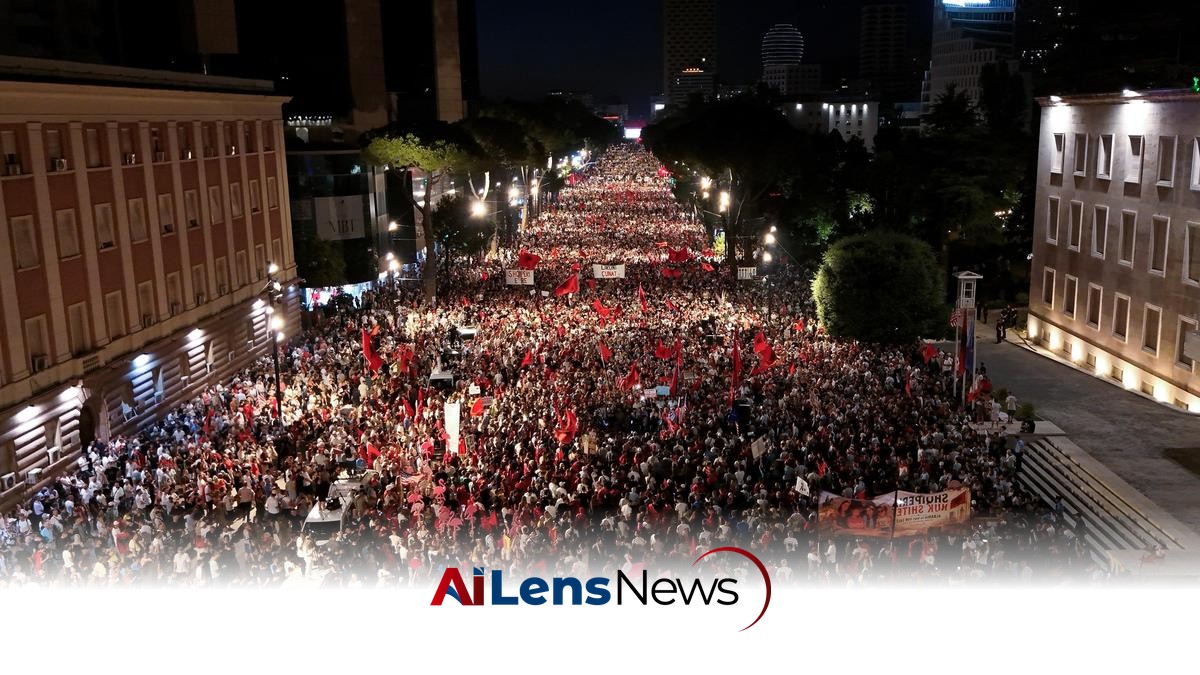


In Albania, protests against corruption and government policies continue for the 35th consecutive night, sparked by a controversial luxury resort development.
New Delhi, India Jul 5, 2026 ALN: A massive demonstration was held for the 35th night in a row in Albania's capital on Saturday, July 4, 2026, with protesters calling for the resignation of Prime Minister Edi Rama, the temporary replacement of his government, constitutional reform, and an end to corruption. This ongoing series of protests has become a significant event in Albania's political landscape, reflecting deep-seated frustrations among the populace regarding governance, transparency, and accountability.
Media images showed tens of thousands of people marching along Tirana's main boulevard toward Skanderbeg Square. While the exact number of participants remains unverified by independent sources, the sheer scale of the protests indicates widespread discontent. The protests have attracted a diverse cross-section of society, including students, activists, and ordinary citizens, all united by their demand for political change. This diversity highlights the broad appeal of the movement, as it resonates with various demographics who feel marginalized or ignored by the current administration.
The nightly demonstrations began over a luxury coastal resort development project in a protected natural area linked to U.S. President Donald Trump’s son-in-law, Jared Kushner. The project has been controversial, as it raises concerns about environmental degradation and the prioritization of private interests over public good. Initially sparked by this particular issue, the protests have since evolved into broader anti-government and anti-corruption movements, highlighting systemic issues within the Albanian political framework. The development’s connection to foreign interests has further fueled anger among citizens, who perceive it as an example of how external influences can undermine local needs and environmental protections.
Protesters have been chanting slogans such as "New Albania" and "Edi Rama, resign," signaling a desire for a fresh political direction and governance that prioritizes the needs of the citizens over the interests of a select few. The calls for constitutional reform suggest a demand for a more democratic and accountable political system, as many believe that the current structure has failed to meet the needs of the Albanian people. This desire for reform is not new; it reflects a long-standing frustration with political elites who are seen as disconnected from the realities faced by ordinary citizens.
The march was heavy on symbolism. A tall bust of Mr. Rama was erected and later toppled with the help of a rope, a gesture reminiscent of the February 1991 toppling of the statue of longtime communist dictator Enver Hoxha, an event commemorated on February 20 each year. This act of destruction serves not only as a direct critique of Rama's leadership but also as a historical reference to a pivotal moment in Albania's transition from communism to democracy. It reflects the protesters' desire to break free from the legacy of authoritarianism and to foster a new political culture. The imagery of toppling statues resonates deeply within the collective memory of the Albanian people, symbolizing a rejection of oppressive governance and a yearning for genuine democratic principles.
Since Saturday’s protest coincided with Mr. Rama’s 62nd birthday, some protesters carried “birthday cakes” made of cement, an allusion to the building projects that have sparked significant public outcry. This creative form of protest illustrates the ingenuity of the demonstrators, who have used humor and irony to convey their message. There was also an ironic “happy birthday” song for Mr. Rama, further emphasizing the discontent with his administration. Such tactics not only capture media attention but also serve to engage the public in a dialogue about the serious issues at stake, using humor to disarm and provoke thought about the current state of governance in Albania.
Some protesters carried pink flamingo balloons, a reference to the birds supposedly threatened by the resort construction project. The demonstrations have long been dubbed “the pink flamingo revolution,” a title that encapsulates both the environmental concerns at the heart of the protests and the playful yet serious nature of the movement. The use of such imagery serves to engage a broader audience and draw attention to the specific issues surrounding environmental degradation and corporate interests. This branding of the protests not only highlights the environmental aspect but also creates a sense of community among participants, reinforcing their shared goals and values.
After protesting for about two hours, a large group marched to a police station, demanding the release of people arrested during Thursday’s protest near parliament. The escalation to confrontational tactics, such as marching to a police station, indicates a growing frustration with law enforcement's response to the protests. The protesters' demands for the release of their fellow demonstrators highlight the solidarity within the movement and the perceived injustices of the government's crackdown on dissent. This solidarity is crucial for the movement’s sustainability, as it fosters a sense of collective identity and purpose among participants.
In a tense moment, protesters broke the windows of the police station, while police responded with a water cannon to disperse the crowd. This incident underscores the volatility of the situation and the potential for conflict between demonstrators and law enforcement. The use of water cannons, a common crowd control tactic, raises questions about the appropriateness of police responses to peaceful protests and the potential for escalating tensions in an already charged atmosphere. The interaction between protesters and police reflects broader societal issues regarding the right to protest and the state’s response to dissent, which can either exacerbate tensions or promote dialogue.
The implications of these protests are significant for the future of Albania. As citizens continue to voice their grievances, the government faces mounting pressure to respond to the demands for change. The ongoing demonstrations reflect a broader trend of civic engagement and activism in the region, as citizens increasingly assert their rights and demand accountability from their leaders. This trend is not isolated to Albania; it mirrors movements in other countries where citizens are challenging existing power structures and demanding more participatory governance.
Furthermore, the international community is closely watching the situation in Albania, as it raises questions about the stability of the region and the potential for political reform. The protests could serve as a catalyst for change, prompting the government to reconsider its policies and approach to governance. Alternatively, if the situation escalates further, it could lead to increased instability and unrest, challenging the government's ability to maintain control. The international response could influence the direction of these protests, as foreign governments and organizations weigh in on the situation, potentially offering support to the protesters or urging restraint from the government.
In conclusion, the protests in Albania represent a significant moment in the country's political history. As citizens unite in their call for change, the outcomes of these demonstrations could shape the future trajectory of governance in Albania. Whether through reforms, resignations, or continued unrest, the implications of this movement will be felt for years to come, as the Albanian people strive for a more just and accountable government. The current situation serves as a reminder of the power of civic engagement and the importance of addressing the concerns of the populace in a democratic society.
To learn more about the latest developments in Culture & Society, stay updated with our exclusive reports and analyses on AiLensNews.

