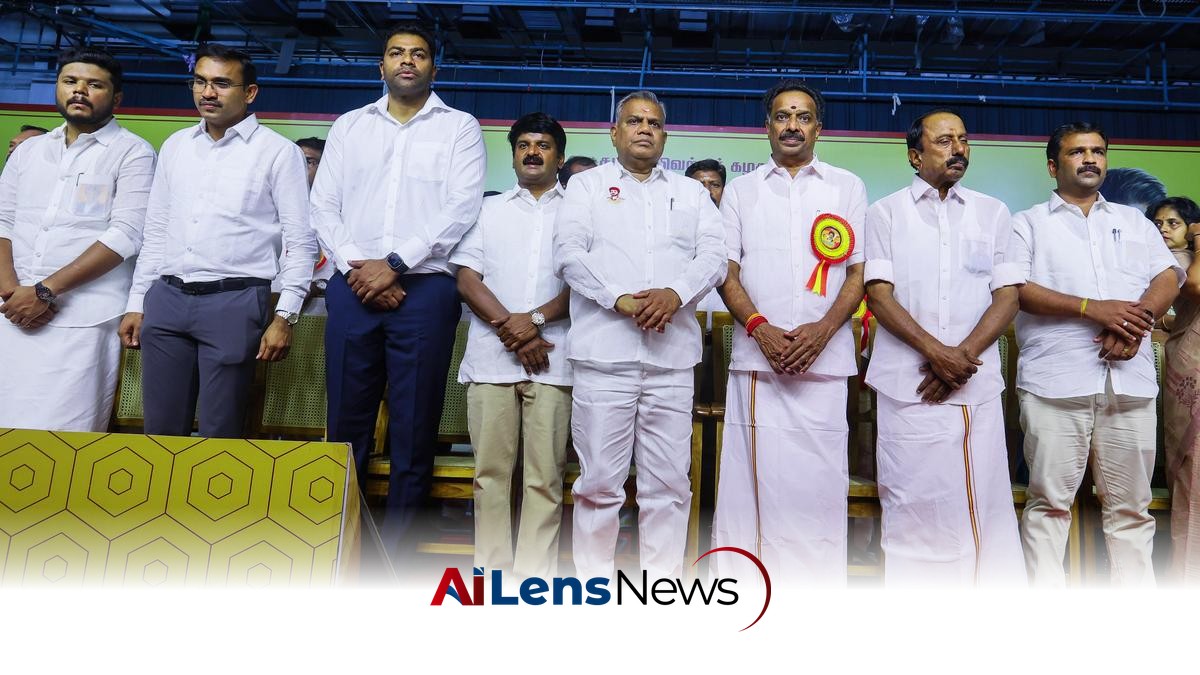


The recent shift of AIADMK MLAs to the Tamilaga Vetri Kazhagam (TVK) signals a significant change in Tamil Nadu's political landscape.
New Delhi, India Jul 7, 2026 ALN: Tamil Nadu is witnessing an unusual political phenomenon ever since the Tamilaga Vetri Kazhagam (TVK), led by actor-turned-politician C. Joseph Vijay, came to power. Several MLAs, most of them from the All India Anna Dravida Munnetra Kazhagam (AIADMK), have resigned their hard-won Assembly seats to join the ruling party, hoping to be renominated by the TVK in the ensuing by-elections. Before their switch over, as many as 25 MLAs even voted in favour of the TVK government during the Assembly floor test.
Although the TVK emerged as the single largest party in the Assembly, it fell short of a majority by 10 seats. It eventually formed the government after the Congress switched allegiance from the Dravida Munnetra Kazhagam (DMK)-led camp, while the two communist parties and the Viduthalai Chiruthaigal Katchi initially extended outside support. They have now joined the government along with the Indian Union Muslim League (IUML). The ruling party, however, does not appear content with a working majority. Instead, it seems intent on strengthening its own numbers so that it need not depend on allies for its survival.
The continuing stream of resignations and defections has been described by the Opposition as “horse trading” — a phenomenon largely unfamiliar to Tamil Nadu politics. So far, six AIADMK legislators have quit and joined the TVK. Governments in the State have traditionally enjoyed comfortable legislative majorities and, even when they fell short of the required numbers, have generally refrained from encouraging defections to secure their position.
The trend began with the shift in loyalty of S. Kamaraj, an MLA of the Amma Makkal Munnetra Kazhagam (AMMK) led by T. T. V. Dhinakaran. When Chief Minister-designate Mr. Vijay presented to Governor Rajendra Arlekar a letter of support purportedly signed by Mr. Kamaraj, Mr. Dhinakaran alleged that the document had been forged. The allegation, however, was soon disproved when Mr. Kamaraj voted in favour of the government during the confidence motion. He was then expelled from the AMMK.
What surprised political observers even more was the defection of MLAs from the AIADMK, a party that ruled Tamil Nadu for decades under towering leaders such as M. G. Ramachandran and Jayalalithaa. Within days of the election results, three MLAs — Maragatham Kumaravel, S. Jayakumar and P. Sathyabama — met Speaker J. C. D. Prabhakar and submitted their resignation letters. They were followed by Esakki Subaya. All of them joined the TVK right after.
More striking, however, was the decision of senior AIADMK leaders and former Ministers, including C. Vijayabaskar, M. R. Vijayabhaskar and Udumalai K. Radhakrishnan (former MLA), to cross over to the ruling party. While they blamed former Chief Minister and AIADMK general secretary Edappadi K. Palaniswami for their decision, their actions suggest a broader political calculation. They appear to have concluded that the bipolar political order that long defined Tamil Nadu — dominated by the AIADMK and the Dravida Munnetra Kazhagam (DMK) — has come to an end with the rise of the TVK, and that an AIADMK bereft of a charismatic leader has little prospect of regaining power.
As the trend continued, the DMK accused the TVK of inducing two of its MLAs — S. Austin and Anbazhagan — to resign their seats and join the ruling party. The allegation came close on the heels of the TVK’s charge that former Minister V. Senthilbalaji had attempted to lure its MLA N. Elaiyaraja with an offer of ₹35 crore. The police subsequently arrested a few persons in connection with the TVK’s complaint. The DMK also alleged that the TVK had sought to persuade two MLAs (who contested on its symbol), originally from the Marumalarchi Dravida Munnetra Kazhagam, to resign and recontest.
The spate of resignations, which began barely 20 days after the formation of the new government, evoked strong reactions from the communist parties. They described the developments as an unhealthy trend that could undermine democratic norms. Yet they appear to have little influence over the unfolding events, watching helplessly as the political drama continues to play out day after day.
Political analysts suggest that the current wave of defections could have significant implications for the future of Tamil Nadu's political landscape. The AIADMK, once a dominant force, now finds itself in a precarious position, struggling to maintain its identity and support base. The party's historical significance, rooted in the legacy of leaders like M. G. Ramachandran and Jayalalithaa, is now challenged by the emergence of new political entities such as the TVK, which has managed to capture the imagination of the electorate, particularly the youth.
Furthermore, the defections raise questions about the stability of the TVK government itself. While the party has gained a number of MLAs from the AIADMK, the long-term loyalty of these legislators remains uncertain. Political allegiances can be fickle, and the TVK's reliance on former AIADMK members could backfire if discontent arises within its ranks. Additionally, the TVK's need to maintain a coalition with other parties, including the Congress and smaller regional parties, adds another layer of complexity to its governance.
Another critical aspect of this political shift is the potential impact on voter sentiment. The electorate in Tamil Nadu has historically valued stability and consistency in governance. The current trend of defections may lead to voter disillusionment, particularly among those who feel that their representatives are prioritizing personal political ambitions over the needs and interests of their constituents. If the trend continues, it could reshape the political landscape, leading to a more fragmented assembly where new alliances are formed based on convenience rather than ideology.
In the context of these developments, the role of social media and public opinion cannot be understated. The rapid spread of information through digital platforms has made it easier for voters to hold their elected representatives accountable. As the political drama unfolds, public reactions to these defections will likely influence future electoral outcomes. The TVK must navigate this landscape carefully, balancing the need to consolidate power while also addressing the concerns of the electorate.
As Tamil Nadu moves forward, the implications of this defection wave will be closely monitored by political observers, party leaders, and the electorate alike. The evolving dynamics of power and allegiance in the state will not only shape the immediate political scenario but could also have lasting effects on the future of governance in Tamil Nadu. The ongoing developments serve as a reminder of the fluid nature of politics in the region, where alliances can shift rapidly, and the balance of power is continually in flux.
To learn more about the latest developments in International Politics, stay updated with our exclusive reports and analyses on AiLensNews.

