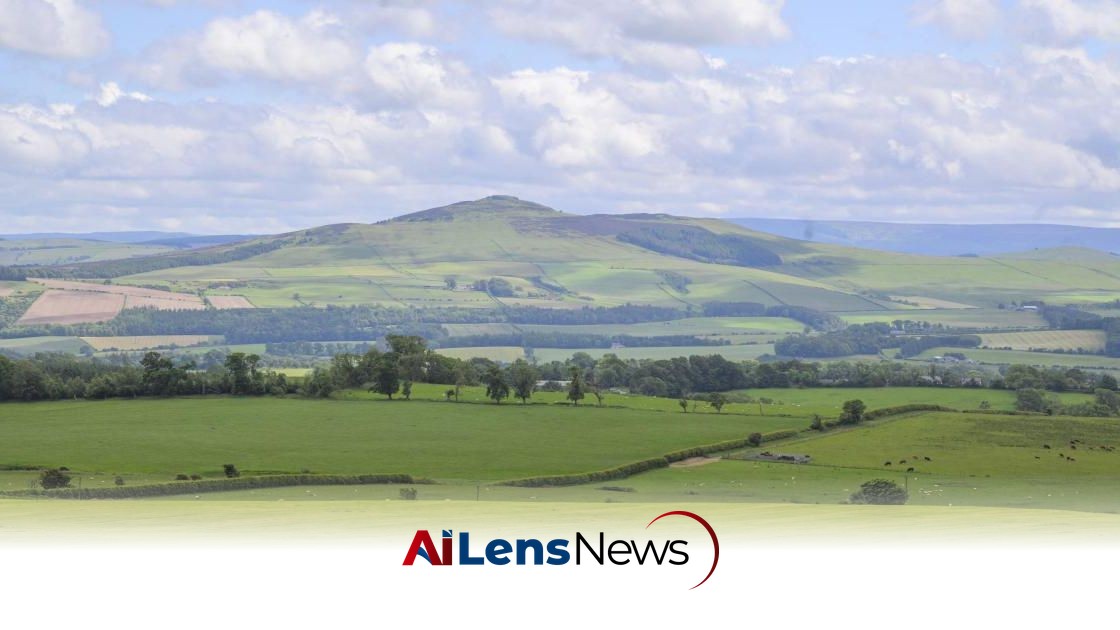


Despite newfound celebrity interest, the Scottish Borders remains a tranquil escape. Rosemary Goring reflects on its beauty and the impact of fame.
London, United Kingdom Jul 19, 2026 ALN: After spending a few days in Scotland earlier this month, Jeremy Clarkson found the answer to a question he has long debated: which part of Britain is most stunning? Now, having ventured beyond Hadrian’s Wall, he has come to the conclusion that it’s neither North Devon nor the Yorkshire Dales, over which he had swithered for years, but the Scottish Borders: “God almighty, they’re beautiful,” he tweeted. “Also, I bought some cows.”
Among the countless attractions of the Scottish Borders, where I live, is its abundance of Belted Galloways, without doubt the most attractive ruminant ever designed. Could it be that Diddly Squat is soon to feature the Liquorice Allsorts of the bovine world? The road out of my village passes a famous old herd, grazing on windswept moorland and, at this time of year, liable to startle walkers crossing the Eildon Hills as they loom unexpectedly out of the undergrowth.
Belties are magnificent creatures, but I like them best when there’s a stout fence between us. Calves are heavier than a quad bike, and their mothers could take on a tractor.
A friend - who once faced down a Simmental bull charging into the village and forced it into a U-turn - remembers the day she was trying to take a blood sample from a Beltie and found herself pinned against the barn wall. As the animal leaned more heavily, she felt her leg bending like a bow. Moments before it snapped she managed to squirm away, but the message was clear. These beasts might look cuddly, but they are potentially lethal.
Clarkson is not the only one enchanted by this part of the country. In February, the stand-up comedian Alan Carr bought Ayton Castle, near Eyemouth, a baronial red sandstone pile that outranks Hogwarts for gothic appeal. With the exception of a few sceptics, the response to his purchase was enthusiastic, with most folk delighted he has moved into the neighbourhood. Indeed, when tickets went on sale for a warm-up gig he was doing at the MacArts music venue in Galashiels last month, I’m told they sold out within minutes. This does not suggest a frosty reception.
On this and other fronts, it would seem the Scottish Borders is having a moment. Center Parcs’ latest venture, now under construction near Hawick, is expected to open in the summer of 2029. As well as offering employment, it will introduce the area to holiday-makers who might previously never have heard of us, let alone considered visiting. Meanwhile, a long-awaited feasibility study for extending the Borders Railway beyond Tweedbank to Hawick and Carlisle will shortly get underway. It holds out the promise (albeit not imminently) of resurrecting a vital train service across the border for the first time since Beeching’s shocking cuts.
To all this can be added anticipation at the impending 2027 Tour de France, which will sweep past our doors next July after making its Grand Départ in Edinburgh. Aerial footage during previous cycling competitions, showing pelotons snaking along the River Tweed, revealed a landscape of verdant fields, shimmering water and lush woodlands to rival anything the Dordogne or Côte d’Azur can offer.
This fanfare of interest is, of course, gratifying to those of us who live here and have long appreciated the region’s distinctive allure. For me, however, the most interesting bit of news lately is not celebrity endorsements or international sporting attention. By far the biggest thrill has been the announcement of an innovative pilot bus service, which started in early July and will run until the end of March next year.
The No. 44, operating between Hawick and the Borders General Hospital via the villages of Lilliesleaf, Midlem and the small town of Selkirk, offers eleven services throughout the day. Run by SEStran and the Scottish Borders Council (SBC), this is precisely the sort of imaginative venture we need, enabling locals to meet hospital appointments or visit unwell relatives and friends without relying on taxis or lifts.
With the increasingly urgent need to reduce our car miles, along with the fact that many older Borderers in more remote areas are no longer able to drive, improving the bus network for outlying communities is a crucial priority. And it is something, it seems, the SBC is aware of. I dearly hope it is doing everything possible to publicise this new route, and not just online. Since so many potential users will be of a generation that prefers paper to digital, it is absolutely essential the council finds a way to reach them directly, preferably by letterbox.
The bus that goes through my own village, which also takes in the Borders General, is publicised mainly by word of mouth. In fact, so little is done to promote it you’d think the authorities would rather it remained a secret service. Nevertheless, in recent years its popularity has soared, to the point where some days, rather than boarding the Marie Celeste, as when we first moved here, it’s standing room only.
All that’s needed now is for its schedule to be extended into the evening and - dare we dream? - at weekends. Currently, villagers without access to a car are effectively stranded on Saturdays and Sundays unless they are willing to walk two miles through the woods or over the hills to the next village, and take a headtorch for returning the same way after dark.
Aside from the vagaries of the bus service, however, this is an unbeatable place to live. The old saying, “A day out of Hawick is a day wasted”, is meant to denote the epitome of parochialism. Yet for me it rings true. There isn’t space here to do justice to the charms of the Scottish Borders, but nor do I want to try. When I saw the number of followers Jeremy Clarkson has on X, I rather wished he hadn’t “discovered” us. The thought of 7.5 million of his fans suddenly waking up to our existence is distinctly alarming.
At the moment, most tourists zoom past on their way to Edinburgh and the Highlands. We’re not exactly hidden or ignored, it’s simply that people treat us as a stepping stone, not the destination. As a result, we barely know the meaning of overcrowded, or traffic jams, or fully booked. Tranquillity and miles of empty hillsides and valleys are among our biggest selling points. But please keep this to yourselves!
Rosemary Goring is a columnist, historical novelist, and author of books on Scottish history. Her latest is Exile: The Captive Years of Mary, Queen of Scots.
To learn more about the latest developments in Destinations, stay updated with our exclusive reports and analyses on AiLensNews.

