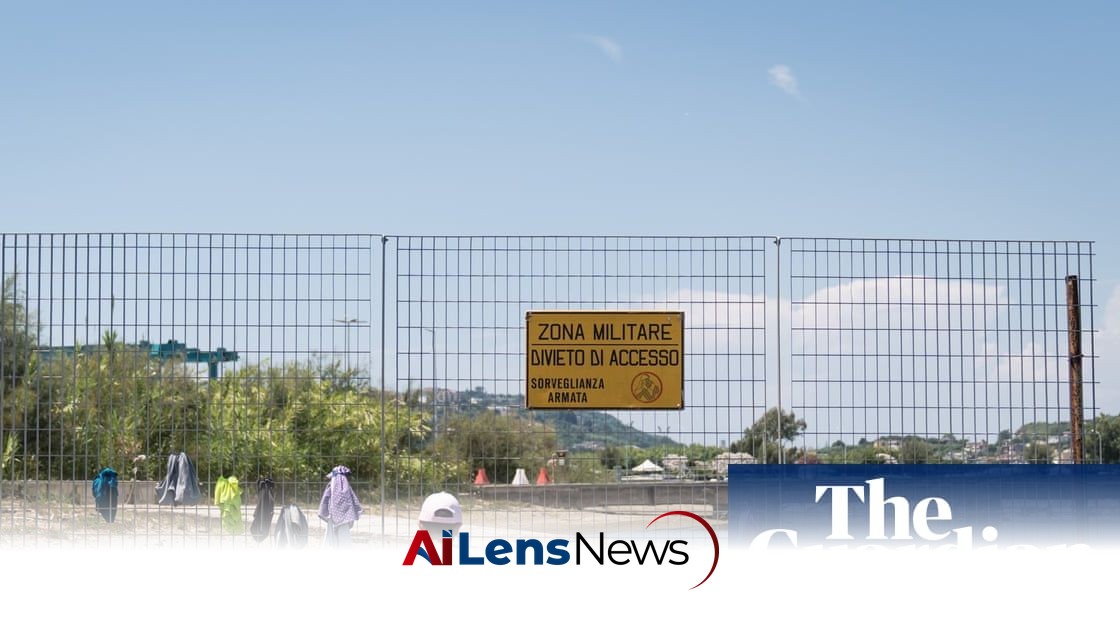


As Italy's private beaches dominate the coastline, activists fight to reclaim public access, challenging organized crime and local authorities.
London, United Kingdom Jul 19, 2026 ALN: Walking along Italian beaches is akin to strolling through a rainbow. The sand is divided into sections, with perfectly spaced parasols and deck chairs transitioning from red to orange, yellow, green, and beyond.
These are the country’s renowned bagni (lidos), formally known as concessioni balneari (bathing concessions). They are simple yet stylish, with sand raked at dawn and bars playing ambient music while serving negronis or fried squid. Many even feature amenities like table tennis and beach volleyball areas, and some boast swimming pools.
Everything about these lidos is orderly. Deck chair pricing resembles that of theater tickets, with spots by the water often costing double those near the bar. In Milano Marittima this summer, a parasol and two deck chairs cost €30 by the bar but could reach €60 by the water. Many families rent a space for the entire summer, year after year.
However, finding a spiaggia libera—a free beach where bathers can lay their towels and set up their own parasols—can require a trek of a mile or two. These free beaches are typically located in less desirable areas, often near estuaries or rocky outcrops, and frequently suffer from litter issues, lacking lifeguards or restroom facilities.
“This set-up is crazy,” remarks a Dutch holidaymaker on a free beach near Naples. “I tried to sit down on the beach over there,” he gestures towards the private lidos, “and they shooed me away. And here,” he shrugs, “there’s no toilet, no shower, no bin…”
The conflict between privatized and free beaches has escalated into a contentious issue in recent years. Italy boasts approximately 30,000 lidos, and a 2022 report from Legambiente, an Italian environmental organization, revealed that around 43% of Italy’s sandy coasts are now occupied by private enterprises.
Danilo Ruggiero, director of the Mare Libero (Free Sea) campaign, states, “Beaches have been transformed into little resorts—these complexes can include swimming pools, car parks, gyms, restaurants, and clothing shops.” Ruggiero resides in Ostia, just west of Rome, where he describes 80% of the town’s beach as “the united states of lidos.” He notes that defenses have been erected around the area—walls, gates, fences, and hedges—to prevent access and obstruct views. Often, for several kilometers, one cannot even see the sea.
Tuscany and Romagna are the regions with the highest density of privatized beaches. In Forte dei Marmi, 94% of the beachfront is rented to resorts, while nearby Pietrasanta and Camaiore report figures of 98.8% and 98.4%, respectively. Until recently, Gatteo a Mare on the Adriatic coast had no free beaches; following public outcry, it now has a mere 1.4% of its beach designated as free—just 10 meters out of approximately 700 meters.
Because operating a lido is highly profitable, often involving cash transactions, they attract organized crime, and the campaign for more free beaches frequently intersects with broader anti-mafia efforts. This beach access issue also raises a pressing question for Italians: how to combat the excesses of overtourism without transforming beautiful locations into theme parks? How can everyone enjoy the seaside when there simply isn’t enough space on the sand?
Bacoli, a town at the northwestern tip of the Gulf of Naples, is both stunning and unstable, shaped by active and extinct volcanoes that have created concentric circles of crater lakes and rocky peninsulas. The entire town sits atop the bubbling magma of the Phlegraean Fields, leading to frequent ground movements that cause cracks and potholes.
“Here,” Fabio Ciciliano, head of Italy’s civil protection department, explains, “they’re not living on a volcano but inside one.”
“It’s like the game of the goose,” laughs the town’s mayor, Josi Gerardo Della Ragione, as he gestures up and down, likening the town’s fortunes to the whims of fate.
Della Ragione has gained national fame for his efforts to liberate Bacoli’s beaches from private interests. “Until recently,” he shares, “our beaches were cluttered with illegal sheds, barbed wire, gates, and intercoms.” Access to various beaches was often through private compounds. “You had to ring the intercom,” he recalls, “and [their response was] I’ll open the gate if I know you.” This reflects a “clientelistic, friends-of-my-friends” mentality prevalent in the area.
The issue of beach access resonates deeply in Naples, a city that feels intrinsically linked to the sea. The local port authority manages the allocation of concessions, and many residents believe the balance between public and private access is heavily skewed: in Campania, the region surrounding Naples, 70% of beach concessions are private, with 95% in Naples itself.
Della Ragione asserts that many lidos acquired their licenses through the payment of fines. “They occupied a stretch of water and a stretch of beach,” he explains. “At the end of the summer, they were fined by the port authority for unauthorized occupation.” This practice, which he refers to as “legalized squatting,” has led to many lidos being classified as abusivi storici (historical unauthorized occupants) that he is now challenging.
“It’s clear that public property seized by force will be defended by force,” Della Ragione states. On one beach, Casevecchie, he deployed heavy machinery to dismantle illegal structures on public land. “We had to bring in bulldozers to demolish warehouses,” he recounts. “In one, we found the person running the warehouse with a chainsaw, heading towards the council workers. Those are the kinds of crimes we’re dealing with.”
Della Ragione has been engaged in this struggle for years. Seventeen years ago, he co-founded a social media campaign called FreeBacoli. He has a background as a sports journalist and is known for his keen listening skills. His efforts to expose corruption in local government led to an arson attack on his family’s delicatessen. In 2015, at just 28 years old, he was elected mayor with nearly 65% of the vote. Although his administration was short-lived, he returned to office in 2019 and has been Bacoli’s mayor for seven years.
What sets Bacoli apart is that the town council owns over a quarter of the 13 square kilometers of land, 60% of which is coastal. Many prime locations have fallen into the hands of the local mafia, the Camorra. Villa Ferretti, a 19th-century villa adjacent to Roman ruins visible beneath the clear waters of Pozzuoli bay, once belonged to the wealthy Ferretti family but was seized by the Camorra, who restricted public access to the beach.
The property was confiscated by the Italian Anti-Mafia Investigation Division in 1995 and transferred to Bacoli’s municipality in 2003. In 2016, the town council transformed the beach and garden into a public park, restoring access and leasing the villa to the University of Naples Federico II.
Della Ragione’s vision for the beaches mirrors his broader political philosophy. “What we’ve tried to do,” he explains, “is to give the city back to its citizens, based on the idea that public administration does not hand out favors and does not engage in patronage.” This vision often struggles to take root in southern Italy, where the “public good” is frequently perceived as a resource to be divided among friends, voters, and relatives.
Miseno beach is another contentious area in Bacoli. This curving stretch of sand is just over half a mile long, yet access from the modern road named after Pliny the Elder is obstructed by triumphal arches leading to private resorts. Free parking is available only for members, and without knowledge of the narrow corridors between resorts, gaining access to the sand is a challenge.
“They’re all military beaches,” Della Ragione explains. “There’s the navy with one resort, the air force with another, the Italian army with two, and the coastguard with one.” Including the nearby Guardia di Finanza resort, about 100,000 square meters of Miseno sand is designated for exclusive use.
However, once you navigate through the military installations, the reward is worth it. The water is cool and clear, with the famous islands—Procida, Ischia, and Capri—appearing so close that swimming to them feels feasible. To the left, a dozen caves once served as storage for the Roman navy.
Two thousand years ago, these saltwater lakes and bays made Bacoli the preferred port for Rome’s elite fleet, the Classis Misenensis. Underground aqueducts supplied freshwater directly to sailors from a reservoir—the Piscina Mirabilis—whose ceiling features circular skylights casting oblique beams onto the water.
Thus, this area has always been militarized. Yet, the military presence at Miseno beach is unrelated to training or drills; it revolves around deck chairs and economics. In the military lidos, un pezzo (“a piece,” referring to either a deck chair or parasol) costs only €3 (with free parking), while in non-military lidos, each piece costs €7 in low season and €10 in high season (with no parking). “We’re being undercut,” laments a barman from a non-military lido, expressing frustration over the unfair competition.
The managers of the military resorts are not in uniform; they are local individuals unconnected to the military. They offer coffee at 60 cents—half the price elsewhere—and welcome anyone to dine in their subsidized restaurants. So accustomed are they to their competitive advantage that they hardly notice it.
Eventually, you arrive at a dilapidated building, chained shut but covered in graffiti. This is the “free beach,” which appears almost deliberately unkempt, with wet wipes and straws littering the sand. The issue of litter is often raised by private operators, who argue that public beaches will inevitably be dirty. However, the atmosphere here differs; instead of orderly seating, groups gather around a Bluetooth speaker.
I speak with a man named Marco about the beach’s condition. “We have to fight a cultural battle,” he states. “When I go to certain free beaches, there’s no bin, and people leave cigarette butts and bottle caps in the sand. It requires education and cultural change…”
For years, activists from Mare Libero have organized flash mobs and beach occupations in areas where access is being continually restricted. Donn’Anna beach, just west of Naples, had been gated since 1999, with citizens only able to access it at the discretion of the keyholder, the manager of a lido called Bagno Elena. Even if one managed to gain access, finding a free space during peak summer would be nearly impossible: of the beach’s 4,490 square meters, only 290 were deemed free.
The Naples chapter of Mare Libero campaigned to “liberate” the beach, organizing sit-ins and arguing in court that a closed gate violated access rights. The Naples port authority appealed against the gate’s removal but ultimately lost its case. In February 2026, the Campania regional administrative court upheld Mare Libero’s cause, and Donn’Anna beach is now freely accessible—a victory that Mare Libero hopes to replicate along the peninsula.
In these tense environments, Della Ragione offers a form of socialist optimism: his fight for beach access is part of a broader plan to reclaim all land owned by the town council. “The sum of every individual interest is less than the common good,” he asserts.
Della Ragione possesses a unique skill set, blending the communication prowess of an influencer—constantly quoted and photographed in his tricolor sash, sharing his personal phone number for emergencies—with the bureaucratic acumen of a seasoned lawyer. His communications come across as both natural and strategic. “In this age of communication, if you don’t say you’ve done something, it’s as if you hadn’t done it. You have to do it and you have to say you’ve done it.” However, his high visibility also serves as a safeguard; what he is doing is perilous (he has received death threats), and his national prominence provides some level of protection.
Although the mayor appears revolutionary, he is also meticulous about formality. He refuses to meet people in shorts, and locals share stories—possibly exaggerated—of groups of visitors sharing a single pair of trousers outside the mayor’s office. When I visit a local boutique to explain my need to buy a pair, the shop owner laughs: “This happens all the time.”
As Della Ragione walks through the town, people frequently approach him to shake his hand, while others wave and call out, “Sindaco!” (mayor). The admiration is palpable. Conversations with townspeople—shopkeepers, bathers, friends—reveal genuine affection for “Josi.” “Fa bene,” they say, meaning “He’s doing a good job.”
And one can sense what the people of Bacoli are striving to create. At sunset, teenagers engage in canoe polo on Miseno’s saltwater lake, and a new beach volleyball court has been established on the reclaimed Casevecchie sand, its floodlights illuminating the evening sky.
To learn more about the latest developments in Destinations, stay updated with our exclusive reports and analyses on AiLensNews.

