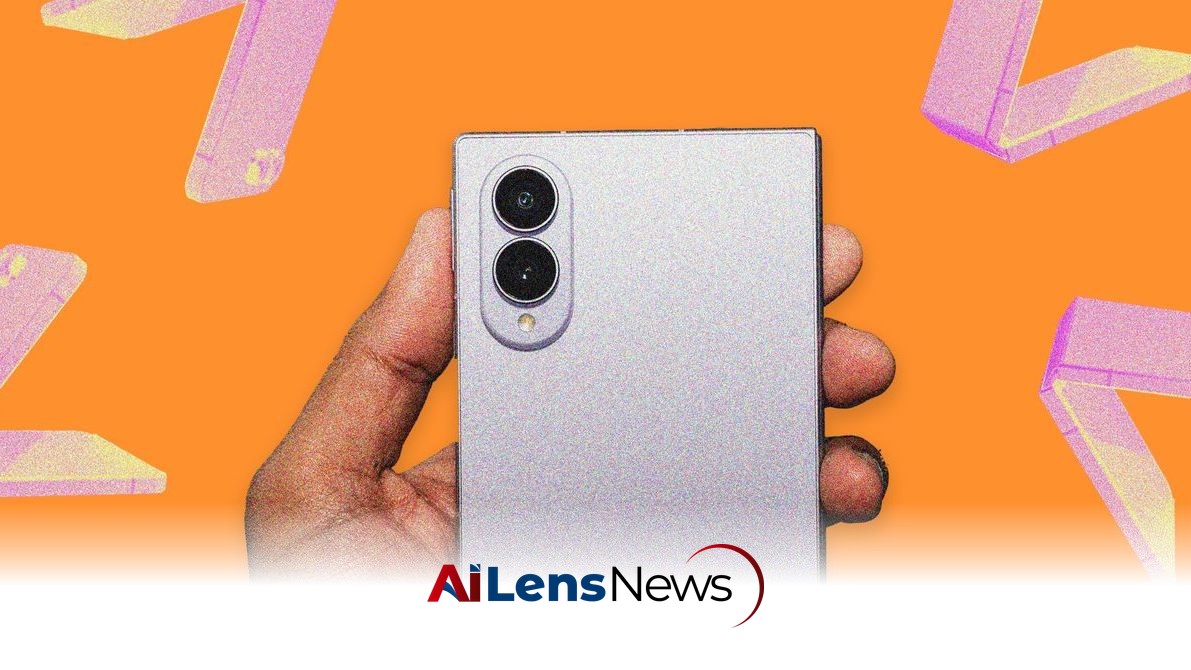


Samsung's Galaxy Z Fold8 features a new passport-like design aimed at improving mobile video consumption, catering to the growing demand for content on smartphones.
Washington DC, United States Jul 22, 2026 ALN: Think “folding phone,” and Samsung probably comes to mind. The company has led the charge in the category since it debuted the first Galaxy Fold in 2019. It has refined the hardware of its Fold and Flip devices ever since, making them thinner, lighter, and stronger.
So what’s next? A new shape, apparently. On Wednesday, at its second Galaxy Unpacked event of the year, Samsung revealed a brand-new design for the Galaxy Fold8—a passport-shaped, book-like fold—which sits between the now-rebranded Galaxy Z Fold8 Ultra and the compact Galaxy Z Flip8.
Drew Blackard, Samsung’s senior vice president of Mobile Product Management, says it’s all about expanding the portfolio. The larger, heavier, big-screen Galaxy Z Fold8 Ultra caters to productivity-oriented folks, the Flip8 satisfies anyone prioritizing portability, while the new Fold8 is all around consuming content.
“One of the things we’re seeing, in the past few years is an explosive growth in mobile video watching,” Blackard tells . “Consumers watch 80 percent of their video on mobile devices now, not in front of a TV screen or tablet. The actual shape of the content has changed—you’ve gone from landscape view format for things like Netflix to vertical orientation for a lot of social media.”
The new Fold8 has a 10:16 aspect ratio for the front cover screen, and when opened, reveals a 4:3 inner display, both of which play well with all kinds of videos, whether that’s clips on YouTube or Instagram Reels. Also, the unfolded 7.6-inch inner screen is ideal for reading websites or ebooks when the phone is held in vertical orientation. That makes it more familiar and comfortable for consuming content, which is the lion’s share of what people use smartphones for these days, than the taller, narrower Galaxy Z Fold8 Ultra.
It looks a lot like what Apple’s first folding device is rumored to look like, with a wider screen that’s much shorter than the traditional booklike fold we’ve come to know. It resembles the original Google Pixel Fold or even the poorly received Microsoft Surface Duo.
Blackard says that when its seventh-generation folding phones came out in 2025, the company thought it had reached an inflection point of a mainstream design—the phone was light enough and the hardware slim enough with few spec trade-offs when compared with candybar smartphones. Last year’s Galaxy Z Fold7, for example, shipped with the same 200-megapixel camera as the flagship Galaxy S25 Ultra. Blackard says he believes this hardware parity will only usher in a diversity of folding phone designs that meet “consumers’ different needs.”
The time for experimenting with new shapes is ripe. Earlier this year, Samsung released the Galaxy Z TriFold—an even bigger folding phone that expanded to tablet size, with an eye-watering price. The company has since stopped selling it, with Blackard saying it was always supposed to be a limited-run product; Samsung did roughly four drops in the US, and with each one, the $2,899 TriFold sold out in minutes.
Now there’s the new shape, at a still-expensive but more palatable $1,900. Francisco Jeronimo, vice president for data and analytics at IDC, says whether it’s reacting to Apple’s upcoming iPhone or just expanding the portfolio, the Fold8 is a good move for Samsung.
“When Apple launches the device, and it becomes popular, then they can also offer the same kind of format to their customers,” Jeronimo says. “They have nothing to lose in launching a new format because it’s just another offering. If someone says, ‘I don’t like the book style,’ then they have the passport style. We will probably see more form factors and devices coming next year.”
A part of what might also help to make these devices more mainstream is the much talked about crease. Folding phones have an unavoidable crease in the middle where the hinge sits, and many have voiced their disdain for it. Now, thanks to a new titanium display layer that Samsung calls Flex Titanium in the Fold8 and Fold8 Ultra, the crease isn’t as noticeable and feels “flatter” than the more obvious ridge in previous models. Apple has reportedly expended significant effort in trying to eliminate the crease. The lesser the crease, perhaps the more appealing the phone.
Samsung says this titanium plate and the titanium-alloy film also help improve durability. And overall, the phone is easier to open and close, though the Fold8 isn’t designed to sit half-open. Blackard expects most users will stick with the cover screen or inner display, and that “Flex Mode” behavior—with the screen open at a 90-degree angle—is something folks using the Fold8 Ultra or Flip8 are more likely to demonstrate.
Crucially, Samsung also claims the Fold8 is the lightest booklike folding phone on the market, weighing in at a mere 201 grams (32 grams less than the iPhone 17 Pro Max). Weight plays a big role in adoption, as many early folding phones were bulky, heavy, and cumbersome to use. Slimming them down and reducing weight makes them significantly more usable, and the value of having much more screen real estate is easy to appreciate.
Blackard isn’t worried about Apple’s foray into its territory. He says more competition brings visibility to the category—people may know what a folding phone is today, but many haven’t seen or actually used one.
“The more there is out there, the more people will be familiar with the form factor,” he says. “When it comes to their decision, we can rely on the fact that this is our eighth generation. Obviously, first generations tend to go through hiccups.” He also points out that Samsung has a portfolio of devices for consumers to choose from rather than just one.
While others—like Motorola and Huawei—have chipped away at Samsung’s foldable dominance, particularly in the US and China, Samsung’s biggest challenge will be the folding iPhone rumored to arrive as soon as this September. The device could swoop in and take nearly 30 percent of global foldable shipments in 2026, according to IDC forecasts, potentially catapulting Apple as the largest player in the category on the strength of that one device.
All of these folding phones, however, are moving further into the “premium” market category. The Flip8 and Fold8 Ultra are seeing $100 price increases over last year, which Blackard attributes to the memory crisis and rising component costs. Motorola also recently jacked up the prices of its folding Razrs. (Apple’s iPhone Fold is also expected to cost north of $2,000.)
It’s unlikely that Samsung will offer a folding phone under $1,000 in the near term, even if the memory shortage were to resolve itself. Blackard says the $899 Galaxy Z Flip7 FE it introduced last year didn’t deliver “the experience consumers wanted.”
Jeronimo says Apple and Samsung are unique in that they can raise prices in this economic climate because most of their customers buy their devices on installment plans or on contract through carriers. “If it costs $200 more, but it means $3 to $5 more per month, of course no one will be happy, but it’s not something consumers will be saying, ‘No, I won’t buy it because it’s $200 more expensive,’’’ he says. “The impact of the price increase on premium devices is less significant than on midrange.”
Blackard did not address rumors that the company may axe the Flip8 series, which is less popular than the booklike fold among its consumers, but says that when people buy a folding phone, most don’t go back to traditional candybar smartphones.
“That’s the exciting part of the form factor innovation of foldables,” he says. “We’re still exploring what all of this can be, but at the same point in time we’ve learned a lot and have a lot of confidence in what we’re doing with this portfolio.”
To learn more about the latest developments in Software & Platforms, stay updated with our exclusive reports and analyses on AiLensNews.

