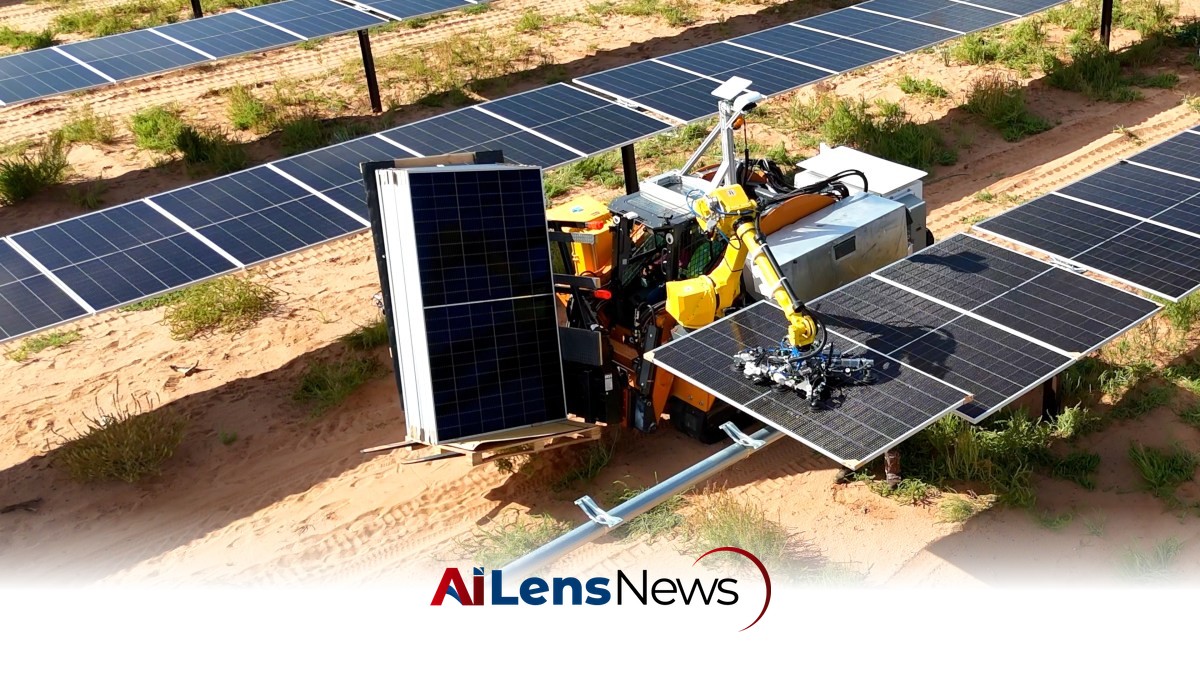


Gritt emerges from stealth mode with $34 million in funding, aiming to automate solar panel installation using advanced robotics and AI technology.
Washington DC, United States Jul 21, 2026 ALN: One of the most important things happening on Earth today is the solar energy build-out. Around the world, companies and countries are racing to deploy solar and batteries to achieve energy independence and limit the effects of climate change.
This transition towards renewable energy sources, particularly solar energy, is pivotal in the global effort to combat climate change. As countries strive to meet international agreements aimed at reducing carbon emissions, the demand for solar energy solutions has surged. The International Energy Agency (IEA) has projected that solar power will become the backbone of the global electricity supply over the coming decades, with substantial investments required to expand this sector. However, this rapid expansion is not without its challenges.
One significant hurdle facing the solar industry is the labor market. As the demand for solar installations grows, there is a noticeable shortage of skilled laborers to carry out the installations. This shortage is compounded by the fact that many construction jobs are considered undesirable by the current workforce, often characterized by their physical demands and outdoor working conditions. As a result, companies are increasingly exploring automation as a viable solution to bridge the gap between demand and available labor.
Historically, industrial robots have struggled to adapt to unstructured environments like construction sites, where conditions can be unpredictable and variable. However, advancements in artificial intelligence (AI) and robotics are beginning to change this narrative. The latest generation of AI models has shown promise in enabling robots to operate more effectively in these challenging settings, paving the way for innovative approaches to construction.
This is the driving idea behind Gritt, a start-up founded by two Carnegie Mellon-trained roboticists, CEO Puneet Puri and CTO Vishal Dugar. Gritt aims to leverage cutting-edge technology to automate solar plant construction, thereby increasing efficiency and reducing reliance on human labor. The company exited stealth mode recently, announcing a successful $26 million Series A funding round led by Obvious Ventures, with participation from Union Square Ventures and Active Impact Investment. With this funding, Gritt's total investment has reached $34 million, following an earlier seed round supported by First Round Capital, Climactic, Congruent Ventures, and VSC Ventures.
Puri articulates the core mission of Gritt: "Our thesis is that if we truly want to speed up construction, you need an intelligence which can work in the outdoor, chaotic environments of these construction sites, and it has to be generalizable enough that it can work in these varied environments." This statement underscores the company's commitment to creating adaptable robotic systems capable of handling the complexities of construction work.
Rather than developing proprietary robots from the ground up, Gritt has adopted a more pragmatic approach by utilizing off-the-shelf hardware. This includes rented skidders and robotic arms manufactured by established companies like Kawasaki. By integrating these existing components with their proprietary AI models, Gritt aims to create a versatile platform capable of performing specific tasks efficiently. Currently, their systems are focused on unloading large glass solar panels, transporting them to their designated locations, and positioning them with sub-millimeter accuracy for installation by human workers.
Andrew Beebe, a partner at Obvious Ventures who led Gritt’s Series A round, commented on the unique blend of experience that the founders bring to the table. He noted, "There are people who used to build rockets that went into space and had infinite budget for the smallest little part, and then there are people who know what it means to get into dirty, dull, and dangerous jobs and scale them like mad. These guys are in the second camp, and that’s a special kind of entrepreneur that has the technical chops, the AI, and the machine vision skills to make it work." This perspective highlights the importance of practical experience in addressing the challenges of labor-intensive tasks in construction.
Gritt has already deployed two systems in the field, and the data collected from these operations is being used to refine and enhance their performance. According to Puri, a typical crew of eight workers can install around 800 solar panels in a day. However, with the assistance of Gritt's systems, that same crew can increase their output significantly, installing between 3,000 to 4,000 panels daily. This dramatic increase in efficiency showcases the potential impact that automation can have on the solar installation process.
Looking forward, Gritt has ambitious plans. The company is contracted to facilitate the installation of 2.8 gigawatts of solar panels over the next 18 months and has secured partnerships with three of the top ten power construction companies in the United States. With a goal of operating 48 systems within the next six months, Gritt is poised to make a substantial impact on the solar construction landscape.
Beyond its current capabilities, Gritt aims to expand its system to include additional tasks, such as fastening solar panels, drilling posts, and even constructing the racks that hold the panels in place. In the long term, the company envisions branching out into other labor-intensive construction activities, such as tying rebar before concrete is poured, further diversifying its applications in the construction sector.
The advancements in AI technology have been a crucial enabler for Gritt's vision. Puri explains, "Making a system for one solution was still possible to some extent five years ago, right? But AI is now making that work generalizable — the same underlying pipeline can be reused and improve across tasks." He cites the efficiency of the training process as a testament to this progress; for instance, training the system to stack cinder blocks previously took weeks, whereas a similar demonstration for rebar tying now takes just one day, thanks to the improved AI frameworks.
However, Gritt’s aspirations extend beyond merely automating physical tasks. The founders believe that the integration of sensors and intelligence into their systems can significantly enhance management and decision-making on construction sites. For example, they envision scenarios where their system can detect an open trench as a storm approaches and alert workers to take preventive measures, such as covering the trench to protect components from water damage. Additionally, the system could flag issues such as missing inventory, thereby streamlining operations and improving overall site management.
Puri emphasizes this multifaceted role of Gritt's technology: "Gritt becomes now this layer of physical AI, which is doing this dextrous, labor-intensive task, plus it can help you take decisions on the site." This dual functionality not only enhances productivity but also contributes to safer and more efficient construction practices, ultimately driving the solar energy build-out forward.
As the world increasingly turns towards renewable energy sources to combat climate change, companies like Gritt are at the forefront of this transformation. By harnessing the power of robotics and AI, they are not only addressing labor shortages but also paving the way for a more efficient and sustainable future in solar energy construction. The implications of such advancements extend beyond the immediate benefits of increased efficiency; they also signify a shift in how construction tasks can be approached in the age of technology, potentially revolutionizing the industry as a whole.
To learn more about the latest developments in Software & Platforms, stay updated with our exclusive reports and analyses on AiLensNews.

