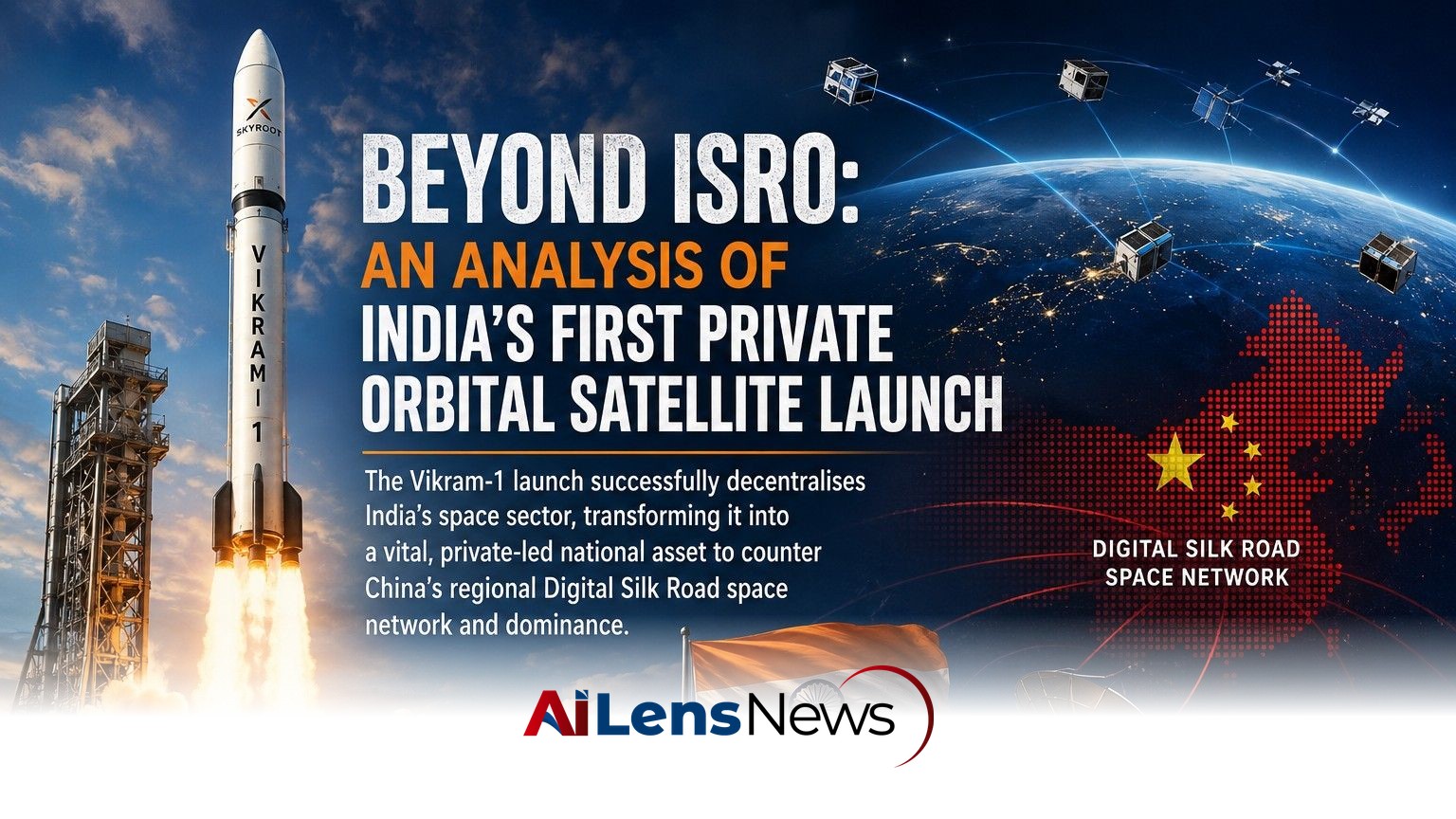


The Vikram-1 rocket's successful launch marks a pivotal shift in India's space sector, introducing private capabilities to counter regional challenges.
New Delhi, India Jul 19, 2026 ALN: The successful orbital insertion of the Vikram-1 rocket under Mission Aagaman on July 18, 2026, marks the definitive decentralisation of India’s space program. Developed by Hyderabad-based Skyroot Aerospace, the multi-stage vehicle lifted off at 12:05 pm IST from the Satish Dhawan Space Centre (SDSC-SHAR) in Sriharikota. After a 15.46-minute flight, the mission successfully placed six customer satellites into a 450-km Low Earth Orbit (LEO).
This milestone positions India alongside the United States and China as the only nations possessing active, private orbital launch capabilities. This launch transitions the Indian Space Research Organisation (ISRO) from a monopoly into a strategic infrastructure lessor. By deploying six satellites simultaneously—including customer payloads like Grahaa Space, Cosmoserve, and Germany’s DCubed GmbH, Skyroot validated India’s private aerospace pipeline. Symbolic payloads, including a handwritten “Vande Mataram” postcard from Prime Minister Narendra Modi, signalled absolute sovereign alignment.
The space economy dictates that dominance is accelerated by commercial activity. Sovereigns build frontiers; corporations build infrastructure.
The strategic value of the Vikram-1 platform lies in its immediate utility for rapid, tactical Responsive Space Launch (RSL) capabilities. In high-intensity regional conflicts, adversarial electronic warfare, kinetic anti-satellite (ASAT) strikes, or directed-energy weapons (DEW) can blind state reconnaissance assets. Vikram-1’s solid-fuel architecture allows the vehicle to be stored near-ready, and launched with minimal infrastructure preparation.
For India’s Defence Space Agency (DSA), this commercial supply chain provides a mechanism to replace destroyed tactical assets within days rather than months. Dedicated high-inclination micro-satellite constellations can be deployed directly over active geopolitical flashpoints like the Line of Actual Control (LAC) or the Indian Ocean Region (IOR). This operational agility alters the regional intelligence equilibrium with Pakistan and China. Rather than depending on large, predictable ISRO satellites whose paths are easily tracked, tactical commanders can mandate on-demand orbital coverage tailored to real-time border dynamics. By routing capabilities through private platforms, New Delhi secures plausible deniability and operational elasticity during grey-zone escalations.
Diplomatically, New Delhi positions its NewSpace ecosystem as an alternative to China’s expanding space computing networks and Belt and Road aerospace initiatives, which aim to bind developing economies to Chinese hardware via satellite connectivity, regional Beidou navigation infrastructure, and digital corridors. Beijing had regional dominance (e.g., the Shanghai Xingshu LEO projects). India has built a counter-weight. It now offers competitive, on-demand orbital routing through NewSpace India Limited (NSIL), the commercial arm of ISRO; and IN-SPACe, its regulator.
Providing non-coercive access to space, to nations across Southeast Asia, Africa, and Latin America creates deep technological bonds, insulating developing economies from Beijing’s data-harvesting frameworks.
However, a stark capabilities gap remains between India’s private launchers and China’s mature, military-integrated commercial sector. While India is just validating its first private orbital deliveries, Chinese entities execute frequent tactical launches using road-mobile transporter-erector-launchers (TELs) and command advanced co-orbital counter-space assets.
Because solid-propellant space launch vehicles share core engineering with Intermediate-Range Ballistic Missiles (IRBMs), India’s private sector faces intense international regulatory hurdles under the Missile Technology Control Regime (MTCR). Skyroot must maintain absolute separation between commercial operations and military supply chains to avoid export control roadblocks.
The narrative of a “fully private” Indian space sector masks major dependencies on the state, and on foreign capital markets. Startups like Skyroot operate essentially as institutional spin-offs, heavily reliant on former ISRO scientists—such as CEO Pawan Kumar Chandana and co-founder Naga Bharath Daka—and over 70 formal technology transfer agreements signed by 2026. Crucial manufacturing and testing facilities are completely subsidised for them by the government.
Private space unicorns offer salary packages 3 to 4 times higher than ISRO’s rigid state-mandated pay structures. This drains the public sector of premier deep-tech engineering talent and creates a domestic talent migration crisis. This is now being addressed by government HR policy interventions.
The domestic venture capital ecosystem remains risk-averse, forcing startups to depend on international financing. While Skyroot successfully raised a $60 million scale-up round in mid-2026, the funding was co-led by foreign entities like Singapore’s sovereign wealth fund GIC and Sherpalo Ventures (USA). This high concentration of foreign capital (over 80 percent) exposes critical dual-use national defense supply chains to volatile international geopolitical crosscurrents and foreign regulatory interventions.
The most glaring long-term threat to Skyroot’s market viability is the lack of reusability. Vikram-1 is an expendable rocket, placing it at an immediate economic disadvantage against international benchmarks like SpaceX’s Falcon 9 or Rocket Lab’s Neutron platforms. Domestically, Skyroot faces intense competition from Chennai-based AgniKul Cosmos, whose Agnibaan platform utilises an advanced semi-cryogenic engine and actively pursues sea-recovery options to achieve true reusability.
Given universal organizational behaviours, turf wars remain an inherent barrier between commercial agility and state security mandates. Thus, beyond technological limits, swift commercial execution is hampered by institutional friction. In this case, the bureaucratic tug-of-war could be between IN-SPACe, the regulator for NSIL (the commercial arm of ISRO, largely replacing Antrix) and the Ministry of Defence, regarding clearing dual-use technology, and unintended data leakage.
This directly impacts payloads like Grahaa Space’s primary satellite, which features advanced, real-time maritime surveillance capabilities designed to process high-resolution video stream data and track illicit ship-to-ship fuel transfers or naval manoeuvres in the Malacca Strait.
To ensure financial viability, the stakeholders must jointly reduce regulatory friction. Skyroot should upgrade towards liquid-fuelled Vikram-2 and reusable booster configurations.
(The author, an Indian Army veteran and a strategic analyst, is former Security Advisor, Ministry of Home Affairs, Government of India and former Advisor, Government of Seychelles. The views expressed are personal.)
To learn more about the latest developments in Software & Platforms, stay updated with our exclusive reports and analyses on AiLensNews.

