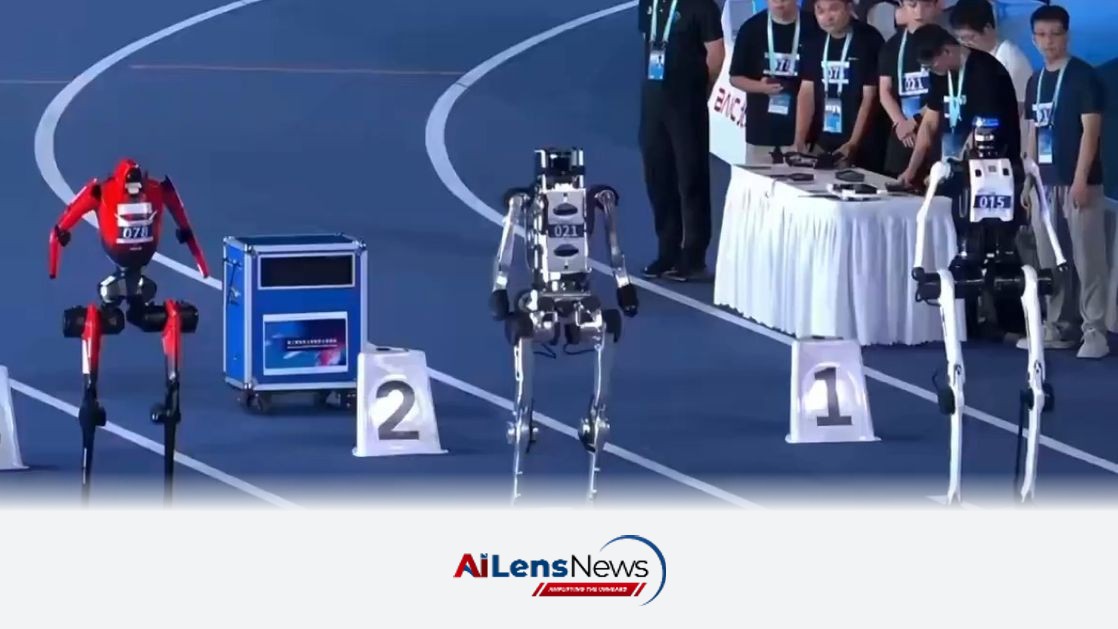



In a stunning display of technological advancement, Chinese humanoid robots shattered human records in sprinting and high jumping at the World Humanoid Robot Games in Beijing.
New Delhi, India Aug 23, 2026 ALN: Chinese humanoid robots broke records set by humans, including beating Usain Bolt's 100-meter sprint world record, on the opening day of the Olympics-like World Humanoid Robot Games in Beijing. This event marks a significant milestone in the field of robotics, showcasing not only technological advancements but also the growing competitive spirit in the global robotics arena.
More than 2,000 humanoid robots were participating in the event, according to the organizers. The five-day games, now in its second year, serve as a spectacle demonstrating China's rapid progress in advanced robotics. As the technology race with the U.S. heats up, the games feature 51 events and over 1,000 competitions, including running, table tennis, and soccer, highlighting the versatility and potential of humanoid robots.
Taking place at the National Speed Skating Oval, a venue built for the 2022 Winter Olympics, the games opened during the same week as the 2026 World Robot Conference in Beijing. This conference saw companies showcasing around 3,000 products, including various humanoid robots, further emphasizing China's commitment to leading in this field.
China is currently the largest producer of humanoid robots globally, a fact that has not gone unnoticed by other nations. The United States, in particular, has increased scrutiny of robots manufactured in China. Last month, the U.S. Federal Communications Commission (FCC) announced a ban on imports of new foreign-made humanoid robots, citing national security concerns. This move particularly targets China, reflecting the geopolitical tensions surrounding technological advancements and military applications. Furthermore, the Pentagon has added Unitree, a leading Chinese humanoid robot maker, to its list of companies linked to the Chinese military, prompting strong rebuttals from Beijing regarding these allegations.
At the opening of the robot games, organizers and robot manufacturers proudly announced that Chinese humanoid robots had not only participated but had also outperformed human world records. In a remarkable display, hundreds of humanoid robots marched in formation onto the field, showcasing a massive exhibition of synchronized coordination, which captivated the audience.
During the competition, a humanoid robot achieved a time of 9.39 seconds in the 100-meter sprint, surpassing Usain Bolt's human record of 9.58 seconds, which had stood since 2009. Additionally, in the standing high jump event, a humanoid robot managed to reach an impressive height of 2.88 meters, well above last year's best result of 0.95 meters by a humanoid robot. This feat also eclipsed the human high jump record of 2.45 meters set by Cuba's Javier Sotomayor in 1993. Both record-breaking robots hailed from Beijing-based X-Humanoid, underscoring the company's leading role in this field.
Prior to the official opening, a humanoid robot developed by the Chinese smartphone company Honor completed a 100-meter sprint in an astounding time of 9.32 seconds during a trial run, achieving a peak speed of 14.5 meters per second. This trial further emphasizes the potential capabilities of humanoid robots and raises questions about the future applications of such technology in various sectors.
Despite the impressive achievements, experts caution that humanoid robots are still primarily utilized for demonstrations, performances, and research purposes at this stage. The transition to mass real-world deployment remains a challenge that will take time to overcome. As technology continues to evolve, the implications for industries such as manufacturing, healthcare, and customer service could be profound, potentially transforming how tasks are performed and services delivered.
Audience reactions to the robot games were overwhelmingly positive, with many spectators expressing excitement about the rapid advancements in humanoid robotics. Li Yanfeng, an education worker and a Beijing resident, shared her initial hesitations about artificial intelligence, stating, "At first, I wasn't very accepting of artificial intelligence. I was even a bit resistant to it because of the possibility that it might replace or displace humans. But now that I see this development is unstoppable, I decided to come and take a look." Her sentiments reflect a broader societal shift as people become more accustomed to the integration of technology in everyday life.
Another spectator, Yang Shangzheng, expressed amazement at the capabilities of humanoid robots, saying, "These sports are perfectly normal for humans, but now robots can do them. I find it amazing." Liu Tao, who attended the games with his son, mentioned his anticipation to witness "the best robots China currently has to offer," illustrating the growing public interest in robotics as a field of innovation.
This year's robot games feature participation from 16 countries, including Germany, Japan, and the United States, indicating a global interest in the development of humanoid robots. The event also includes diverse competitions such as weightlifting and tug of war, highlighting the multifaceted nature of robotics and the potential for humanoid robots to engage in various physical activities.
The implications of these developments extend beyond mere competition. As countries invest in robotic technology, the potential for collaboration, ethical considerations, and regulatory frameworks will become increasingly important. The advancements made in humanoid robotics at events like these could pave the way for future innovations that enhance human capabilities and address societal challenges, but they also raise important questions about the role of technology in our lives and the balance between human and robotic contributions in various fields.
To learn more about the latest developments in Robotics & Automation, stay updated with our exclusive reports and analyses on AILensNews.

