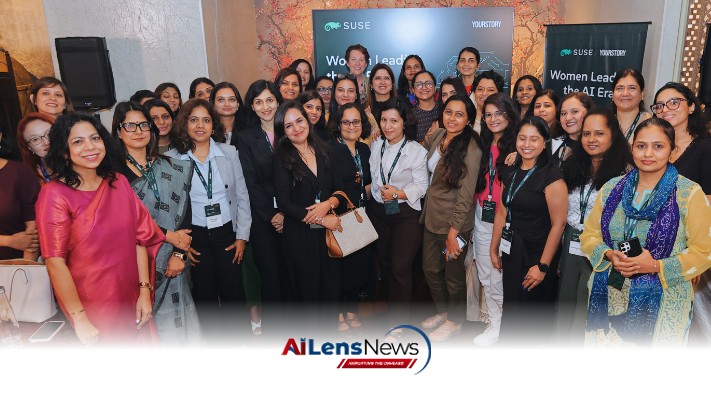



At SUSE's Women in Technology event, leaders discussed AI's business value, the need for women's leadership in tech, and the evolving landscape of AI adoption.
New Delhi, India Aug 21, 2026 ALN: AI adoption is moving quickly across enterprises, but companies are becoming more focused on a basic question: what business value does it deliver?
That was one of the key themes at SUSE’s Women in Technology leadership event on August 5, 2026, where senior women leaders discussed AI adoption, leadership, career opportunities, and the barriers women continue to face in technology.
The event featured a keynote by Tracy Quah, Marketing Director Asia Pacific, SUSE, followed by a panel discussion, ‘Leading Through the AI Era’, with Margaret Dawson, CMO, SUSE, and Krithiga Thakkar, Managing Director, Tech Strategy and Transformation, Accenture. The session was moderated by Shubhangi Mishra, Senior Creative Lead.
Opening the event, Quah positioned AI as a leadership opportunity rather than another technology trend. The focus, she said, should be on measurable outcomes, including product velocity, resilient infrastructure, secure operations, and more empowered teams.
Dawson noted that enterprises have moved through the AI hype cycle unusually quickly. “With AI, we've gone through the entire hype cycle in a record amount of time. We went to the top of the hype cycle, we’re already in the trough of disillusionment,” she said.
The focus is now shifting towards what AI can actually deliver. Rather than simply replacing people with agents, enterprises are looking at how AI can help employees become more strategic and productive.
However, measurable returns are still emerging. “We have a long path ahead of us before AI workloads are actually ubiquitous across all organizations. So I still think we're just putting our toe in the water, and we're seeing initial results, but the true value and ROI, it's not there yet,” Dawson stated.
Thakkar mentioned that conversations with clients have evolved. Companies are no longer asking whether they should use AI; they want to know what they will get from it and how quickly.
This shift is pushing organizations away from running multiple pilots without clear outcomes towards funded programs with defined goals and accountability. Companies are also beginning to deal with the cost and complexity of running several AI initiatives simultaneously.
The panel highlighted that “AI” encompasses very different use cases. AI embedded in products, internal productivity and workflow applications, and AI workloads built for customers require different technologies and measures of success.
The growth of AI could create new opportunities for women in technology, but Thakkar cautioned that existing patterns could simply be reproduced in new roles. “One of the pitfalls or the trap that I'm seeing potentially is women typically tend to get skewed towards the governance side of AI, the responsible side of it, or the transformation side of it, and we leave the P&L or the models or the architecture to men,” she said.
She argued that women should connect responsible AI and governance with business outcomes, rather than limiting themselves to oversight roles. This also means pursuing opportunities involving P&L, models, and architecture.
Dawson sees AI potentially changing the skills valued in technology leadership. As AI reduces some of the need for hands-on technical work, she said, business strategy, adaptability, and other leadership capabilities could become more important.
However, the underlying challenge remains familiar: women have the skills and talent, yet those strengths have not consistently translated into leadership positions.
For AI to create a meaningful reset, women need to be involved in shaping the technology rather than simply participating in its adoption.
For Thakkar, the focus on business value also changes how companies should approach accountability. Every stage of an AI program should connect to a measurable outcome, whether that means improving productivity, reducing cost per transaction, or changing a metric such as days sales outstanding.
Governance should not become a standalone function disconnected from business performance, she argued.
Dawson stated that the principle is similar to any transformation program: start with the end state. Organizations need to define what they are trying to solve, what success looks like, and which metrics will demonstrate it.
The technology may be new, but the fundamentals of transformation remain the same.
The discussion also turned to why women continue to leave technology careers. Dawson highlighted the disproportionate responsibility women continue to carry for childcare and caring for parents and in-laws. “In every country, every culture, women take on the burden exponentially of childcare or of parents and in-laws. I'm seeing a lot of women leave to have children and not come back,” she said.
She sees AI and the emergence of new roles as a potential route back into technology for women who have taken career breaks.
Thakkar spoke about her own experience of taking three career sabbaticals and returning each time on her own terms. She said focusing on her own journey, rather than comparing her progress with peers, helped her navigate those transitions.
Both leaders stressed the role of women already in senior positions. Building teams that can continue to operate when a leader takes a break can make it easier for women to step away without permanently losing their place on the leadership track.
The panel also touched on the biases that can enter AI systems in less obvious ways. Dawson cited an example from SUSE, which had an AI agent called Liz. The organization questioned why an AI agent needed to have a gender at all and eventually replaced the name with a gender-neutral mascot.
India's opportunity in AI will require more than technical skills. Thakkar identified three capabilities that professionals should develop: evaluating AI outputs, building deep domain expertise, and communicating ideas clearly.
Dawson pointed to India's technology talent, scale, and open-source mindset as advantages in developing more transparent and sovereign AI.
Thakkar believes AI could create a more level playing field because many of the capabilities being developed today are still new. India has the talent, scale, and confidence to participate in that shift.
The challenge will be ensuring that the expansion of AI does not widen the existing digital divide. For women in technology, that means making sure the next wave of AI does not simply reproduce existing leadership patterns. The opportunity is to move into the roles that shape products.
To learn more about the latest developments in Startup Ecosystem Trends, stay updated with our exclusive reports and analyses on AILensNews.

