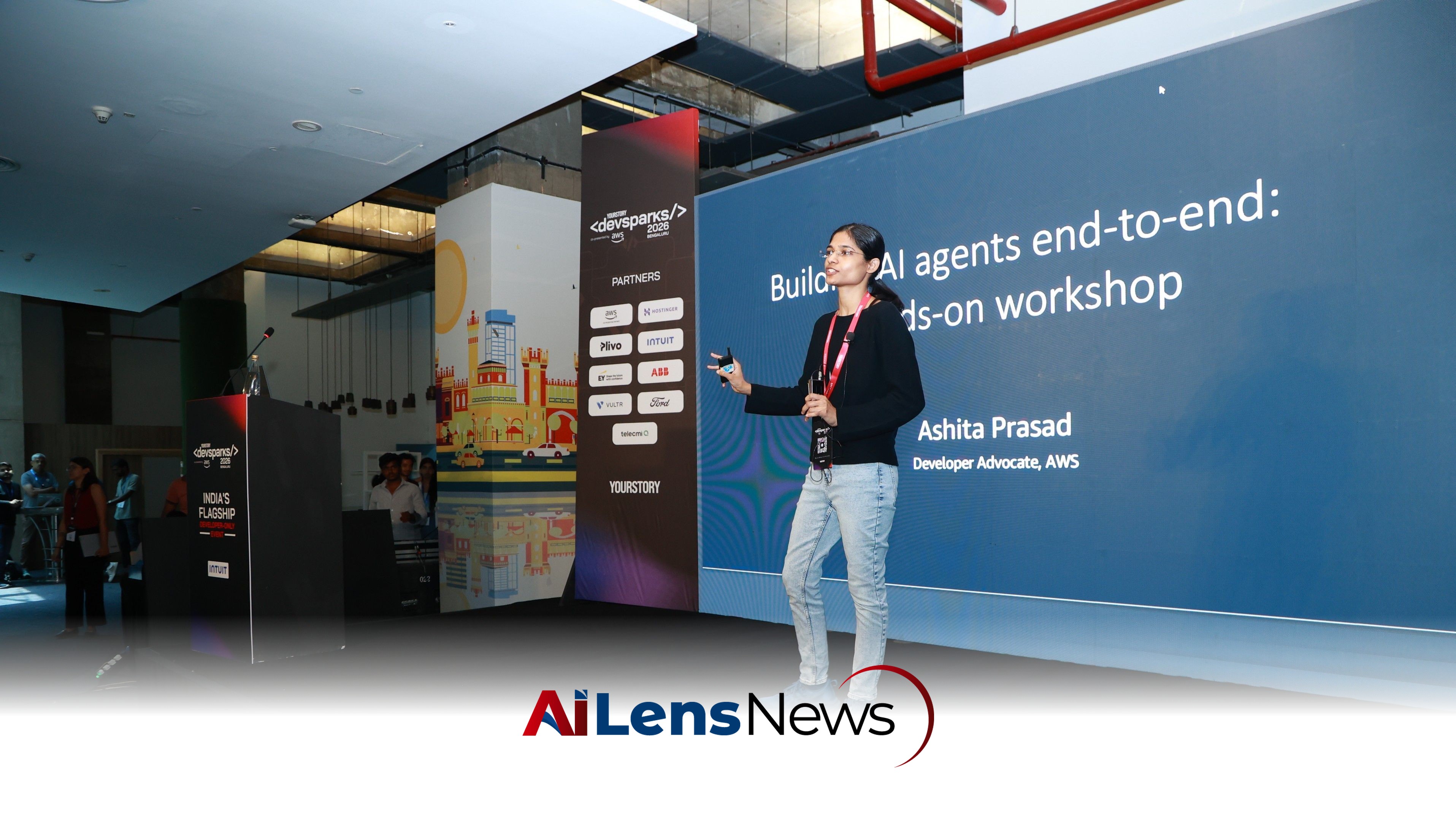


At DevSparks Bengaluru 2026, AWS Developer Advocate Ashita Prasad guided developers in creating production-ready AI agents using the Strands Agents SDK.
New Delhi, India Jul 9, 2026 ALN: The landscape of artificial intelligence (AI) has evolved rapidly in recent years, with developers increasingly able to create AI models that respond to user prompts with impressive accuracy. However, transitioning from a basic AI model to a fully functional agent that can operate reliably in a production environment remains a significant challenge. This gap is where many projects aimed at developing AI agents tend to falter. The hurdles include frameworks that impose rigid structures, systems that fail to provide transparency when issues arise, and an ever-shifting standard for enterprise readiness that complicates the development process.
Addressing these challenges head-on was Ashita Prasad, a Developer Advocate at AWS, during a hands-on workshop at DevSparks Bengaluru 2026. This two-hour session attracted around 170 developers eager to learn how to leverage AWS’s Strands Agents, an open-source SDK designed to facilitate the creation of robust AI agents. The workshop provided participants with an opportunity to build their own agents, guiding them from a basic framework to a more sophisticated version equipped with essential features such as guardrails, persistent memory, and enhanced observability.
Ashita began the workshop by outlining the primary issues that developers face when working with existing frameworks for AI agents. The first challenge is the steep learning curve associated with grasping agentic concepts and translating them into practical implementations. Many developers find themselves overwhelmed by the complexity of the frameworks available, which often do not adequately prepare them for the nuances of building functional agents.
The second issue is that most frameworks prioritize convenience over flexibility, leading to constraints that can become problematic as projects scale. Developers may find that the tools they initially chose do not accommodate the growing needs of their applications, forcing them to either compromise on functionality or undertake significant refactoring efforts.
Perhaps the most critical concern is the opacity of these systems. Ashita emphasized this point by stating, "You do not know what the agent is doing behind the scenes, what tool calls it is doing, what messages it is sending." This lack of transparency can create challenges in debugging and maintaining the agents, as developers often find themselves navigating a black box without clear insights into the underlying processes.
The Strands Agents SDK takes a model-driven approach that addresses these issues by allowing the underlying large language model (LLM) to dynamically determine the best course of action—whether that be calling a tool, returning a response, or continuing the reasoning process. This design exposes the entire agentic loop to developers, making it easier to understand and manage. The loop operates in a straightforward manner: a user prompt is received, the model decides on the next steps, any necessary tools are called, results are fed back into the model, and a final response is generated. Strands Agents effectively manages the intricate plumbing required to facilitate this process.
The workshop progressed through a series of labs, each designed to incrementally add functionality to the agents being developed by participants. It began with the most basic agent configuration, consisting of a model, a system prompt, and a user query. This foundational step allowed participants to familiarize themselves with the essential components of an AI agent.
As the labs advanced, participants learned to integrate various tools into their agents. The first addition was a custom weather function, followed by the inclusion of community-built tools, such as a calculator that comes pre-packaged with Strands. This hands-on experience illustrated the versatility of the Strands SDK and its ability to support diverse functionalities.
In the model provider lab, participants were introduced to Ollama, a tool that enables developers to run LLMs locally. This is particularly beneficial for developers who may not have access to a cloud model subscription, allowing them to experiment with AI agents without incurring additional costs. Participants built a file operations agent powered by a local Llama 3.2 model, which demonstrated the capability to read, list, and write files within a specified directory. This exercise underscored the adaptability of the Strands architecture, showing that it can function effectively regardless of the model's location.
The complexity of the workshop increased significantly during the AWS services lab, where participants constructed a restaurant booking agent capable of creating, retrieving, and deleting bookings stored in DynamoDB. Additionally, the agent could pull restaurant information from an Amazon Bedrock Knowledge Base indexed in OpenSearch Serverless. This lab highlighted the importance of understanding when to leverage the capabilities of an LLM and when to rely on standardized operations. Ashita noted, "If I want to create a booking, it creates a booking. It's just like an entry in the database. There is no question of any ambiguity here," emphasizing that knowing when not to engage the LLM is just as crucial as knowing when to utilize it.
The MCP tools lab introduced participants to various transport mechanisms, including standard input/output for local servers and streamable HTTP for remote servers. The lab also demonstrated how multiple MCP servers could be connected simultaneously, showcasing the flexibility of the Strands framework in handling different types of interactions. Following this, the streaming lab covered asynchronous iterators and callback handlers, which are essential for keeping users informed during extended agent operations.
The final two labs of the workshop focused on the critical aspects that differentiate a simple demonstration from a production-ready solution. The guardrails lab utilized Amazon Bedrock Guardrails to configure topic-level blocks, content filters for sensitive categories such as violence, and mechanisms for prompt attack detection. Participants learned to implement specific word triggers and customizable response messaging for blocked inputs and outputs. A concrete use case was presented, emphasizing that an agent with access to customer databases must never expose personally identifiable information (PII), such as Aadhaar or PAN numbers, regardless of how a user phrases their query.
In the memory lab, participants addressed another essential production concern. While Strands agents automatically store conversation history within a session, this memory is lost when the session ends. By integrating Mem0 and OpenSearch Serverless, participants learned how to persist user preferences and contextual information across sessions, enabling the agent to remember details about users for future interactions. This capability enhances the user experience and ensures continuity in conversations.
Together, these two labs encapsulated a fundamental design principle that underpinned the entire workshop: production readiness should not be an afterthought. Instead, elements such as observability, safety, and memory must be considered from the outset of the design process. By embedding these features early on, developers can create agents that are not only functional but also reliable and secure.
For those interested in further exploration, the complete codebase is available on GitHub within the Strands Agents Samples repository. Each lab is designed to run locally with Ollama, making it accessible for developers who do not have a cloud model provider. Additionally, the repository includes multi-agent labs that cover swarms and agent graphs for those looking to delve deeper into advanced agent architectures.
The session concluded with practical reminders for participants about managing their labs on their own AWS accounts, a fitting note for an audience eager to apply their newfound knowledge. The workshop not only equipped developers with the tools to build production-ready agents but also fostered a community of practitioners who can continue to innovate in the rapidly evolving field of AI.
To learn more about the latest developments in Events & Summits, stay updated with our exclusive reports and analyses on AiLensNews.

