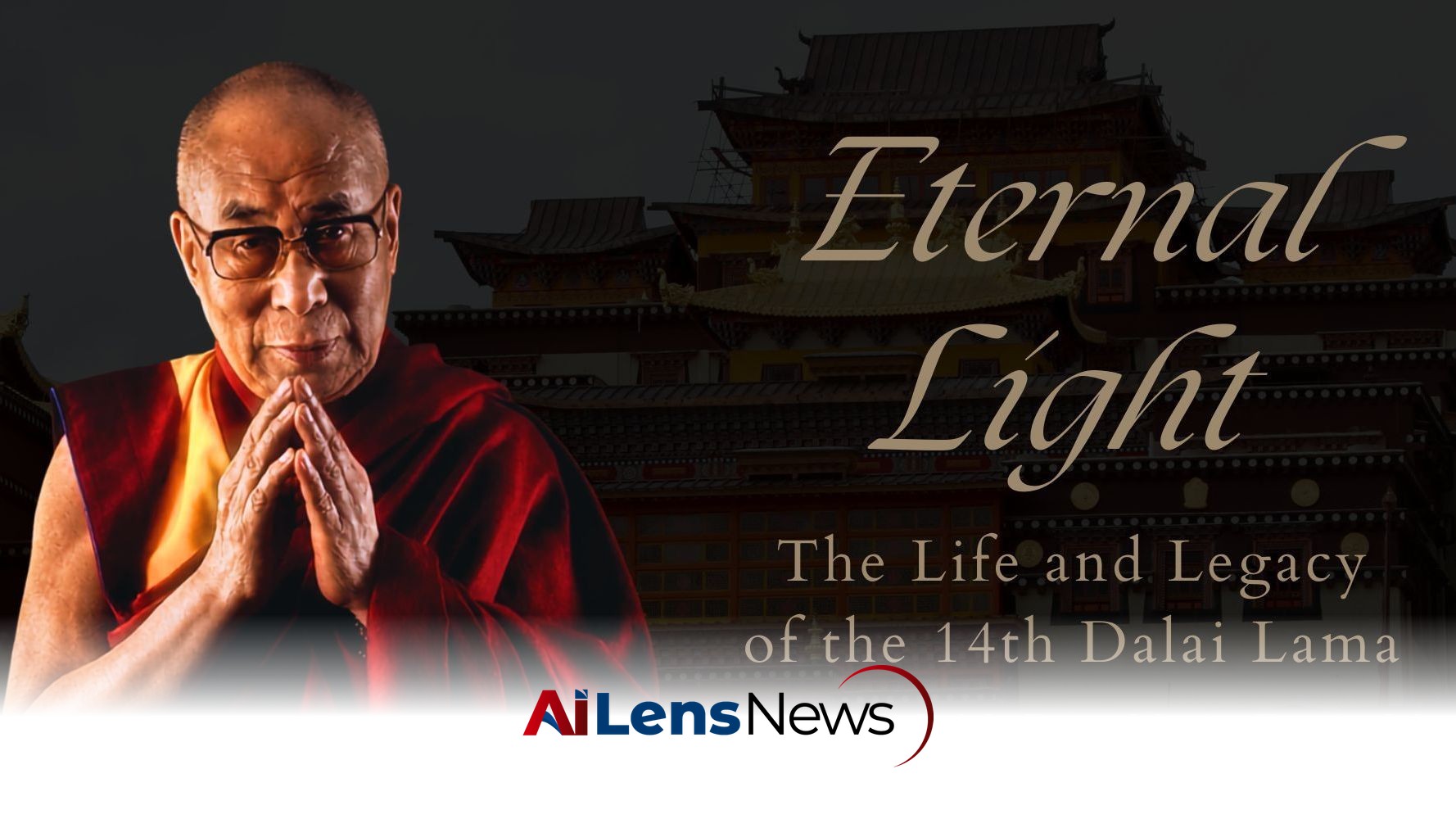


Eternal Light, a new biography by Dr. Arvind Yadav, chronicles the Dalai Lama's journey from his birth in Tibet to his global advocacy.
New Delhi, India Jul 7, 2026 ALN: A new biography titled Eternal Light: The Life and Legacy of the 14th Dalai Lama is set for release on 30 July 2026. This comprehensive work is authored by senior journalist Dr. Arvind Yadav and published by Westland Books. Notably, the biography has been written with the personal blessings of His Holiness the Dalai Lama and will be available in English, Hindi, and Telugu, catering to a diverse readership. Pre-bookings for the book opened on 6 July 2026, coinciding with the spiritual leader's 91st birthday, marking a significant moment in the celebration of his life and teachings.
The Dalai Lama, Tenzin Gyatso, is not only a religious leader but also a symbol of peace and resilience for millions around the world. His life story is intertwined with the history of Tibet, which has faced immense political and cultural challenges over the decades. Several biographical accounts of the Dalai Lama have been published over the years, including his own autobiographical works. However, what distinguishes Eternal Light, according to its publisher, is its focus on historical events that are frequently misunderstood, misreported, or insufficiently documented. This emphasis on accuracy is critical, as the narrative surrounding the Dalai Lama and Tibet often involves complex geopolitical dynamics and cultural nuances.
The biography's earlier Hindi edition, titled Anashwar, was published in November 2025 by Sarv Bhasha Trust, and the English edition from Westland Books is an expanded version of that work. This expansion allows for a deeper exploration of the Dalai Lama's life, philosophy, and the socio-political context in which he has operated, offering readers a more nuanced understanding of his legacy.
The biography traces the Dalai Lama's life from his birth on 6 July 1935 in the village of Taktser in Tibet. The circumstances surrounding his birth are steeped in Tibetan cultural significance. According to the book, his mother, Diki Tsering, went into labor during a storm while tending to her daily chores, and the baby was born silently, without crying—a detail that is often interpreted as an auspicious sign. His older sister, Tsering Dolma, played a crucial role in the traditional Tibetan ritual following his birth, helping to open one of the newborn's eyes and offering him his first nourishment. Shortly after his birth, a neighbor reportedly rushed to inform the family that a rainbow was touching the roof of their house, a phenomenon that many in the community would interpret as an omen of great significance.
The narrative then shifts to pivotal moments in the Dalai Lama's early life, including the formal renaming ceremony on 24 November 1939, his enthronement at the Potala Palace on 22 February 1940, and his assumption of political authority at the remarkably young age of 15. These events are crucial in understanding the responsibilities that were thrust upon him at such a tender age, especially in the face of growing tensions between Tibet and China. The biography delves into the circumstances that led to his exile in 1959, a turning point that would define his life's work and mission.
A significant thread in the Dalai Lama biography is his relationship with India's political leadership, which has been pivotal in shaping the Tibetan exile experience. The book recounts his 1956 meeting with Prime Minister Jawaharlal Nehru during the Buddha Jayanti celebrations, where he expressed his desire to remain in India. Nehru, understanding the complexities of the situation, advised him to return to Tibet and work within the framework of the Seventeen-Point Agreement, which was intended to ensure Tibetan autonomy under Chinese sovereignty. This advice reflects the delicate balance India sought to maintain in its foreign policy towards China and Tibet.
The narrative takes a poignant turn with the assassination of Indira Gandhi in October 1984. At the time, the Dalai Lama was traveling from the United States to London and was deeply shaken by the news, particularly as he had been scheduled to have lunch with her and philosopher J. Krishnamurti that very day. The biography emphasizes his respect for Indira Gandhi as a leader who had shown support for the Tibetan cause. Following her death, he viewed her successor, Rajiv Gandhi, as a leader with a kind heart who would continue India's support for the Tibetan community, illustrating the personal connections that have shaped political alliances.
Dr. Arvind Yadav, a Hyderabad-based journalist and biographer, first met the Dalai Lama in 2002 and shared his idea of writing the biography. According to reports, the spiritual leader responded with encouragement, asking Yadav to include three things in the narrative: his teeth being in excellent condition, his radiant skin without wrinkles, and the child within him. This lighthearted request reflects the Dalai Lama's characteristic humor and humility, traits that have endeared him to followers worldwide.
Minakshi Thakur, publisher and editor at Westland Books, expressed that the book provides fascinating details from the Dalai Lama's childhood while correcting inaccuracies in earlier accounts. The intention behind Eternal Light is not just to document his life but to present a comprehensive portrait that resonates with contemporary issues, including the ongoing struggles for cultural preservation and human rights in Tibet.
With its 30 July release, Eternal Light arrives alongside continued global conversations about Tibet's cultural preservation. The biography also covers the Dalai Lama's Five-Point Peace Plan, presented before the US Congress on 21 September 1987, which called for Tibet to become a zone of non-violence and for negotiations on its future. This plan has been a cornerstone of the Dalai Lama's approach to seeking a peaceful resolution to the Tibetan issue and remains relevant in discussions about autonomy and human rights.
For Indian readers, the book offers a window into seven decades of ties between the Tibetan exile community and India's political establishment. These ties have been characterized by mutual respect and shared values, particularly in the context of non-violence and spiritual leadership. The biography not only serves as a historical account but also as a source of inspiration for those advocating for peace and understanding in a world often marked by conflict.
As pre-orders are now open across all major bookstores, Eternal Light is poised to contribute significantly to the ongoing dialogue surrounding the Dalai Lama's teachings and the broader implications of his life story in contemporary society. The biography promises to be an essential read for anyone interested in understanding the complexities of Tibetan history, the intricacies of international relations, and the enduring power of compassion and non-violence as espoused by the Dalai Lama.
To learn more about the latest developments in Founders' Stories, stay updated with our exclusive reports and analyses on AiLensNews.

