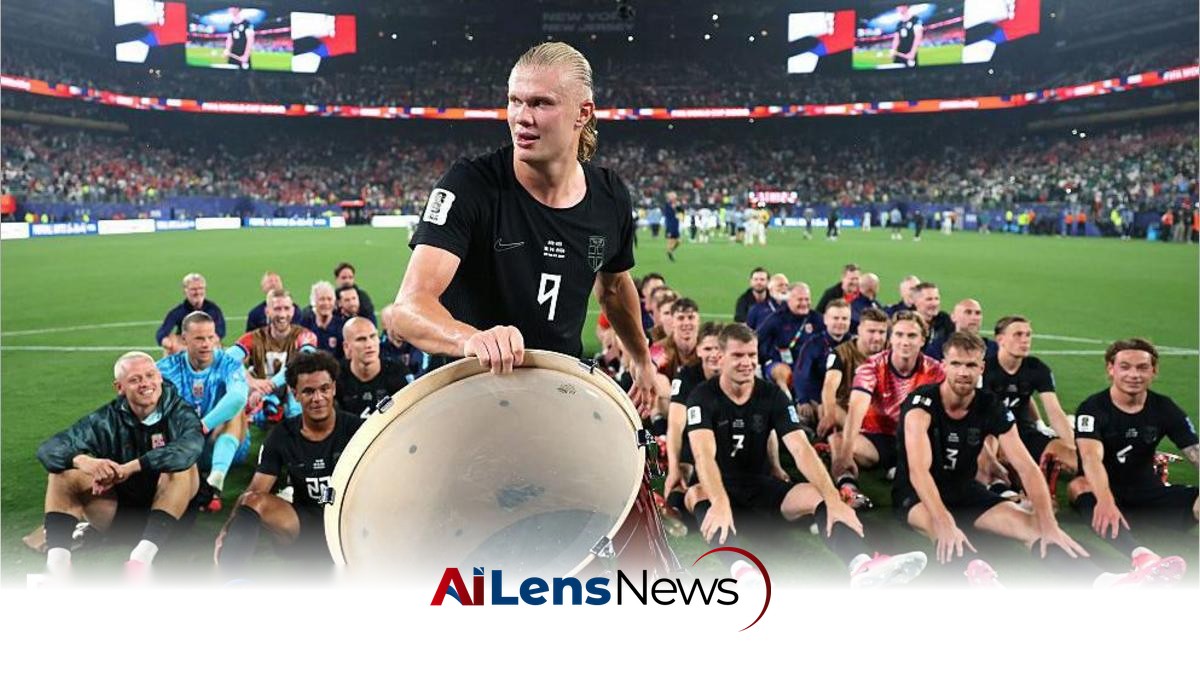


As England faces Norway in the World Cup quarter-finals, memories of a legendary commentary from 1981 resurface, highlighting the intense rivalry.
New Delhi, India Jul 8, 2026 ALN: England and Norway renew a rivalry better known for one famous piece of commentary rather than when they meet in the World Cup quarter-finals in Miami on Saturday.
It was 45 years before Jude Bellingham and Erling Haaland were illuminating the current tournament that a Norwegian by the name of Bjorge Lillelien delivered the speech that has assumed legendary status. This moment in s history is not merely a reflection of a single game but a vivid illustration of how can transcend mere competition to become a cultural touchstone.
Norway, nowhere near the dangerous force they are now in September 1981, had just beaten an England side boasting players of the class of Bryan Robson, Glenn Hoddle, Kevin Keegan, and Trevor Francis 2-1 in a World Cup qualifier. The win was a seismic shock, regarded as a national embarrassment for England and Norway's greatest triumph at Ullevaal Stadium in Oslo. This match not only altered the trajectory of both nations in but also cemented a rivalry characterized by moments of intense emotion and unexpected outcomes.
Lillelien was not going to let the opportunity to pile on the agony for England pass him by as he directed a message aimed at the country's political figures - especially then Prime Minister Margaret Thatcher. The political context of the time added an extra layer to Lillelien's commentary; Thatcher's government was facing criticism on various fronts, and Lillelien's words resonated with a sense of national pride and defiance. He was tapping into a collective sentiment that extended beyond , reflecting Norway's aspirations on the world stage.
A reserved man in private, he warmed up by accusing Polish referee Jerzy Kacprzak of being "close to receiving English citizenship" by playing what he felt was too much added time as Norway protected their lead. This humorous jab at the referee not only showcased Lillelien's wit but also set the stage for the emotional outpouring that followed. When Kacprzak finally blew the whistle, Lillelien was ready to let rip on the airwaves as the main radio commentator for the Norwegian Broadcasting Corporation, known as NRK.
A slightly edited version of his wonderfully excitable commentary is: "Lord Nelson. Lord Beaverbrook. Sir Winston Churchill. Sir Anthony Eden. Clement Atlee. Henry Cooper. Lady Diana. We have beaten all of them." This list of iconic British figures served to amplify the significance of Norway's victory, framing it as a triumph against not just a team, but against a nation steeped in history and tradition.
And then came Lillelien's most famous words. "Maggie Thatcher. Can you hear me? We have a message for you. We have knocked your boys out of the World Cup. Maggie Thatcher. As they say in your language, in the boxing bars around Madison Square Garden New York, your boys took a hell of a beating." The emotional weight of this statement has transcended generations, becoming a rallying cry for Norwegian fans and a source of embarrassment for their English counterparts.
He then repeated for good measure: "Your boys took a hell of a beating." The last line, in particular, has been repeated – and altered to suit the occasion – ever since Lillelien delivered it. It has become a part of the lexicon of commentary, often invoked in discussions about upsets and unexpected victories.
England did, contrary to Lillelien's claim, qualify for the 1982 World Cup in Spain, but no matter. The commentary overshadowed the technicalities of qualification, embedding itself in the cultural memory of both nations. Social media did not exist in 1981. The impact and traction of his commentary, had it happened now, would be mind-boggling. Today, a moment like Lillelien's would likely go viral within minutes, sparking discussions and memes across platforms worldwide.
Lillelien, who was a hugely popular figure, died six years later aged 60, but has been immortalised by those words, which he always insisted were spontaneous, not prepared. His commentary encapsulated the raw emotion of , a reminder that is not just about the game but about the stories and narratives that unfold around it.
The emotional speech has been preserved forever by the wonders of YouTube, helped by Lillelien, fluent in English, switching from his native tongue when he said: "Maggie Thatcher. Can you hear me?" and "your boys took one hell of a beating." This accessibility has allowed new generations to experience the fervor of that moment, keeping Lillelien's legacy alive.
England's defeat was one of the biggest shocks in their history, having won the first qualifier 4-0 at Wembley a year previously. This stark contrast between expectations and reality is a theme that resonates in s, where the underdog can sometimes triumph against all odds. In Norway's moment of triumph, Lillelien's colourful commentary meant those who represented England in that defeat will never be allowed to forget it. The psychological impact of such a loss can linger, affecting the mindset of players and fans alike in future encounters.
Every time England meet Norway, Lillelien will be remembered with affection by everyone except those who still have to suffer those painful recollections. His son Marius, who later became a senior broadcasting executive, told an NRK documentary: "The person we meet in the big radio moments is a man who has built himself up. Like an artist, he prepared himself for a concert. He was a very different man off air." This insight into Lillelien's character reveals the duality often present in public figures, where the persona they project can differ significantly from their private selves.
Former Norway striker Egil Ostenstad, who played in the Premier League for Southampton and Blackburn Rovers, told the Times: "It was Bjorge. This was something that summarised his personality and the way he was as a commentator. I would say he's a very untypical Norwegian. Norwegians in general try to be quite comfortable and not show too much emotion. Maybe that's why he was so popular. He knew how to show emotions and this commentary proves it very well." Lillelien's ability to convey emotion made him a standout figure in a field often dominated by more reserved personalities.
"He is proving that he is a well-read person to put all those things together, which, without being prepared for it, it's a big achievement." Since the start of the Premier League, England has been a popular destination for Norway's best players, with almost 100 Norwegians having played in the league. This influx of talent has not only enriched the English game but has also fostered a sense of camaraderie between the two nations, as players and fans alike celebrate the shared love of .
From Jan Age Fjortoft, Morten Gamst Pedersen, and John Carew to Ole Gunnar Solskjaer, Martin Odegaard, and Haaland, the countries have been closely linked in terms of ing talent for the past 30 years. The exchange of players has created a unique bond, with each nation learning from the other and contributing to the growth of in their respective countries.
England have won one, drawn one, and lost two of four competitive meetings with Norway, and this World Cup has already provided plenty of opportunities for colourful commentary with a succession of superb games. The competitive nature of these encounters adds to the excitement of their meetings, as each side looks to assert its dominance on the pitch.
The men's sides have never met in a major tournament, and Saturday will be the first time they have met for 12 years. This long-awaited encounter is sure to reignite the passion and rivalry that has characterized their historical matchups. The anticipation surrounding this game is palpable, with fans eagerly awaiting the chance to witness a new chapter in this storied rivalry.
The rivalry was renewed in 2015 when England met Norway in the last 16 of the Women's World Cup in Canada. This crossover into women's highlights the broader implications of the rivalry, as it extends beyond just the men's game. Norwegian newspaper VG even asked if Mark Sampson's team were "ready for a hell of a beating" in Ottawa. England won 2-1, but the playful banter served to underscore the enduring nature of the rivalry.
Whether anyone can conjure words to match, or be as long-lasting and memorable, as Bjorge Lillelien's remain to be seen, but there is every chance they will get a mention amid the action in Miami. As the two teams prepare to face off, the legacy of Lillelien's commentary looms large, reminding us all of the power of to evoke emotion and create unforgettable moments.
The friendly rivalry will certainly be put to one side for 90 minutes, as both teams will be aiming for victory, but the echoes of history and the weight of past encounters will undoubtedly influence the atmosphere surrounding the match. Fans from both sides will gather, united by their love for , yet divided by their loyalties, creating an electric atmosphere that is sure to resonate well beyond the final whistle.
To learn more about the latest developments in Football (Soccer), stay updated with our exclusive reports and analyses on AiLensNews.

