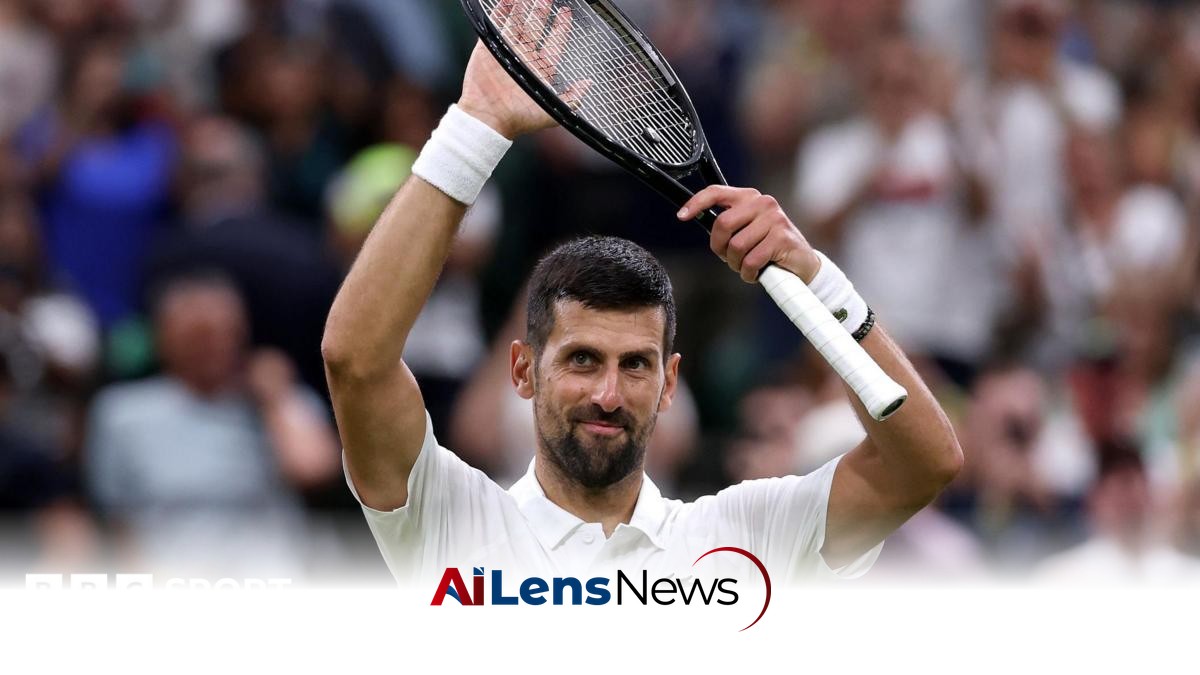


Novak Djokovic outclasses Stefanos Tsitsipas in a statement performance to reach the Wimbledon third round.
New Delhi, India Jul 2, 2026 ALN: Novak Djokovic outclassed Stefanos Tsitsipas in a statement performance to reach the Wimbledon third round, after Jannik Sinner came through a tricky encounter with Nuno Borges to continue his title defence.
The 39-year-old Djokovic maintained his pursuit of history at Wimbledon - where he is seeking a record-equalling eighth triumph and an outright record 25th major title - by beating Tsitsipas 6-3 6-4 6-2 in 98 minutes. This victory not only solidifies Djokovic's status as one of the greatest players in tennis history but also highlights his remarkable consistency and ability to perform at the highest level, even as he ages. Djokovic's career has been marked by numerous records, including being the only male player to win all four Grand Slam titles at least twice, and he continues to add to his legacy with each passing tournament.
Djokovic was operating at his clinical best on Centre Court, where he was watched by Masters champion Rory McIlroy and supported in his box by actor Ben Stiller. The presence of such high-profile figures in the audience underscores Djokovic's status not only as a ing icon but also as a cultural figure. His performances often attract celebrities and s stars, further enhancing the spectacle of the event.
His performance peaked in a second set where he won 100% of points behind his first serve and made just one unforced error. This level of play demonstrates Djokovic's incredible focus and skill, particularly under the pressure of a Grand Slam match. Winning all points on serve in a set is a rare feat, showcasing his dominance and precision. The ability to minimize errors is crucial in high-stakes matches, and Djokovic’s performance exemplified this principle.
"I like the terminology 'vintage', it is nice because it brings back the best days," Djokovic told the crowd after setting up a meeting with French 25th seed Arthur Rinderknech. This statement reflects Djokovic's deep appreciation for his craft and the moments that have defined his career. He has often spoken about the importance of enjoying the journey, and this sentiment resonates with many fans who have followed his career over the years.
Former British number one Tim Henman described it as "Djokovic in full flow." Henman’s analysis points to the fact that Djokovic's performance was not just effective but also aesthetically pleasing, characterized by fluid movement and strategic shot-making. "Tsitsipas isn't in the best form or in the best place in his career, but the way Djokovic just absolutely dismantled him was incredibly impressive," he said on BBC TV. Henman's comments also highlight the challenges Tsitsipas has faced recently, as he has struggled with injuries and form, which have impacted his ranking and performance on the court.
World number one Sinner, taken to five sets by an inspired Miomir Kecmanovic in his opening match, patiently ground out a 7-6 (7-4) 7-6 (7-2) 6-4 win against Borges on his return to Centre Court two days later. Sinner, who is seen as one of the rising stars of men's tennis, has garnered attention for his aggressive playing style and powerful groundstrokes. His ability to win under pressure, especially after a grueling first match, speaks volumes about his mental toughness and potential for future success.
Ranked 48th in the world, Portugal's Borges thrilled the crowd and was the better player at times against Sinner, who upped his level when it mattered before charging through the third set to seal his ninth straight win at the All England Club. Borges's performance illustrates the unpredictable nature of tennis, where lower-ranked players can challenge higher-ranked opponents, especially on a prestigious stage like Wimbledon. This unpredictability is part of what makes tennis so compelling, as it allows for potential upsets and thrilling matches.
Sinner will face American Jenson Brooksby, the world number 81, next. Brooksby, known for his unconventional style and strategic gameplay, will present a different challenge for Sinner. This upcoming match will test Sinner's adaptability and ability to maintain focus as he progresses deeper into the tournament.
Djokovic said that he was "happy but not the freshest" after needing more than three hours to defeat Wu Yibing in his first match of the season on grass on Monday. This acknowledgment of fatigue is a reminder of the physical demands of professional tennis, especially during Grand Slam events where players often face multiple matches in a short timeframe. Djokovic's ability to recover and perform at a high level despite these challenges is a testament to his training regimen and mental fortitude.
The Serb's meeting with Tsitsipas, a top-10 player for most of the past decade but ranked 87th following injury struggles, had the air of a contest which belonged deeper in the tournament as the Greek showed glimpses of his ability - including bending a stunning forehand winner around the net post. This moment of brilliance from Tsitsipas serves as a reminder of his potential and talent, even as he navigates a challenging period in his career. The contrast between Djokovic's current form and Tsitsipas's struggles highlights the unpredictable nature of s, where peaks and valleys can occur within a player's career.
But, as relaxed as anyone on the biggest stages, Djokovic even found time to prank a ball kid during the interval before the third set, pretending she had hurt him while cutting some string off his top, before storming to victory. This lighthearted moment showcases Djokovic's personality and ability to engage with fans, which contributes to his popularity both on and off the court. His sense of humor and approachability have endeared him to many, making him a fan favorite despite the intense competition.
He also joked after the match that he wanted to challenge McIlroy to a tennis match - with the winner taking the Masters green blazer that he wore in the Royal Box. This playful banter reflects Djokovic's competitive spirit and willingness to engage in friendly rivalry with other athletes, further blurring the lines between s and entertainment.
Djokovic started well on serve but, after forcing the breakthrough, had to withstand three break points from 0-40 down to consolidate his advantage. The ability to navigate such pressure situations is critical in tennis, where momentum can shift rapidly. Djokovic’s experience and composure under pressure were evident as he managed to maintain his lead and control the match.
Normal service resumed thereafter, with Djokovic producing just seven unforced errors in a display which once again asserted him as one of the title favorites. His ability to minimize errors is a hallmark of his playing style, and it often gives him a significant edge over opponents who may be less consistent. Djokovic’s performance not only reinforces his status as a title contender but also raises questions about who can effectively challenge him in the tournament.
"I'm feeling great. I try not to take these moments for granted when playing on the Centre Court of Wimbledon," Djokovic said. This sentiment reflects the deep appreciation that many athletes have for the venues and tournaments that have defined their careers. Wimbledon, with its rich history and tradition, holds a special place in the hearts of many players, and Djokovic's acknowledgment of this adds to the narrative of his journey.
"It was the childhood dream tournament. I feel very privileged to be walking out on this court at age 30-plus. I don't think it's a cliché because I actually believe it is true, but age is just a number." This perspective on age and performance is particularly relevant in s, where athletes often face scrutiny regarding their longevity and ability to compete at an elite level. Djokovic's success at an older age challenges conventional notions about athletic prime and longevity in professional s.
Sinner opted against contesting a grass tournament in the lead-up to Wimbledon, despite suffering a seismic second-round loss at the French Open at the end of May. This decision reflects a strategic approach to his preparation, as players often weigh the benefits of competing in lead-up events against the need for rest and recovery. Sinner's choice to focus on Wimbledon directly speaks to his confidence in his abilities and his desire to perform well on the grass courts.
When he squeezed past the 50th-ranked Kecmanovic in a match where he lacked sharpness and struggled physically, it felt like the decision could come back to haunt him. This match served as a wake-up call for Sinner, highlighting the need for focus and physical readiness, especially in a Grand Slam setting.
While still not quite at his metronomic best against Borges, striking 29 unforced errors, this was an improvement on his performance against Kecmanovic. The ability to learn and adapt from previous matches is crucial for success in tennis, and Sinner's progression demonstrates his resilience and determination to improve.
In a tight opening first set, Borges impressed with a mix of hard hitting and delicate drop shots, but he faded towards the back end of the tie-break and Sinner asserted control. This dynamic showcases the importance of mental fortitude in tennis, as players must maintain their focus and composure throughout the match. Sinner's ability to capitalize on Borges's errors reflects his growing maturity as a player.
Sinner did not face a single break point in the opener, but the briefest of blips allowed Borges to take a break lead early in the second set. This momentary lapse is a reminder of how quickly fortunes can change in tennis, and Sinner’s ability to recover from this setback speaks to his competitive spirit.
However, when he tried to serve it out and level the tie, the 29-year-old tightened up, missed a set point, and gifted Sinner the break back with another unforced error. This moment illustrates the pressure of serving in critical moments, where the weight of expectation can lead to mistakes. Sinner's resilience in capitalizing on these opportunities is a key component of his success.
More misses cost him in the resulting tie-break as Sinner charged through, and the four-time major winner recovered from a poor opening service game in the third set to seal victory after two hours and 32 minutes. This victory not only advances Sinner in the tournament but also serves as a confidence boost as he continues his title defense. The combination of mental toughness, strategic gameplay, and the ability to adapt under pressure are essential traits for any player aiming for success at Wimbledon.
To learn more about the latest developments in Tennis, stay updated with our exclusive reports and analyses on AiLensNews.

