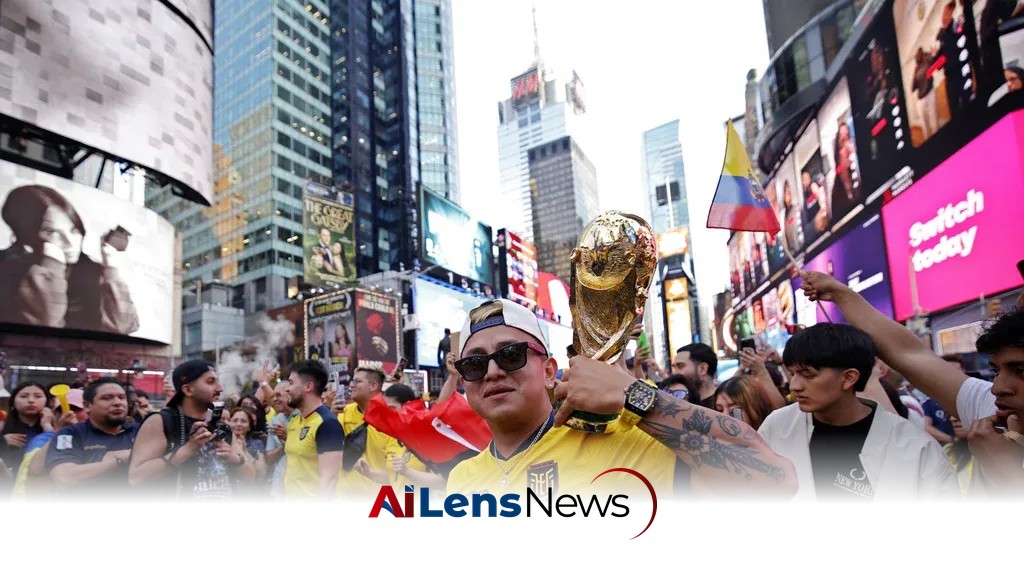


Times Square has become a vibrant hub for World Cup fans, showcasing unity and celebration amidst the tournament's excitement.
Washington DC, United States Jul 16, 2026 ALN: On a recent Sunday afternoon, the usual motley crew convened beneath the glowing billboards of Times Square. Costumed King Kong, Spiderman, and Minnie Mouse performers beckoning tourists for photos; snake guys assuring curious passersby that the reptiles draped on their shoulders really are harmless; and a group of buskers announcing showtime. But there was one big difference from most days: all the soccer jerseys.
Since the World Cup began, Times Square has become one big, unofficial fan zone. Bogdan Zhukovskyi, an artist who has sold his paintings from Times Square for 15 years, tells me the groups resemble “a ship coming through the sea” because “they’re all wearing the same clothing and same colors.” This vibrant display of national pride is emblematic of the World Cup's ability to unite fans from diverse backgrounds, creating a shared experience that transcends language and culture.
The day I visited, the pedestrian plaza at 46th Street and 7th Avenue was bright yellow ahead of Brazil’s match with Norway at MetLife Stadium, thanks to hundreds of people wearing Neymar, Vini Jr., and the odd Ronaldo jerseys. A couple of weeks before, the TKTS steps at the top of the plaza were completely packed with Norway fans dressed in red doing their synchronized row. And ahead of that, a throng of Colombia supporters in yellow, red, and blue unfurled a massive flag and passed it around like a crowd surfer. Such scenes illustrate not only the passion for soccer but also the communal spirit that the World Cup fosters, as fans come together to celebrate their teams in a shared space.
“There’s always something going on,” says Milenny Guimaraes, who had a Brazil flag wrapped around her shoulders and traveled from Boston for the weekend to watch the game in Times Square. “It’s alive here.” This sentiment resonates with many who find themselves swept up in the energy of the crowd, where the anticipation of a game can turn strangers into friends in an instant. The atmosphere is electric, with chants, songs, and cheers echoing off the towering buildings, creating a cacophony that is both chaotic and exhilarating.
That Times Square has become this beacon for the World Cup is sort of obvious—it is a tourist destination, after all—but the way it has welcomed everyone for sustained celebration and camaraderie, and become the beating heart of the tournament as a result, is much more unexpected. This transformation into a global fan zone reflects a broader trend in urban spaces where public life is prioritized, allowing for spontaneous gatherings and celebrations of culture.
It’s the result of a pretty radical idea: that people should be prioritized in one of the busiest intersections in the city. This year also marks the 10th anniversary of the completion of its pedestrianization. When cities make space for public life, it thrives. The pedestrianization of Times Square has not only made it safer for pedestrians but has also encouraged social interactions, turning the area into a vibrant hub for events and gatherings. The World Cup has merely highlighted the potential of such spaces to bring people together.
At the top of the TKTS steps, I met Edgar Manica, who was wearing a Mexico jersey and visiting from San Francisco. “I’m just looking for the vibe,” he tells me. “I want to see how people cheer for their teams.” As we were speaking, Pedro Cabas, 14, from Brazil, scrambled up the steps and asked for a selfie with Manica. “I’m taking photos with everyone with different countries on.” He had just posed for a shot with an Argentina fan. Such interactions underscore the festival-like atmosphere that the World Cup creates, where fans not only celebrate their own teams but also engage with supporters of rival nations in a spirit of friendly competition.
Marcel Coelho booked a spontaneous trip to New York after learning that Brazil made it to the Round of 16. He picked a hotel a block away from Times Square after seeing so many social media videos of fellow Canarinho fans gathering there and planned to watch the game from the Hard Rock Cafe. (Tickets to the live game were too expensive.) “Seeing a lot of Brazilians here and singing—it’s so fun,” he tells me. “It’s already worth everything just to see this.” This highlights how the World Cup serves not only as a sporting event but also as an opportunity for fans to connect with their heritage and share their culture with others, reinforcing a sense of community among expatriates and travelers alike.
Some of the stunts have surprised some Times Square workers (and knowing what they see on a daily basis, that’s quite a feat). Sydney C., who has been employed in the area for a year, was astonished when she saw Norway fans sitting on the ground to prepare for their row. “It’s like, ‘Oh, y’all are going to take home a disease—don’t do that!” she tells me. “But seeing the videos of it is actually really cool.” This reaction is indicative of the unique atmosphere that the World Cup brings to urban environments, where the unexpected becomes commonplace, and the mundane is transformed into a spectacle of joy and celebration.
The scene has felt practically utopian, particularly amid tense geopolitical times: Friendly fans from all around the world displaying their respective allegiances and ultimately uniting in the name of soccer. Perhaps this is why Times Square was electric when the Great American State Fair—which depicted a nativist and insular vision of the U.S.—floundered. The contrast between the inclusive, multicultural celebration of the World Cup and the divisive narratives often found in contemporary discourse highlights the power of sports to bridge divides and foster understanding among diverse groups.
A few minutes before kickoff, I found a bar to watch the match, then returned to the scene after Brazil’s loss to Norway. “The Norway fans must still be celebrating in New Jersey,” I overheard someone say as I arrived. Just then, a crowd of Mexico fans appeared through the steam wafting from a row of halal carts—an emerald ship, to borrow Zhukovskyi’s term, thanks to their green jerseys—some spinning wood matracas, some wearing lucha libre costumes, and many waving flags. This lively display of enthusiasm is a testament to the cultural significance of soccer in many countries, where the sport is not just a game but an integral part of national identity and pride.
As it turned out, Dr. Simi—a pharmacy chain mascot who has also become a soccer icon—had announced a special appearance at Times Square. The elated crowd around him jumped in unison. Janelle Luna and her family traveled from Long Island to see him (and to watch the match against England at a public Hudson Yards viewing party after). I asked her what she thought of the energy here. “It’s awesome,” she tells me. “Once every four years, it’s great that there’s a bunch of Mexicans here and we get together.” This sentiment encapsulates the essence of the World Cup experience in Times Square, where fans from different nations come together to celebrate not only their teams but also the shared love of the sport, creating a sense of belonging that transcends borders.
To learn more about the latest developments in Football (Soccer), stay updated with our exclusive reports and analyses on AiLensNews.

