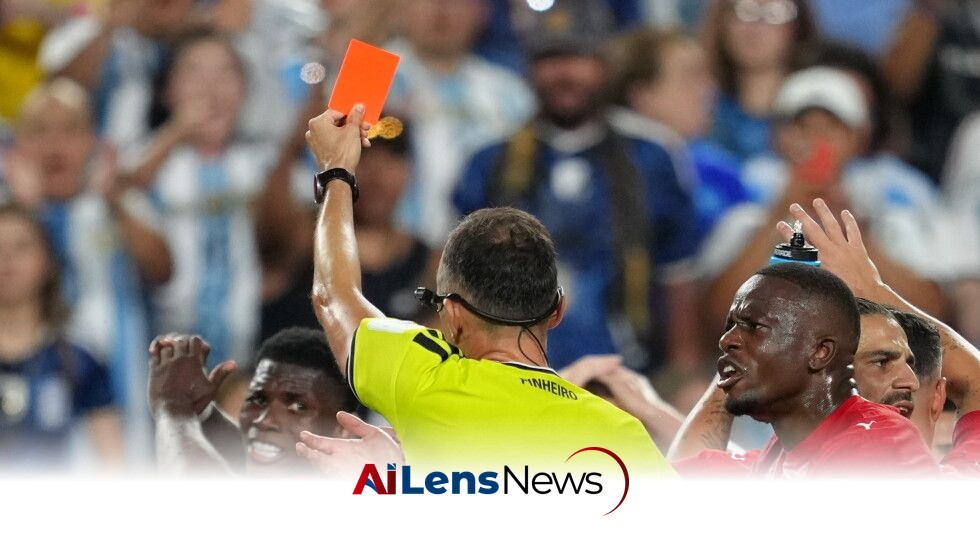


Switzerland's Breel Embolo received a contentious red card during the World Cup quarterfinal against Argentina, leading to a 3-1 defeat and criticism of officiating.
Washington DC, United States Jul 13, 2026 ALN: KANSAS CITY, Mo. — Switzerland forward Breel Embolo was sent off in the second half of its World Cup quarterfinal loss to Argentina on Saturday night, a controversial decision following a video review that is certain to fuel those who believe referees have been biased toward the reigning champion throughout the tournament.
The incident occurred in a high-stakes match where emotions were running high, and both teams were vying for a place in the semifinals. The match had already seen its share of tension and competitive spirit, with both sides showcasing their skills and strategies. Dan Ndoye had just tied the game at 1-all in the 67th minute when Argentina’s Leandro Paredes was shown a yellow card following a tackle on Embolo. However, video evidence revealed that the Swiss player was falling before Paredes made contact, leading to Embolo receiving a yellow card under the “mistaken identity” protocol being utilized at the World Cup.
This protocol, which allows for video assistant referees (VAR) to correct clear errors in officiating, has been a topic of debate since its implementation. Critics argue that it can disrupt the flow of the game and lead to controversial decisions, as seen in this instance. Having already received a yellow card earlier in the match, Embolo was sent off, leaving Switzerland to play with 10 men for the remainder of the match. This numerical disadvantage shifted the dynamics of the game, putting additional pressure on the Swiss players.
Despite their numerical disadvantage, Switzerland managed to push the game into extra time, demonstrating resilience and determination. The team fought to maintain their composure and strategy, hoping to survive to a shootout. Unfortunately, Julián Alvarez scored from long range in the 112th minute, followed by another goal from Lautaro Martínez shortly after, sealing a 3-1 victory for Argentina. The defeat was particularly frustrating for the Swiss team, who had fought hard to reach the quarterfinals and were left to ponder what might have been without the controversial red card.
“We were punished because of a rule that in my opinion is completely unacceptable,” Swiss coach Murat Yakin stated. “It’s very painful that we were eliminated that way. I don’t think we deserve that today, and in my opinion, my boys are the real heroes. They put all their heart and their passion into their performance. I am very proud. They are very proud.” Yakin's comments reflect a broader sentiment among teams that feel they have been adversely affected by officiating decisions during the tournament.
Yakin continued to express his dissatisfaction with the officiating, particularly criticizing Portuguese referee João Pinheiro. “The referee made the wrong decision,” Yakin said. “It was in my opinion a harmless foul, if it even was a foul. I know they will protect their referee but this rule destroyed our game today, and it’s very painful, and to be eliminated in that way hurts a lot.” Such statements highlight the emotional toll that officiating decisions can have on players and coaches, especially in high-stakes matches like the World Cup.
Argentina coach Lionel Scaloni acknowledged that “luck was on our side because one of their players was sent off.” This statement underscores the thin margins that often define outcomes in elite football matches. Scaloni's comments also reflect a common perspective in competitive sports, where teams often recognize the role of chance and officiating in determining the final result.
This incident marked the second time a yellow card was overturned using the “mistaken identity” protocol at the World Cup, a relatively obscure rule that allows the video assistant referee to intervene when an incorrect player is shown a yellow or red card. The rule aims to ensure fairness in officiating but has also led to contentious moments that can overshadow the sporting event itself. The implementation of such rules has sparked discussions about the effectiveness and reliability of VAR technology in enhancing the game.
“I think the red card changed our game,” Swiss captain Granit Xhaka said. “This decision was difficult to accept now after the game because the dressing room was very quiet, disappointed.” Xhaka's reflections capture the somber mood within the Swiss camp as they processed the loss. The emotional impact of such decisions can linger long after the final whistle, affecting players' morale and team dynamics.
Earlier this week, the Egyptian Football Association expressed its concerns over biased officiating after its own controversial loss to Argentina in the Round of 16, where they felt the refereeing played a significant role in the outcome. This situation highlights a growing narrative among teams from various nations that have faced similar challenges during the tournament. With the World Cup being the pinnacle of international football, the stakes are incredibly high, and teams are increasingly vocal about perceived injustices.
As the tournament progresses, the discourse surrounding officiating and the use of VAR technology is likely to intensify. Fans, players, and analysts alike will be watching closely to see how these issues are addressed by FIFA and the tournament organizers. The outcome of matches can hinge on a single decision, and as such, the pressure on referees and their assistants is immense. The controversy surrounding Embolo's red card serves as a reminder of the complexities of modern football and the ongoing evolution of the rules that govern the game.
The implications of this incident extend beyond Switzerland's immediate exit from the tournament. It raises questions about the consistency and fairness of officiating at the highest levels of football, particularly in a competition as prestigious as the World Cup. Teams invest significant resources into preparation, training, and strategy, and the stakes are high for players and coaches alike. When a match can be decided by a controversial decision, it can lead to broader discussions about the integrity of the sport.
Moreover, the use of VAR technology, while intended to enhance the accuracy of officiating, has not been without its challenges. The reliance on video reviews can lead to delays in the game, impacting the flow and rhythm that players and fans expect. Critics argue that while the technology has the potential to correct clear errors, it can also introduce new forms of controversy, as the interpretation of incidents can vary from one referee to another. This inconsistency can lead to frustration among players and supporters who seek clarity and fairness in officiating.
In the wake of the incident, discussions about the future of VAR and the protocols surrounding it are likely to gain momentum. Stakeholders within the sport, including players, coaches, and governing bodies, may advocate for clearer guidelines on how VAR should be implemented and how referees are trained to utilize the technology effectively. The goal would be to minimize the potential for contentious decisions that overshadow the competition's spirit.
As the tournament continues, the Swiss team's experience serves as a cautionary tale about the unpredictable nature of football and the role of officiating in shaping outcomes. Fans and analysts will undoubtedly continue to debate the merits of the red card issued to Embolo, and whether the rules governing officiating need to be revisited in light of such incidents. The emotional fallout from this match will likely resonate with the Swiss players and coaching staff for some time, as they reflect on what could have been had the circumstances been different.
In conclusion, while Switzerland's exit from the World Cup was marked by a controversial red card, it also brought to light broader discussions about officiating standards and the impact of technology in sports. As teams continue to navigate the challenges of high-stakes competition, the quest for fairness and clarity in officiating remains a central theme in the ongoing narrative of the tournament. The events surrounding Embolo's red card will likely contribute to ongoing debates about the future of officiating in football, ensuring that the conversation surrounding fairness and integrity remains at the forefront of the sport.
To learn more about the latest developments in Football (Soccer), stay updated with our exclusive reports and analyses on AiLensNews.

