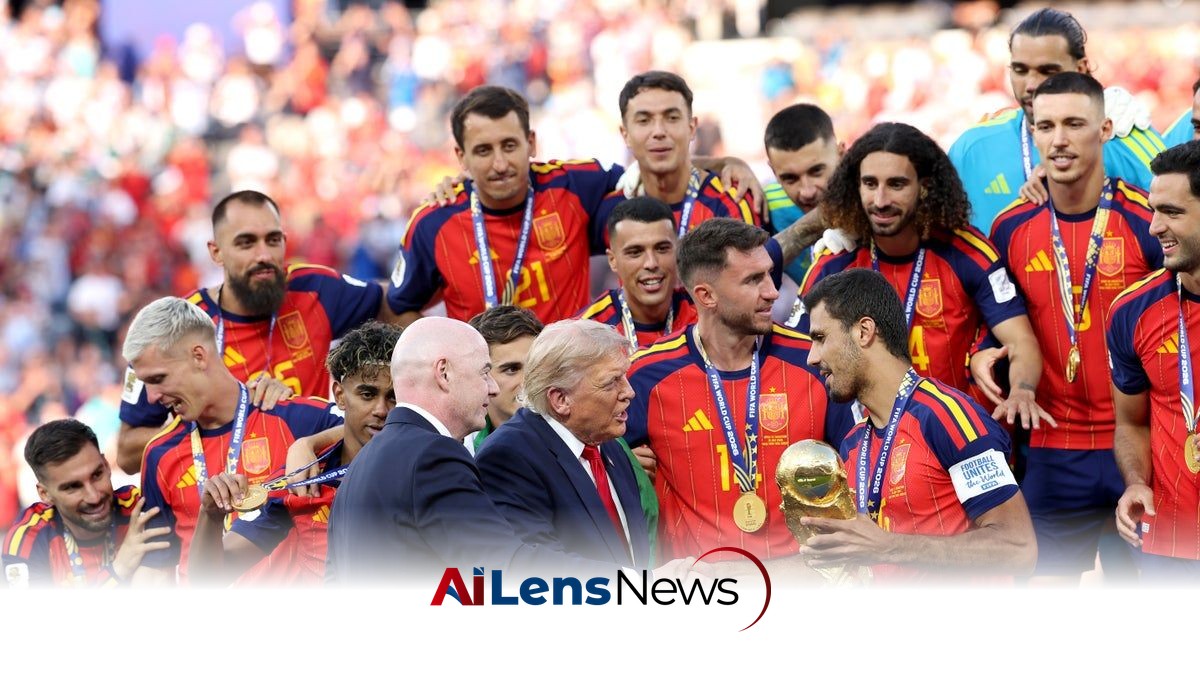


Donald Trump was met with jeers and boos as he presented the World Cup trophy to Spain after their victory over Argentina at MetLife Stadium.
London, United Kingdom Jul 20, 2026 ALN: Donald Trump, the former President of the United States, faced significant backlash during a high-profile event as he presented the World Cup trophy to Spain following their victory over Argentina in the final of the 2026 FIFA World Cup. The match, held at MetLife Stadium in New Jersey, concluded with a score of 1-0, marking Spain's second World Cup win in its history. The event not only showcased the athletic prowess of the teams but also highlighted the political climate surrounding Trump's appearances at public events.
The atmosphere in the stadium was electric, filled with anticipation as fans gathered to witness what was touted as one of the most significant matches in recent football history. Trump attended the game alongside FIFA President Gianni Infantino, both of whom were seated in a secure area behind bullet-proof glass, indicative of the heightened security measures often associated with Trump's public appearances. Accompanying him were First Lady Melania Trump and their son, Barron Trump, who were also present to experience the excitement of the World Cup final.
Despite the festive nature of the occasion, Trump's presence was met with loud boos and jeers from the crowd as he stepped onto the pitch to present the trophy. This negative reaction can be interpreted as a reflection of Trump's polarizing political legacy, which has continued to evoke strong emotions among the public long after his presidency. The boos were not just isolated incidents; they were part of a larger trend observed during various public appearances made by Trump since leaving office, where he often encounters mixed reactions from the public.
Following the match, Trump participated in the FIFA trophy presentation ceremony, a role he had also played in the previous year when Chelsea won the FIFA Club World Cup at the same venue. In that instance, he joined Reece James in celebrating Chelsea's victory over Paris Saint-Germain. However, this time, the dynamics were notably different. After presenting the trophy to Spain's captain Rodri, Trump positioned himself strategically at the edge of the group for the initial lift of the trophy, seemingly aiming to ensure his inclusion in the celebratory photographs. This maneuver did not go unnoticed, as Infantino appeared to subtly attempt to guide Trump away from the spotlight, indicating a desire to maintain the focus on the players and the celebration rather than on the former president.
The reaction to Trump's presence during the trophy presentation was overwhelmingly negative, with the audible discontent from the crowd rising to levels that could be measured at approximately 84 decibels, compared to the ambient noise of 78 decibels. This stark contrast showcases the extent of the crowd's disapproval and highlights the challenges Trump faces in re-establishing his public image, particularly in contexts that are meant to be celebratory.
During the presentation ceremony, Trump handed out medals to the officials and players, a customary part of the event. However, the focus quickly shifted back to the match itself, which had been a tense and hard-fought battle. Spain's triumph came after a grueling extra time, with Ferran Torres scoring the decisive goal in the 106th minute. This goal was a result of a well-executed play initiated by Nico Williams, showcasing Spain's tactical prowess and resilience under pressure.
Argentina's performance was marred by disciplinary issues, as they were reduced to ten men following a red card issued to Enzo Fernandez. The situation escalated further at full time when Leandro Paredes received a red card for an altercation with Eric Garcia, which reportedly involved physical confrontations. Such incidents not only overshadowed the match's competitive spirit but also highlighted the intense emotions often associated with high-stakes games like the World Cup final.
The implications of Trump's appearance at such a significant sporting event extend beyond the immediate reactions of the crowd. His presence at the World Cup final serves as a reminder of the intersection between sports and politics, a phenomenon that has become increasingly pronounced in recent years. As sports events often act as platforms for political expression, the reactions Trump faced may reflect broader societal sentiments regarding his presidency, policies, and ongoing influence within the Republican Party.
In the context of the World Cup, a global event that unites fans from diverse backgrounds and cultures, Trump's booing may signify a rejection of his divisive political rhetoric, particularly in a sport that is celebrated for its ability to bring people together. The event also raises questions about the role of public figures in sports and the expectations placed upon them, especially when their political affiliations and actions have polarized public opinion.
The World Cup itself has a rich history of intertwining with political narratives. From the 1934 tournament in Italy, which was used by Mussolini to showcase fascism, to the 1978 World Cup in Argentina, which was overshadowed by the military dictatorship's human rights abuses, football has often been a reflection of the political climate of the times. Trump's appearance at this year's final serves to remind us that sports can be a microcosm of society, where political and social issues often bubble to the surface.
Moreover, Trump's booing at the World Cup final illustrates the ongoing divisiveness in American society, particularly in the wake of his presidency. Many Americans remain deeply divided over his policies and the events that transpired during his time in office, including the handling of issues such as immigration, race relations, and the COVID-19 pandemic. The reactions he receives at public events can serve as a barometer for his standing within the public consciousness and the Republican Party, as he continues to wield significant influence over its direction.
As the dust settles on the 2026 World Cup final, it is clear that Trump's involvement will be remembered not just for the trophy presentation, but for the stark reminder of the complex relationship between sports, politics, and public sentiment. The event encapsulates the challenges faced by political figures in navigating public spaces and the enduring impact of their legacies on contemporary society. As the world of sports continues to evolve, the intersection of politics and athletics will likely remain a focal point of discussion, shaping the way audiences engage with both realms.
To learn more about the latest developments in Basketball, stay updated with our exclusive reports and analyses on AiLensNews.

