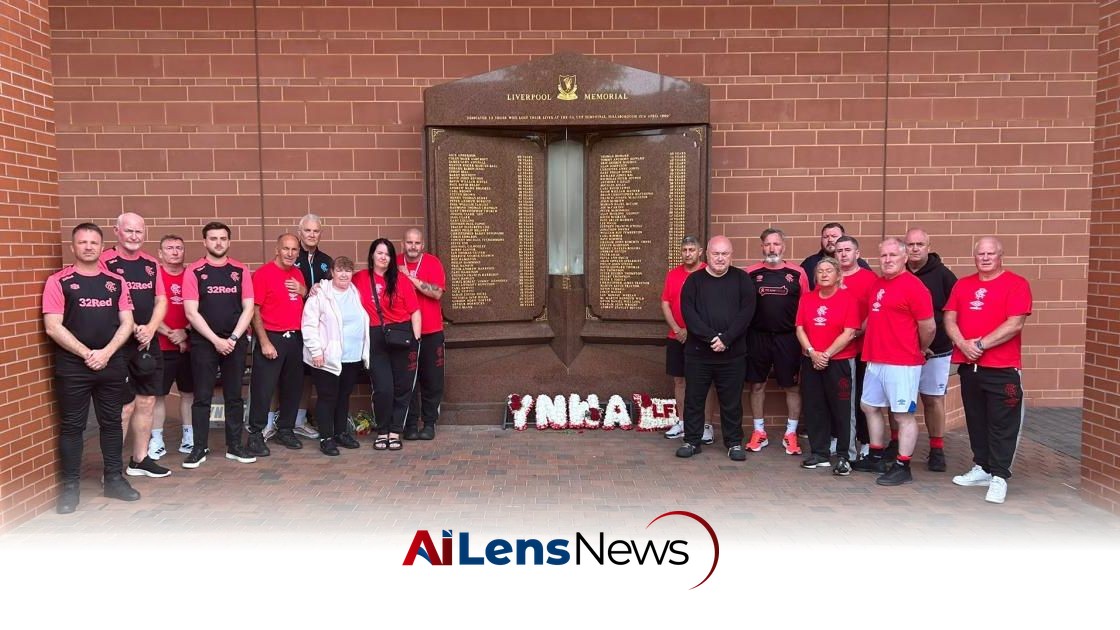


Graeme McGarry reflects on a poignant event in Liverpool aimed at combating tragedy chanting in football, highlighting the emotional toll on victims' families.
London, United Kingdom Jul 12, 2026 ALN: Football, undoubtedly, can often bring out the worst in people. But it can also bring out their best. And nowhere is this illustrated more clearly than when grappling with the issue of tragedy chanting.
It is 4.20am on a Sunday morning when I arrive at the imposing main doors to Ibrox, driving past the stragglers finally heading home from the pubs and clubs of Govan. The bus laid on by Rangers, taking their Charity Foundation's walking footballers south to Liverpool for a tournament bringing together clubs who have been beset by their own individual tragedies, is set to leave in 10 minutes. I’m the last to arrive.
The full team, proudly decked out in their official training gear, their coach Harry McLaughlin, representatives from the Rangers Fan Advisory Board, the Rangers Supporters Association, club legend and ambassador John Brown and Annette McLeish, whose beloved Aunt, Margaret Ferguson, was the sole female victim of the Ibrox Disaster, look to have already been here for some time.
Clearly, for all involved, this is an important day. For one, the Rangers walking football side are the defending champions, having lifted the trophy at the inaugural ‘Unity is Strength’ event 12 months prior.
More importantly, though, this day - hosted by the Liverpool FC Foundation and the Hillsborough Survivors Supporters Alliance at Liverpool’s training centre - is an opportunity to highlight an issue that has cast a dark shadow over football’s terraces for some time. A shadow that in recent years, has only seemed to lengthen.
While any club that has lost supporters in such circumstances carries the scar forever, when instances of tragedy chanting occur, it is those families left behind who feel the salt being rubbed in the wound most deeply.
So it was for Annette when Celtic fan Darren Malloch was caught on camera mocking the 66 victims of the Ibrox disaster at an Old Firm match last season. And so it is for her and all of those who lost loved ones in such harrowing, unexpected circumstances whenever someone weaponizes their grief in a ghoulish attempt to score points against their rivals.
“It hurts so much,” she said. “All you can think is, ‘Why won’t you let my auntie rest in peace?’ Surely, she deserves that. Their families get to rest in peace, why does my family not?
“I've fought so hard to try not to let it bother me but each time it just gets harder and harder. I think it’s because I'm getting older now and I understand more, but you would think it would get easier, and it just doesn’t. It still doesn't get any better. It’s not fair.
“People like the Mallochs of the world, they don’t open Facebook or social media and see their families getting disrespected and slandered and harassed on it. Why do people think it’s acceptable to do that to my family?
"It has gotten worse since social media came along. You’re dreading it all the time now. It dies down every now and then and it can go quiet, and then all of a sudden there is a spate of it. You get back on an even keel and then it’s like someone kicks the legs from you and you're flat on your back on the floor again."
Such incidents are all the more painful for Annette given that she is a lifelong Celtic supporter and former season ticket holder herself. But what was particularly jarring for the outside world when images of Malloch were published in the press was that a child was alongside him as he openly mocked the dead.
It is such callousness that strengthens Annette’s resolve to not only use events such as this one in Liverpool to push back against such behaviour, but also to use the platform it provides to humanize the victims once more, and serve a reminder that these loved ones are not just statistics from a bygone catastrophe, but real people whose lives were tragically cut short through no fault of their own.
"Margaret was only 18,” she said. “She was feisty. She loved a laugh and a carry on. She was the youngest and she got away with everything as well!
"She adored Colin Stein, and had been up to his house with a teddy she had made for his new-born daughter. He had invited her in for a cup of tea and a chat, and then, a couple of weeks later, he came to her funeral.
“She actually went to the match against my Papa’s wishes. She wasn’t supposed to go. There was a supporter’s bus that ran from a pub called The Ranch in the village of Maddiston up in Falkirk, where we’re from. She sneaked out the doors through the back and got on the bus. She got money from Uncle Sandy who was my mum's brother-in-law, went to the football match and then never came home.
“It was two days before they found out that it was actually her who had been killed. When my Papa had gone through, they said that it was an older lady about 42. Two guys from Manchester had carried her across the park, and she was still alive then, but she died in the dressing room. She was the last one of them to be identified.
“The impact, dearie me, it had a horrendous impact on the family. It was terrible. It broke them. There was only nine months between her parents dying. Her dad died at 58 and her mum was 56. There’s no doubt that what happened played a part in that. My mum always said that they got to the stage where they just never recovered.
“To be honest, the family have never recovered to this day. It just had an impact on everyone. It all ripples out, and we are all living in the shadow of the disaster. My kids are now bearing the weight of it, and even my grandkids.
“I did an impact statement the last time this happened with Malloch. It took me months to write that because every time I went to try and write it, I had to shut it away. Doing what he did in front of a kid and other young people that were there, that's just bringing another generation up with hatred.
“It isn’t just him though. And it isn’t just Celtic, in fairness. There have been incidents involving Aberdeen, Hibs and even Dunfermline. But the worst one was actually the graffiti in the stadium about the disaster at an Old Firm game last season. That was the worst. It was horrible, I cried for days when I saw that.”
As we arrive at the Liverpool academy pitches, the first thing that is clear is that the victims of these tragedies are not alone in their effort to reject such conduct.
There are teams from Liverpool of course and two from the Hillsborough Survivors Supporters Alliance, but so too are their teams from Burnley, and most notable of all, a team from Liverpool’s bitter rivals, Manchester United.
Considering the four-hour journey and the fact they had around 20 minutes to change into their spanking new Rangers kits before the action got underway, the Rangers team start well, with a couple of wins in the morning session seeing the travelling party in buoyant mood as they file into the academy canteen for a well-earned break.
There is a more important reason though why the teams have been gathered together, as Steven Head of the HSSA demonstrates in an impassioned address, outlining not only how Liverpool supporters fought to uncover the truth about what happened at Hillsborough, but how they have successfully lobbied to ensure that punishments for tragedy chanting are now more severe in England than they once were.
"The Hillsborough campaign has been going on for a long time, as in Glasgow,” Head told me.
“We have been focusing on getting the truth out there and getting the truth into schools, but some of our membership started saying they were getting sick and tired of it being thrown at us at the match. Why weren't the police doing anything?
“Various other groups got involved. I know the directors got in touch with the police and started asking for meetings. The police started to listen eventually.
“Liverpool and Everton have always had a reasonably calm atmosphere around football. Even the derby days have usually been calm compared to what you guys have in Glasgow, but it started to seep into that.
“The police recognised there was going to be an issue. Plus, our police, with the legacy of Hillsborough, they know about crowd trouble and they know about disasters. They were more switched on to it.
“A couple of years ago a detective superintendent came out to talk to our monthly meeting. We bent his ear. He started to say, 'Look, if we don't lock them up right away, we go and kick the door in a week later because we have them on video.' The response he got at that point was, 'Yeah, great, let's go with it.'
“The Hillsborough Justice campaign has been going on for 35 years. That is all part of it, to get people to realise it wasn't the fans' fault. Fans have more in common with each other than differences.
“My theme in there, as you heard, was that the authorities didn't give a stuff about the fans going back to the Burnden Park disaster in Bolton in 1946. It was just football fans. It is just what it is and the police just don't do anything about it.
“But there has been a shift. People are gradually becoming aware of it, and it is starting to move forward.”
In Scotland, though, legislation is lagging behind, with tragedy chanting generally prosecuted as a breach of the peace offence, rather than a public order offence as it is in England, where the Crown Prosecution Service updated their guidance for prosecutors in 2023 to instruct them to actively seek a Football Banning Order (FBO) on conviction unless there are exceptional reasons not to do so.
The Scottish Government released a statement on Thursday of this week announcing that courts would be given tougher powers to impose Football Banning Orders for the use of pyrotechnics and inappropriate behaviour such as missile throwing, but tragedy chanting was not explicitly mentioned, despite Rangers submitting testimony to the FBO consultation that it was becoming a major issue at matches.
The Rangers submission read: “There has also been a re-emergence of tragedy-related chanting and abuse, including references to the Ibrox Disaster of 1971. When it occurs, it causes real harm and undermines the dignity that should accompany sporting rivalry.
“Tragedy chanting, particularly references to historic events such as the Ibrox Disaster, goes beyond sporting rivalry…[and] risks normalising behaviour that diminishes basic standards of respect.”
On extending FBO-eligible conduct, Rangers listed ‘tragedy-related abuse’ as behaviour that should let courts consider a Football Banning Order as part of sentencing, provided any extension is ‘clearly defined, focused on serious harm and applied with judicial discretion.’
Elsewhere in these pages, Stephen Kerr MSP, Shadow Cabinet Secretary for Justice, calls upon the Scottish Government to strengthen Scotland’s criminal law and bring potential punishments into line with those in England. As Head explains, through his own experiences attending Liverpool matches since tougher punishments were put in place, such measures can make a difference.
"A lot of people have actually put their hand up and said, 'No, we don't want this stuff anymore,’” he said.
“It is just like racism or homophobia. When I started watching football, they were chanting racist chants; the whole ground would be chanting homophobic chants. Now people are going, 'Hang on, that's not right.' There was a guy slung out of Liverpool and convicted, a guy in a wheelchair, for hurling abuse at Wilfried Zaha, the Palace player. You can't get your head around that one. He was turned in by everyone else.
“Ordinary people are now not afraid as much to put their hand up in a crowd and say, 'Hang on, that's not right.'
“A journey of a thousand miles starts with one step. There was a little step on that journey where we're gradually changing people's attitudes and perceptions. We're gradually shifting those things. It's the same with Ibrox.
“The story of the Hillsborough campaign has been a battle and eventually people started to listen. It is slightly different with Rangers and Celtic and the antagonism between the two, but that campaign is people coming together and saying, 'No, we're not happy, we're not having that.'
“Together we are strong. 'Unity is strength' is our motto. We do think if we all stick together, we can change the world. We're changing it bit by bit.”
That inspirational message from Head is one that clearly chimes with Greig Mailer, Rangers chief communications and marketing officer, who has picked up the baton in engaging with the families of the Ibrox Disaster victims, and who is energised by the success of the Hillsborough campaign in not only getting the truth out about what really happened on that awful day, but in pressing home to the authorities – whether that be in government, police or in football – that tragedy chanting has to be taken, and treated, more seriously.
“You come away from a day like today with ideas,” Mailer said. “You see some of the things that are working that you could replicate. More than that, you come away with motivation to see what more we can do.
“That for me is the big thing about days like today. You get a chance to speak to people across different programs, whether that be folk from different backgrounds or those who came down on the trip from the Rangers party.
“You hear from those who have been involved in the Hillsborough disaster, some of the guys who were there. You think, ‘We can make a difference’. That motivation for me is the big thing to take away.
“For us now, we want to think about can we do more in Scotland, could we create a similar program of educational work like this north of the border? Because it's needed. There's scope for everybody to do more and football authorities should be included within that too.
“We've seen the football authorities have stepped in on certain behavioural issues around the game and that can help clamp down on behaviour. But you need to balance it with some of these educational programs or some of the community programs. It is not just down to more sanctions. It's a combination of all of these things.
“There needs to be real consequences for bad behaviour. We've seen some of that this year. There is still a need for these types of events because it's still a problem and if anything, it's getting worse.
“There's an opportunity for those in authority to do more. But we also want to see what we can do, how Rangers can help to lead this, how we can look at educating people about the impact of tragedy chanting and the importance of respect in football.”
To learn more about the latest developments in Football (Soccer), stay updated with our exclusive reports and analyses on AiLensNews.

