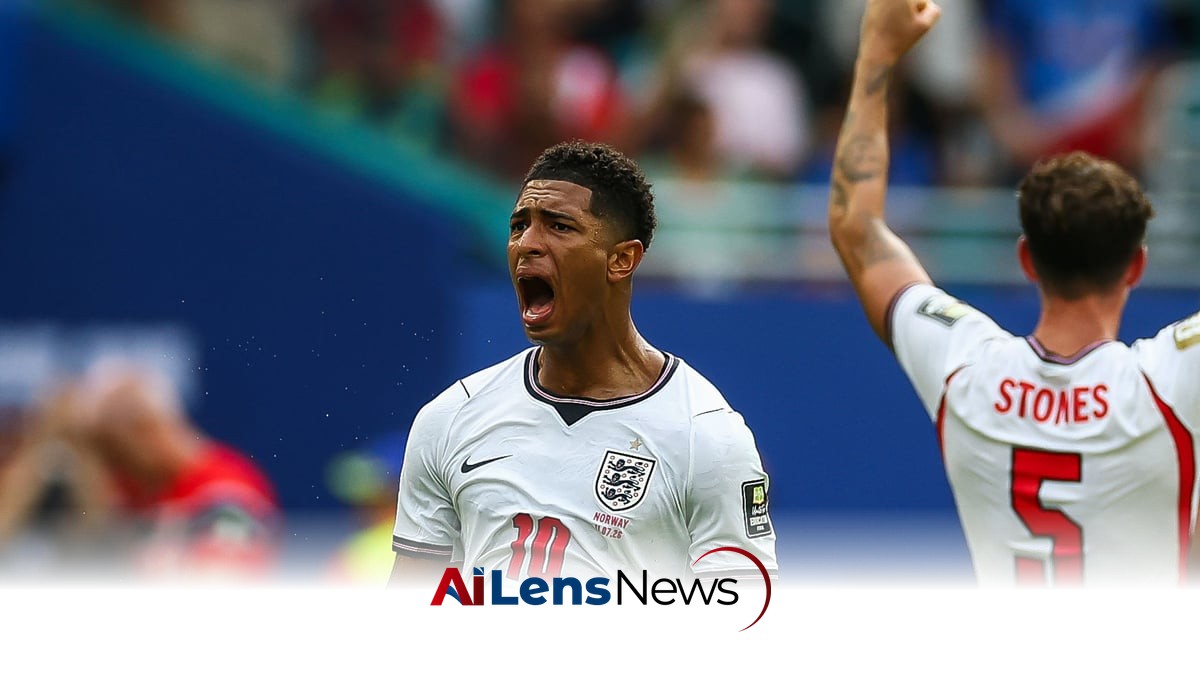


Jude Bellingham shines with two goals as England defeats Norway 2-1 in extra time, advancing to the World Cup semi-finals.
Islamabad, Pakistan Jul 12, 2026 ALN: Jude Bellingham was England’s hero once more by scoring twice as the Three Lions came from behind to end Norway’s historic run and reach the World Cup semi-finals with a 2-1 win after extra-time on Saturday.
In their first ever quarter-final, Andreas Schjelderup fired Norway into a shock lead in the searing Miami heat. This match was a significant milestone for Norway, marking their first appearance in a World Cup quarter-final, a feat that reflects the growing strength of their national team on the international stage. Norway's footballing history has been marked by moments of promise, but this tournament represented a breakthrough for the team, showcasing their potential against some of the world's best.
However, England, a nation with a rich footballing heritage and a storied history in World Cup competitions, was determined to continue their quest for glory. Jude Bellingham, the young midfielder who has quickly become a linchpin for both his club and country, produced a moment of magic to equalise just before half-time. His ability to perform under pressure has drawn comparisons to some of the greats of the game, and his impact on the match was a testament to his burgeoning talent.
Norway had a second goal controversially disallowed after a VAR review in the second half for a foul by Erling Haaland as both sets of players were pushed to their physical limits by going to extra-time. The use of VAR in this tournament has been a hot topic, with debates about its effectiveness and the clarity of its decisions. In this instance, the decision to disallow the goal added to the drama of the match, as it could have significantly altered the course of the game.
Bellingham came up with another big moment as he pounced on an error by Orjan Nyland to sweep in his sixth goal of the tournament. This goal not only showcased Bellingham's alertness and positioning but also highlighted the pressure that comes with playing at such a high level, where mistakes can prove costly. England will face Argentina or Switzerland on Wednesday for the chance to reach a first World Cup final in 60 years, a tantalizing prospect for fans who have long awaited a return to the pinnacle of international football.
Haaland’s spectacular run of scoring in his last 14 competitive matches for Norway came to an end against the land of his birth with Norway’s exhausted talisman replaced at half-time of extra-time. Haaland, who has emerged as one of the most feared strikers in world football, has been instrumental in Norway’s success in recent years, and his performance in this tournament has only solidified his status. However, fatigue and the intense competition of the knockout stages can take a toll on even the most prolific of players.
Having failed to win a World Cup knockout game after conceding first since the final of 1966 before this tournament, England have now done so twice in three matches. This statistic underscores the psychological barriers that teams face in high-stakes matches, particularly for a nation that has historically struggled to convert potential into results on the world stage. The resilience shown by England in coming from behind not once but twice in this tournament speaks volumes about their mental fortitude and tactical adaptability.
– Energy-sapping heat –
Harry Kane’s heroics prevented an embarrassing early exit to the Democratic Republic of Congo in the last 32. Kane, as captain, has been a pivotal figure for England, leading by example and providing crucial goals at critical moments. His leadership on and off the pitch has been vital in fostering a sense of unity within the squad, which has been essential for their success in this tournament.
But it is Bellingham who has stood up in the past two matches to keep England in the hunt to end their long wait for major tournament glory despite far from flawless performances. The pressure placed on young players in high-stakes matches can be immense, yet Bellingham has embraced the challenge, proving himself to be a player for the big occasions.
The 5:00 pm local time (2100 GMT) kick-off in Florida meant that temperatures remained above 30 degrees Celsius throughout, with intense humidity making for draining conditions for the players. Such weather conditions can significantly impact player performance, leading to fatigue and decreased effectiveness as the match progresses. The ability of players to manage their energy levels and hydration is crucial, particularly in knockout matches where every moment counts.
The heat looked as if it would spoil the spectacle in the first half. Thomas Tuchel’s men were rattled as England goalkeeper Jordan Pickford saved low from Martin Odegaard before Alexander Sorloth wasted a glorious chance when he failed to feed Haaland and instead went for goal himself. These early moments were indicative of the high stakes and pressure that both teams faced, as they sought to establish dominance in the match.
Almost immediately Bellingham pulled his team out of the mire once more. Bellingham had been well marshalled until he collected Anthony Gordon’s pass, burst into the box at speed, and then slotted home on his weaker left foot. This goal not only shifted momentum in England's favor but also demonstrated Bellingham's technical ability and composure in front of goal, qualities that have made him a standout player in this tournament.
Momentum was suddenly in England’s favour and they nearly went into the break ahead. Bellingham was this time the creator for Kane, who dinked the ball coolly over Nyland, but had just drifted offside. Such near-misses can be both exhilarating and frustrating, as they highlight the fine margins that often dictate the outcomes of matches at this level.
Tuchel introduced Bukayo Saka and Eberechi Eze at the break for the ineffective Noni Madueke and Declan Rice — the Arsenal midfielder had been suffering with illness earlier in the week. Tactical changes are a crucial aspect of football management, and Tuchel's decisions reflected a desire to inject fresh energy and creativity into the team. However, these changes left England light in midfield, and they were left hanging on at spells in the second half.
Torbjorn Heggem made the most of some sloppy defending to turn in at the back post, but Haaland was penalised for a push on new Manchester City teammate Elliott Anderson before the corner had been taken, and the goal was disallowed. The decision to disallow the goal was a pivotal moment in the match, as it robbed Norway of a potential lead and shifted the momentum back to England.
Norway were inches away from a winner again when Kristoffer Ajer hit the bar after England failed to deal with another dangerous corner. Such moments of near success can be agonizing for teams, as they represent missed opportunities that could change the game's outcome.
Both sides visibly wilted in the energy-sapping conditions late on but were forced to endure an extra 30 minutes. The physical toll of the match was evident, with players struggling to maintain their intensity as fatigue set in. The mental resilience required to push through such challenges is a hallmark of successful teams.
Nyland had been Norway’s supporting act in the last 16 win over Brazil with a series of saves before Haaland struck twice late on for a landmark victory. This match against England, however, saw him falter at a crucial moment, as his mistake allowed Bellingham to score. The pressures of knockout football can lead to unexpected errors, and such moments can define a player's tournament.
This time the Sevilla goalkeeper was the villain as he spilled substitute Morgan Rogers’ shot from distance, and Bellingham pounced and scored. England were awarded a penalty moments later, but this time VAR intervened in Norway’s favour to deem Djed Spence had initiated contact inside the box. The use of technology in the game continues to be a double-edged sword, with moments of controversy often sparking debates about fairness and accuracy.
Yet, Norway’s spirit was already crushed, epitomised by a slouched Haaland watching on from the bench with nothing more to give. The emotional and physical toll of the match was evident, as the players grappled with the disappointment of falling short in such a significant moment. For Norway, this tournament has been a learning experience, and while they may be leaving the competition, the foundation has been laid for future success.
To learn more about the latest developments in Football (Soccer), stay updated with our exclusive reports and analyses on AiLensNews.

