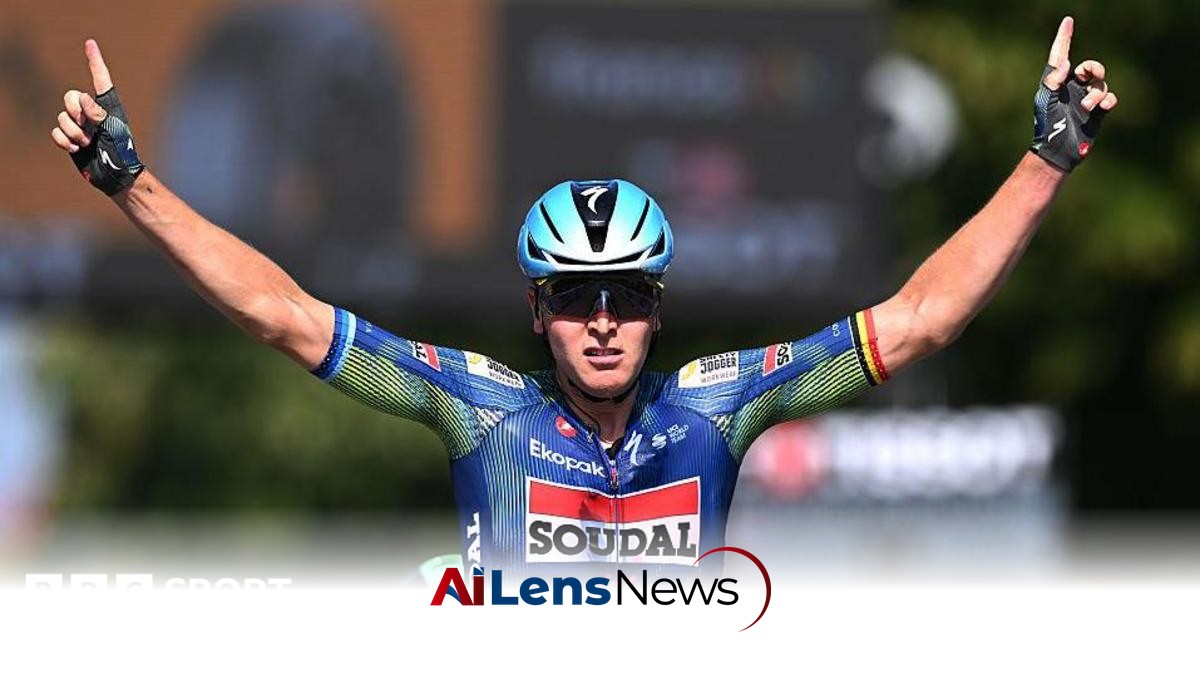


Belgium's Tim Merlier secures consecutive victories on stage eight of the Tour de France, triumphing in another thrilling sprint finish.
New Delhi, India Jul 11, 2026 ALN: Belgium's Tim Merlier made it back-to-back wins on stage eight of the Tour de France on Saturday.
The Soudal Quick-Step rider claimed victory in a sprint for stage seven on Friday and followed that up during another bunch finish in Bergerac. This remarkable performance not only showcases Merlier's sprinting prowess but also highlights the competitive nature of this year's Tour, which has seen several riders vying for stage victories and the coveted green jersey.
At 33 years old, Merlier has established himself as a formidable sprinter in the world. His victory in Bergerac marked his fifth stage win on the Tour, a testament to his consistent performance and ability to navigate high-pressure situations. Notably, he appeared to be out of contention as the riders approached the final 500 meters, having been caught out of position. However, Merlier's strategic decision to launch a long-range charge proved decisive, allowing him to reel in his rivals and claim victory.
As the race unfolded, Merlier found himself in a challenging position, boxed in among other competitors. Yet, with less than 200 meters remaining, he managed to surge ahead, holding off Eritrean sprinter Biniam Girmay, who had been waiting for his fourth win after previously securing three stage victories in 2024. Dutch rider Olav Kooij, who had celebrated his first stage win on Wednesday, finished in third place, adding to the excitement of the sprint finish.
"If you win one, you can win a second, and I'm happy," Merlier said after his victory. His statement reflects the psychological boost that comes with consecutive wins, which can significantly impact a rider's confidence and performance in subsequent stages. Merlier's success in two out of three sprint stages thus far positions him as a strong contender for the green jersey, with the points standings showing him just 15 points behind Mads Pedersen.
In the overall classification, defending champion Tadej Pogacar continues to hold the yellow jersey, maintaining his lead over Jonas Vingegaard. Pogacar's ability to perform consistently across various terrains has been a hallmark of his racing strategy, and his performance in the flat 180.4km ride from Perigueux to Bergerac was no exception. The stage in the Dordogne, known for its picturesque landscapes and historic castles, set the scene for a thrilling finish.
The day began with a three-man breakaway, which included Liam Slock, who made a notable attempt to stay ahead of the peloton. However, his efforts were ultimately thwarted as he was caught just 1.3 kilometers from the finish line. This highlights the tactical nature of professional , where breakaways can sometimes lead to dramatic finishes, but often the peloton's collective strength proves too formidable. The dynamics of the peloton, including teamwork and strategy, play a crucial role in determining the outcome of each stage.
As the race approached its climax, Mathieu van der Poel made a concerted effort to set up his Alpecin-Premier Tech teammate Jasper Philipsen for a potential victory. Van der Poel's role as a lead-out rider is crucial in sprint finishes, as positioning and timing can be the difference between winning and losing. Despite these efforts, it was Merlier who ultimately powered into the lead, demonstrating his superior speed and timing.
"I needed to fight for my position all the time until the last minute," Merlier recounted. His experience in managing positioning during critical moments is indicative of the skills required at the elite level of professional . He noted a moment of concern when he was boxed in before a corner, which nearly resulted in a crash among the competitors. Such split-second decisions can have significant repercussions in races, emphasizing the need for awareness and quick reflexes.
Looking ahead, the ninth stage of the Tour de France is set to be shortened due to an "intense heatwave" affecting the Correze region. Tour organizers have adjusted the route from Malemort to Ussel, reducing its length from 185.5 kilometers to 155.5 kilometers. This decision underscores the challenges that extreme weather conditions pose to athletes, as heat can significantly affect performance and safety. The adjustment also reflects the organizers' commitment to ensuring the well-being of the riders, allowing them to compete under more manageable conditions.
As the Tour progresses, the implications of Merlier's back-to-back wins extend beyond individual accolades. His victories contribute to the overall dynamic of the race, influencing team strategies and the competition for the green jersey. The battle for stage wins, as well as the overall classification, remains fierce, with several riders still in contention. The upcoming stages will undoubtedly continue to test the riders' endurance, strategy, and resilience.
In the context of the Tour de France, Merlier's performance illustrates the importance of adaptability and tactical acumen. The ability to respond to the evolving race conditions and rival strategies is essential for success in such a prestigious event. His recent victories may also inspire younger riders and serve as a reminder of the potential for seasoned athletes to reclaim their place at the forefront of the .
Moreover, the competition for the green jersey is heating up, with Merlier's presence adding a new layer of excitement to the race. The green jersey, awarded to the best sprinter in the Tour, is not only a symbol of individual success but also a reflection of a rider's ability to consistently perform in various stages of the race. The points system, which awards points based on stage finishes and intermediate sprints, creates a dynamic environment where strategy and speed intertwine.
As the Tour de France continues, fans and analysts alike will be closely watching the developments in the standings and the impact of each rider's performance on the overall race. The interplay between sprinters, climbers, and all-rounders will shape the narrative of the competition, making every stage a critical battleground for glory.
To learn more about the latest developments in Global Tournaments & Olympics, stay updated with our exclusive reports and analyses on AiLensNews.

