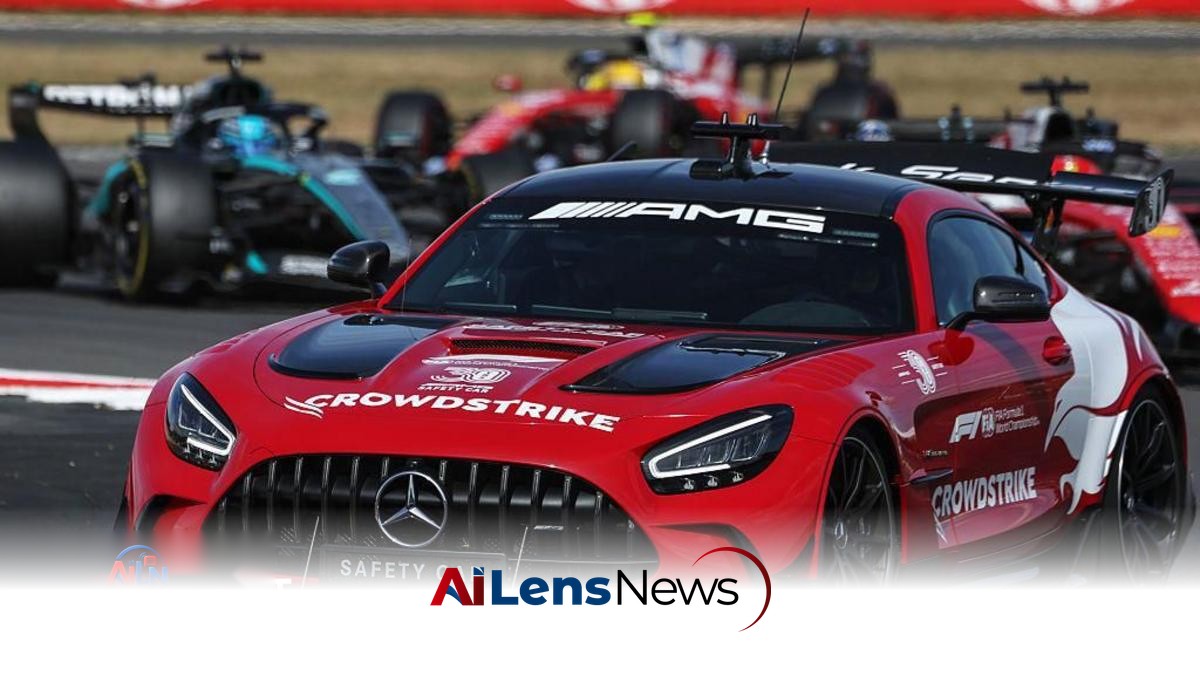


BBC F1 correspondent Andrew Benson addresses questions following the British Grand Prix, focusing on the safety car's impact and Max Verstappen's performance concerns.
New Delhi, India Jul 7, 2026 ALN: Charles Leclerc added a second win for Ferrari in three races at a dramatic British Grand Prix at Silverstone.
Mercedes' George Russell finished second, while Leclerc's teammate Lewis Hamilton secured third place in their home race. The British Grand Prix is one of the most prestigious events on the 1 calendar, drawing in large crowds and generating significant media attention. The race at Silverstone is known for its rich history, having hosted its first Grand Prix in 1950, and it continues to be a fan favorite due to its challenging circuit layout and passionate local support.
Kimi Antonelli, who won his first sprint on Saturday, ended the race in 16th due to car problems, reducing his lead over Russell to 25 points. Antonelli's performance in the sprint race had generated excitement, but his struggles during the main event highlight the unpredictable nature of motor, where mechanical failures can dramatically impact race outcomes.
BBC F1 correspondent Andrew Benson answers your latest questions after a race that concluded under the safety car following Max Verstappen's crash. The safety car's deployment is a crucial aspect of 1 racing, designed to ensure driver safety when incidents occur on track. However, it also raises questions about race strategy and the fairness of outcomes, particularly when races conclude under caution.
Did F1 miss an opportunity with the British GP's ending? Should they consider a strategy similar to this year's Indy 500?
This situation has sparked diverse opinions, each with its validity. F1 has established a certain approach based on historical lessons. The Indy 500, a prestigious event in American motor, has its own set of rules regarding restarts and finishes, often leading to thrilling conclusions. The contrasting approaches between F1 and IndyCar highlight the differing philosophies in motor regarding safety and entertainment.
Ideally, races would not finish under a safety car, as it can feel anti-climactic. However, the British Grand Prix was filled with drama and excitement, despite concluding under caution. The race's conclusion under the safety car led to discussions about how F1 might evolve its rules to enhance the spectacle while maintaining safety standards.
The regulations surrounding the safety car have evolved over the years, with the FIA, F1, and teams satisfied with the current framework while remaining open to improvements. The introduction of rules that govern the safety car's operation, including when and how it can be deployed and when lapped cars are allowed to un-lap themselves, reflects a desire to balance safety with competitive integrity.
F1 learned from the Abu Dhabi 2021 incident, where it was agreed that races ideally should not end under a safety car. The race director's attempt to ensure a green flag finish led to a series of mistakes, including rule violations. This incident has had lasting implications on how race directors approach safety car situations, emphasizing the need for clear communication and adherence to regulations.
Some believe the race director can operate the safety car freely, but this is a misinterpretation; they must adhere to established rules. The role of the race director is complex, requiring them to balance safety with the competitive nature of the . At Silverstone, the race director could have red-flagged the race when Verstappen crashed at Stowe. However, if the incident had occurred earlier in the race, a red flag would likely not have been issued. This inconsistency can lead to confusion and frustration among teams and drivers.
There is an integrity question here; any decision by the race director could influence the race outcome. In this case, George Russell did not stop for tires and gained a position as a result. Had the race been red-flagged, all drivers would have had the opportunity to change tires, potentially altering positions again. The strategic decisions made during a race can have far-reaching consequences, and how teams respond to unexpected situations often defines their success.
Opinions on the situation vary, even among drivers, depending on their circumstances. Race-winner Charles Leclerc remarked, "It's not great for the fans that are here around the track. In the helmet, I was kind of happy that there was not a restart to keep that win." This sentiment reflects the conflicting emotions drivers face between their competitive instincts and the desire to provide an entertaining experience for fans.
Russell noted, "Of course it's a shame for any race to finish under the safety car. But then you go back to Abu Dhabi '21, and that is just how racing goes." His comments underscore the complexities of racing, where rules and circumstances can lead to outcomes that are not always satisfying for all parties involved. Mercedes team principal Toto Wolff stated, "Sometimes it doesn't give for the most exciting finale. Certainly from a spectacle standpoint, everybody would have loved to see Lewis (Hamilton) on a soft tire against us and maybe fighting with Leclerc. But this is a show that follows, not the other way around." Wolff's perspective highlights the balance between entertainment and the integrity of racing results.
Why is it necessary to allow lapped cars past the safety car before the race resumes?
The rationale for letting lapped cars pass is to ensure the race restarts with all cars in their correct order, allowing drivers to compete with their direct competitors immediately. This rule aims to maintain the competitive nature of the race and prevent lapped cars from interfering with the battle for position among the leading drivers. While this may slightly manipulate the race's purity, it is a rule established over many years as the best compromise.
Is Max Verstappen's frustration a strategy to trigger a performance clause in his contract with Red Bull?
Verstappen has expressed dissatisfaction with Red Bull's performance, wanting to win. However, his comments over team radio are unlikely to be linked to his contractual situation. The dynamics of a driver-team relationship can be complex, and Verstappen's frustrations may stem from a desire for immediate results rather than a calculated strategy to leverage contractual clauses. While he has a contract until the end of 2028 with performance clauses that may allow him to leave at the end of this season, the outcome remains uncertain.
Verstappen's management is in discussions with potential teams, including Mercedes, Ferrari, and McLaren, but he has time to evaluate Red Bull's direction. The competitive landscape of 1 is always shifting, and the decisions made by drivers and teams can have significant ramifications for their futures. Red Bull must work to convince him that they remain his best option for competitiveness, particularly as rival teams continue to improve their performance.
Have Red Bull found a solution to their second seat problem in Isack Hadjar?
Isack Hadjar is impressively navigating his first season with Red Bull alongside Verstappen. He is only one place and 24 points behind a four-time champion driving the same car. Hadjar's performance has been noteworthy, showcasing his potential as a future star in 1. His ability to compete closely with Verstappen, who has established himself as one of the top drivers in the , speaks volumes about Hadjar's skill and determination.
Hadjar has shown competitive pace, with a head-to-head qualifying score of 9-2 against Verstappen, with a minimal performance gap of 0.25 seconds. Such statistics indicate that Hadjar is not only adapting well to the demands of 1 but also pushing the boundaries of what is possible within the Red Bull team. Team principal Laurent Mekies praised Hadjar's progress, emphasizing that he is learning from Verstappen and consistently improving. This mentorship dynamic can be beneficial for both drivers, as they push each other to achieve greater heights.
As the season unfolds, Red Bull remains optimistic about Hadjar's development and contributions to the team. The performance of junior drivers is closely monitored, and Hadjar's success could impact future driver line-ups and team strategies. The ongoing evolution of the team’s roster will be crucial as they strive to maintain their competitive edge in the ever-evolving landscape of 1.
To learn more about the latest developments in Formula 1 & Motorsports, stay updated with our exclusive reports and analyses on AiLensNews.

