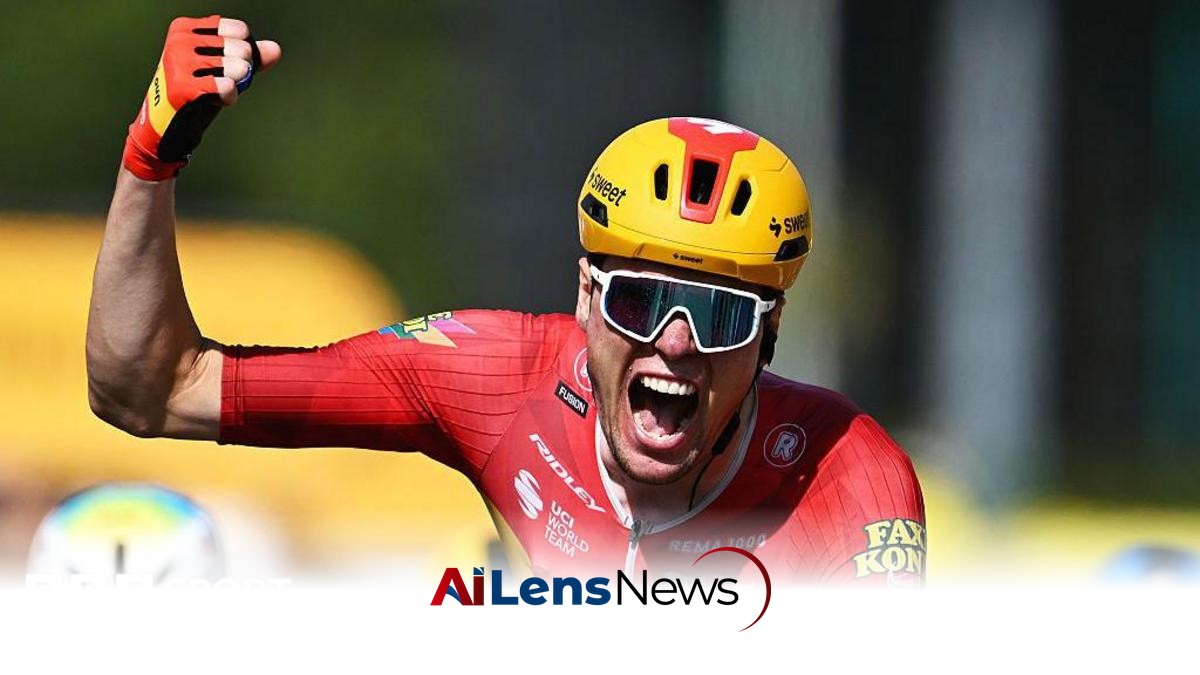


Soren Waerenskjold surprises competitors with a stunning sprint to win the fastest stage in Tour de France history, marking his first stage victory.
New Delhi, India Jul 15, 2026 ALN: Soren Waerenskjold caught the big guns by surprise with a long-range sprint to win the fastest-ever stage of the Tour de France.
Racing in his fourth Tour, the 26-year-old Norwegian claimed his first stage win and just the second for his team, Uno-X Mobility. This victory is not only a personal milestone for Waerenskjold but also a significant achievement for his team, which has been striving to establish itself on the world stage. Founded in 2020, Uno-X Mobility has been focused on developing young talent and competing with established teams in the world. Waerenskjold's victory is a testament to the team's philosophy of nurturing emerging cyclists and providing them with the platform to showcase their abilities.
Overall race leader Tadej Pogacar remains three minutes and 36 seconds ahead of Jonas Vingegaard in the general classification standings, showcasing the ongoing battle between these two elite cyclists. Pogacar, who rides for UAE Team Emirates, has been dominant throughout the Tour, and his performance continues to set the standard for the competition. Vingegaard, riding for Jumbo-Visma, has been a consistent challenger, but the gap indicates that Pogacar's lead is substantial as the race progresses. The rivalry between these two riders is one of the most compelling narratives of this year's Tour, as both have demonstrated exceptional climbing and time-trialing abilities, making them formidable opponents in various terrains.
The peloton completed stage 11 at an average speed of 50.9 km per hour, beating the previous record of 50.3 kph set in 1999. This remarkable speed reflects the increasingly competitive nature of the Tour, as teams and riders push the limits of endurance and strategy. The stage featured a flat 161.3 km route from Vichy to Nevers, which is typically conducive to high-speed finishes, and the riders took full advantage of favorable weather conditions, including mild winds that aided their performance. The record-breaking speed achieved during this stage is indicative of the advancements in training, nutrition, and equipment that modern cyclists benefit from, allowing them to perform at levels previously thought unattainable.
A sprint finish was expected on Wednesday, and as the peloton rolled into the final 500m after catching the day's breakaway, Cees Bol made the first move. However, his team-mate Olav Kooij did not follow, creating a moment of hesitation among the leading riders. Waerenskjold seized this opportunity, sneaking through a gap beside the barriers to launch a counter-attack with 400m remaining. His decisive move caught the competition off guard, allowing him to charge past Bol and secure his victory. Kooij and Jasper Philipsen attempted to pursue him, but their efforts were insufficient as Waerenskjold crossed the line almost a bike's length ahead. This strategic maneuver highlights the importance of timing and positioning in sprint finishes, where even a split-second decision can determine the outcome of a race.
Philipsen, who initially finished third, was later relegated for moving in the sprint, allowing Milan Fretin to be promoted to the podium. Such decisions are not uncommon in professional , where the rules are strictly enforced to ensure fair competition. The relegation of Philipsen underscores the intense scrutiny that occurs during sprint finishes, as officials review footage to ensure compliance with race regulations. Waerenskjold's win is a testament to his tactical awareness and sprinting capabilities, especially given the high stakes of the Tour de France.
Reflecting on his victory, Waerenskjold expressed a mix of disbelief and joy. "I thought I was too far back and then it opened up on the right side, like it usually doesn't do. I saw Cees Bol had a gap and I tried to sprint up to him and hold a little bit back to go from his wheel. Then I saw there were 250 to go. I was just waiting for the same thing to happen when Merlier passed me, but it didn't happen this time. It's surreal, it's unbelievable. It means everything, it's my biggest win so far. I just have to let it sink in and then I will probably be more happy than I look now, but it's a big surprise for myself." Waerenskjold's candid reflections reveal the emotional weight of competing at such a high level, where the pressure to perform can be immense.
Waerenskjold's stage win adds to an impressive Tour for Uno-X, with team-mate Torstein Traeen having worn the yellow jersey for two days in the opening week. This performance not only highlights the potential of the Uno-X team but also underscores the increasing competitiveness of the Tour, where traditionally dominant teams are facing challenges from emerging squads. As the evolves, the emergence of teams like Uno-X represents a shift in the landscape of professional , where talent is increasingly dispersed across various teams rather than concentrated in a few historically successful organizations.
Despite Waerenskjold's success, the sprint stars have yet to shine in this year's Tour. Philipsen and Girmay, who have a combined 13 Tour stage wins between them, have not added to their tally this year. Instead, Waerenskjold, Merlier, and Kooij have claimed the sprint-friendly finishes, indicating a shift in the competitive landscape of the Tour de France. The dynamics of sprint finishes can be unpredictable, and with several stages still remaining, the competition remains wide open. The unpredictability of sprint outcomes adds an exciting element to the Tour, as fans are left guessing which rider will seize the moment in the upcoming stages.
Looking ahead, Thursday's stage is also flat and is expected to present another opportunity for a sprint finish. The big guns of the sprinting world will be eager to break their drought and reclaim their positions at the forefront of the competition. The anticipation surrounding these stages is palpable, as fans and analysts alike speculate on who will emerge victorious in the upcoming challenges. The stakes are high for all riders, as each stage presents a chance to gain crucial points, not only for individual accolades but also for team standings in the overall classification.
As the Tour de France progresses, the implications of Waerenskjold's victory extend beyond the immediate glory of a stage win. It highlights the unpredictable nature of professional , where emerging talents can disrupt established hierarchies. For Waerenskjold, this victory may serve as a launching pad for future success, while for teams like Uno-X, it reinforces their commitment to developing riders capable of competing at the highest level. The upcoming stages will be critical, not only for the general classification contenders but also for the sprinters looking to reclaim their dominance. The excitement surrounding the Tour de France continues to build as the competition intensifies, and fans eagerly await the next chapters of this storied race.
To learn more about the latest developments in Basketball, stay updated with our exclusive reports and analyses on AiLensNews.

