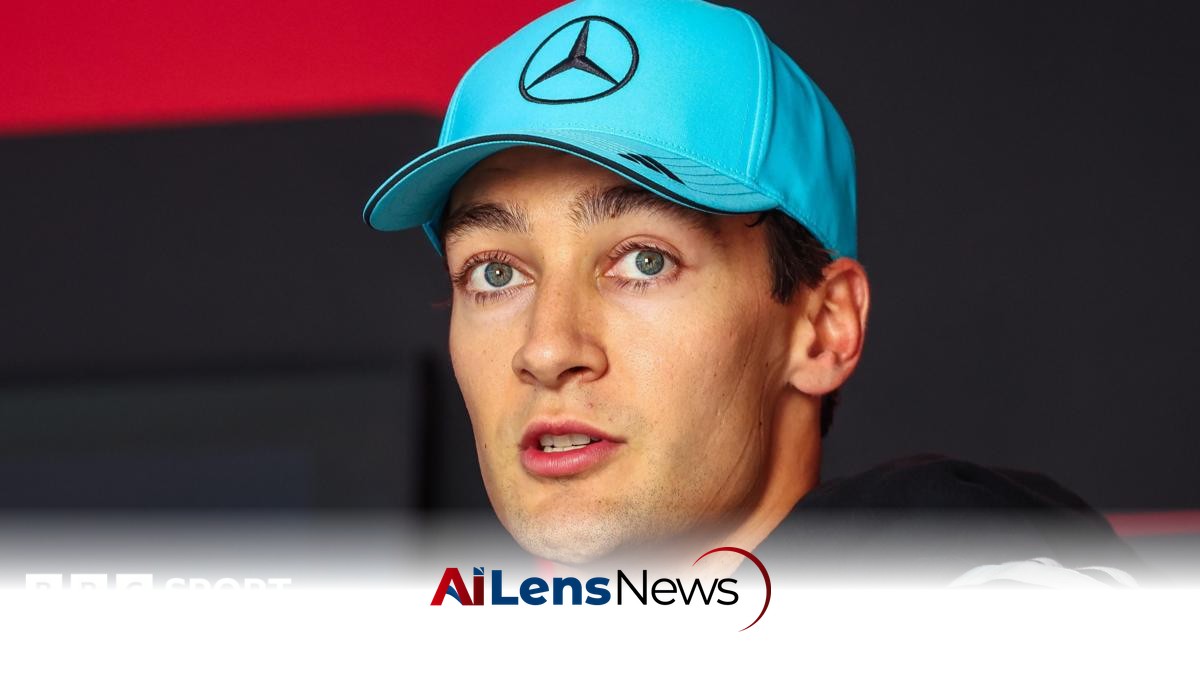


George Russell has voiced his frustration regarding a significant straight-line speed issue with his Mercedes, impacting his title challenge against teammate Kimi Antonelli.
New Delhi, India Jul 19, 2026 ALN: George Russell says a "serious issue" with the straight-line performance of his Mercedes is making his title fight with team-mate Kimi Antonelli "impossible".
Russell qualified fourth for the Belgian Grand Prix, and was 0.508 seconds slower than the 19-year-old Italian, who took his sixth pole position in 10 races. This qualifying session highlighted the ongoing struggles faced by Russell and the Mercedes team, as they aim to compete at the highest level in the highly competitive world of 1.
The disparity in performance between Russell and Antonelli has been a significant talking point throughout the race weekend at the iconic Spa-Francorchamps circuit in Belgium, a track known for its challenging layout and rich history in motor. Russell noted that the majority of his deficit to Antonelli could be attributed to a mysterious lack of speed on the straights, which has left him and the team searching for answers.
When discussing his performance, Russell expressed his frustration, stating, "When I cross the line, you see you're half a second down, it feels pretty rubbish. But when you realize more than 75% of that's coming from the power-unit, you feel a bit better." This comment underscores the psychological aspect of racing, where drivers often grapple with the emotional weight of their performance relative to their competitors.
Russell's analysis of his lap time revealed that while he was competitive in the corners, he struggled significantly in the straights. He remarked, "I was pleased with my lap. When I look at the corners, there's a lot of corners I was faster. There's definitely corners I needed to improve. But the corners look like a normal fight you'd have for a pole. The straights is not." This distinction highlights the critical importance of straight-line speed in 1, where even minor differences can translate to significant time losses on the track.
Throughout the weekend, Russell has been struggling for pace in comparison with Antonelli. He ended Friday practice more than a second adrift, and had been informed by his team that the deficit was due to his driving in the corners. However, the team recognized that Russell was less comfortable with the car in the medium and high-speed corners of the middle sector, which resulted in him making corrections to the steering that Antonelli did not have to make. This discrepancy cost Russell vital speed, which he attempted to compensate for using battery power. However, as electrical energy is limited, this left him down on deployment in the final third of the lap, exacerbating his performance issues.
Despite these struggles, Russell managed to make significant progress over the weekend, yet Mercedes admitted they were still observing a straight-line discrepancy that remained unexplained. This ongoing challenge has raised concerns within the team about their competitiveness moving forward, especially with Russell heading into the race 25 points behind Antonelli in the championship standings.
In light of these challenges, Russell stated, "There's a serious issue at play here and the team are working so hard to resolve it. But every lap I do, when I see I'm down anywhere from 0.2-0.6secs in the straights, it's pretty infuriating." This sentiment reflects the urgency felt by both the driver and the team as they strive to address the underlying issues affecting their performance.
Russell continued, "My whole focus for the last 36 hours has been on straight-line speed. It hasn't been focused on the set-up, the tyres or anything, because we're all trying to solve what is going on. And even my last lap, for some reason, I lost another 0.15secs to myself, just on the straight." His comments illustrate the intense pressure drivers face to constantly adapt and improve, as well as the intricate balance between driver skill and vehicle performance.
Mercedes trackside engineering director Andrew Shovlin commented on Russell's situation, stating, "George continued to suffer from poor deployment into the final chicane, which cost him a grid position. We're investigating what's causing this as a priority as there is a clear loss that we cannot explain by driving style." This acknowledgment from the engineering team highlights the collaborative effort required to solve complex performance issues in 1, where technology and human skill must work in tandem for success.
Additionally, it is worth noting that McLaren, who use Mercedes customer engines, were seeing a similar split in deployment across the cars of Lando Norris and Oscar Piastri. Team principal Andrea Stella remarked, "If I compare Lando and Oscar in their best lap in Q3, Oscar is losing time in the final straight and Blanchimont for reasons that have nothing to do with Oscar's driving. They are just a minor deviation in how the power unit was operated. And I think this seems to be pretty much the same across the two Mercedes cars. When you overlay Antonelli and Russell, it looks like Lando and Oscar." This observation suggests that the issues with straight-line speed may not be isolated to Russell alone, but rather indicative of a broader trend affecting multiple teams using similar power units.
Piastri and Russell were both experiencing their straight-line speed cut earlier into the first corner, La Source, than Norris and Antonelli, before both had similar losses in the final sector. This pattern of performance raises questions about the consistency and reliability of the power units being utilized, as teams strive to find the optimal setup for their cars.
Spa has a reputation as one of the greatest race tracks on the planet, but this weekend's grand prix has confirmed fears that the new engines introduced this year have diminished much of its challenge. The track's most iconic corner, Eau Rouge, has been easily flat out on a qualifying lap for the best part of two decades. However, the new engines are energy-starved, taking away the challenge from what had been Spa's most difficult corner, the fast downhill double left-hander known as Pouhon.
While the cars entered Pouhon flat-out, just as they did last year, the turn-in speed was much slower. Antonelli noted that his car started recovering energy from the apex onwards, indicating a shift in how drivers must approach this iconic section of the track. Max Verstappen, who qualified second for Red Bull, commented, "It is not only Pouhon. It is the whole track. It is a different Spa." This sentiment reflects the recognition within F1 that the current engines are flawed, and that mistakes were made in the regulation process.
As a result, steps have already been taken this year to improve the situation, with more adjustments planned for the next two years. These changes aim to restore some of the challenge and excitement that fans and drivers alike have come to expect from the . As the drivers adapt to the changes, the focus remains on resolving the issues affecting straight-line speed, with Russell and his team determined to find a solution that will allow them to compete effectively in the championship.
To learn more about the latest developments in Formula 1 & Motorsports, stay updated with our exclusive reports and analyses on AiLensNews.

