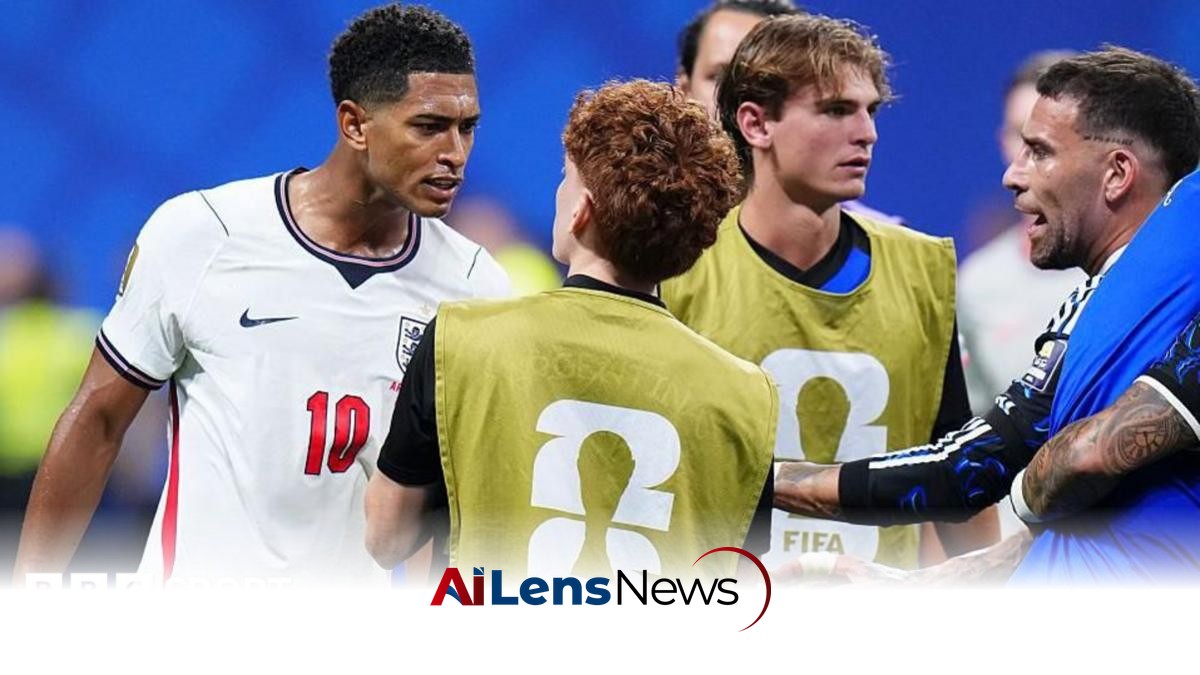


Jude Bellingham slapped Argentina's Valentin Barco after England's 2-1 defeat in the World Cup semi-final, sparking a brief altercation on the pitch.
New Delhi, India Jul 16, 2026 ALN: Jude Bellingham slapped Argentina substitute Valentin Barco on the back of the head following England's 2-1 World Cup semi-final defeat. This incident, which occurred at the conclusion of a highly charged match, has drawn attention not only for its immediate implications but also for the broader context of player conduct in high-stakes international tournaments.
Barco, who did not play in the game, came onto the pitch at full-time and was seen hugging team-mates near Bellingham when the England midfielder approached him and slapped him. This action sparked a small melee as players from both sides became involved before Bellingham walked away from the scene. Such confrontations are not uncommon in the world of competitive , where the emotional stakes are high, and players are often under immense pressure to perform.
The precise reasons behind Bellingham's reaction remain unclear, but it is noteworthy that Barco had previously celebrated in front of the England players after Enzo Fernandez's 85th-minute equaliser. This moment of celebration, particularly in the context of a World Cup semi-final, can amplify tensions on the pitch. Players invest not only their physical abilities but also their emotional energy into such matches, and any perceived provocation can lead to heightened reactions. In this case, the act of celebrating in close proximity to the opposition can be interpreted as an affront, especially when the match is so closely contested.
Former England goalkeeper Paul Robinson, who was commentating on the match for BBC Radio 5 Live, described Barco's actions as "probably the worst example of smanship we've seen at this World Cup." This comment underscores the ongoing debate surrounding player conduct in , where the expectations of smanship can vary widely. In high-pressure situations, the line between celebration and provocation can easily become blurred, leading to incidents that may overshadow the ing event itself.
As a result of the incident, Bellingham could face action from FIFA's disciplinary committee for violent conduct. If found guilty, the 23-year-old midfielder could be suspended for the upcoming bronze medal match against France in Miami, scheduled for Saturday. FIFA's disciplinary processes are known to be thorough and often take into consideration the context of incidents, including the intent behind a player's actions. This means that while Bellingham's slap might be viewed as a provocation, FIFA may ultimately categorize it as a moment of petulance rather than a serious act of violence.
The laws of the game state that there is no red-card offence if a player deliberately strikes an opponent on the head and the force used is negligible. This distinction is crucial in understanding how disciplinary actions might unfold in this case. FIFA tends to differentiate between incidents that could lead to serious injury and those that are more reflective of frustration or provocation. The governing body's approach is often guided by the principle of maintaining the integrity of the game while allowing for the passionate nature of competition.
The match itself was a tense affair, with Lautaro Martinez scoring the winning goal for Argentina in the second minute of stoppage time, bringing an end to England's hopes of advancing to the final. England had initially taken the lead with a goal from Anthony Gordon early in the second half, but the dramatic nature of the match, particularly the late winner, contributed to the emotional volatility experienced by players on both sides. Such late-game developments can heighten tensions and lead to confrontations, as players process the highs and lows of competitive .
Barco, 21, who plays for French side Strasbourg and previously had a spell at Brighton, is expected to join Chelsea. His career trajectory has been closely followed, especially given the high-profile nature of his potential transfer. Players who perform well on the international stage often attract attention from top clubs, and Barco's involvement in the World Cup, albeit limited, could play a significant role in shaping his future prospects. He has featured once at the tournament as a second-half substitute in a 3-1 group win against Jordan. The World Cup provides a platform for players to showcase their skills on a global stage, and even limited appearances can significantly impact a player's marketability and career trajectory.
The first half of the match in Atlanta was characterized by intense physicality, with a total of 19 fouls committed. American referee Ismail Elfath faced challenges in maintaining control throughout the game, a common issue in knockout-stage fixtures where the stakes are particularly high. The accumulation of fouls can disrupt the flow of the game, making it difficult for referees to enforce discipline among players who are fiercely competing for victory.
Bellingham, who has scored six goals in the tournament, also had a confrontation with Argentina captain Lionel Messi in the fourth minute after England midfielder Elliot Anderson had been fouled. This moment further illustrates the high stakes and emotional investment of players during crucial matches. Bellingham's ability to score and contribute to his team's performance has made him a key player for England, and his interactions with other top players like Messi only heighten the drama surrounding his career.
After the match, Bellingham was reported to have downplayed the confrontation with Barco, stating, "We were really just discussing a foul, actually. It wasn't anything bad. I'm sure everyone will do their thing and make it a big deal, but it was nothing." His comments reflect a desire to minimize the incident and maintain focus on the match itself rather than the surrounding controversies. Players often feel the pressure of media narratives, and Bellingham's response suggests an awareness of the potential for scrutiny that comes with high-profile matches.
The implications of this incident extend beyond the immediate match. It raises questions about player conduct, the role of officiating in maintaining discipline, and how emotions can impact player behavior on the field. As the tournament progresses, FIFA will need to consider how to address such incidents to uphold the integrity of the game while allowing for the passionate nature of competition. Striking a balance between ensuring fair play and acknowledging the emotional stakes of the World Cup is a complex challenge for governing bodies.
In conclusion, the post-match incident involving Jude Bellingham and Valentin Barco serves as a reminder of the intense emotions that accompany high-stakes matches. As England prepares for their bronze medal match against France, the focus will be on how Bellingham's actions are interpreted by FIFA and whether they will have any bearing on his participation in the upcoming game. The World Cup continues to be a stage for not only athletic excellence but also for the complexities of human emotion and smanship in one of the world's most beloved s.
To learn more about the latest developments in Football (Soccer), stay updated with our exclusive reports and analyses on AiLensNews.

