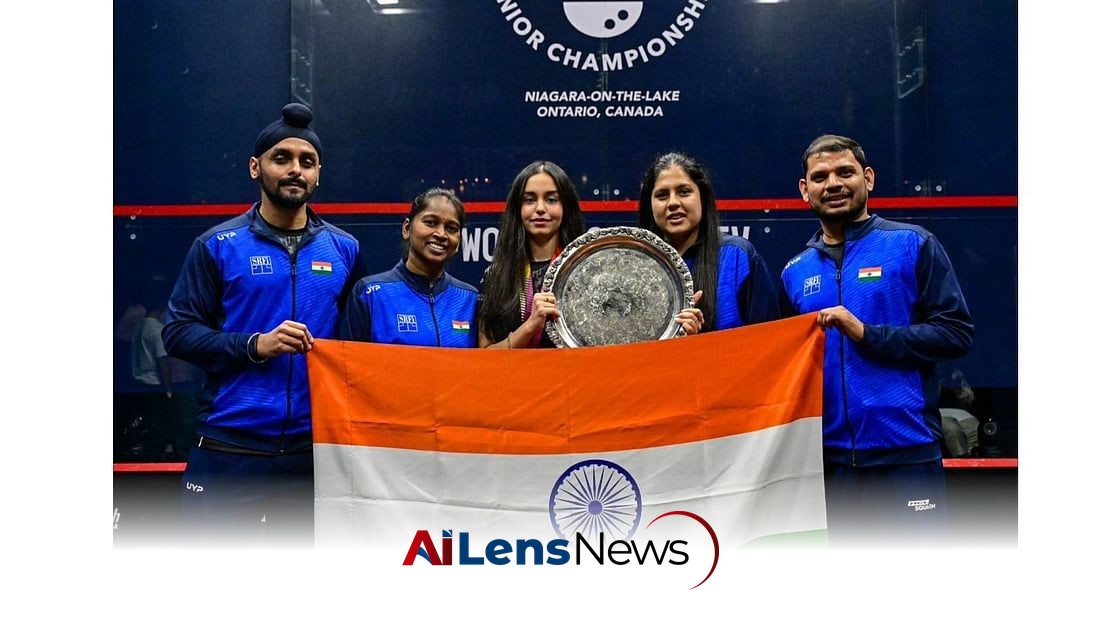


In a stunning victory, Anahat Singh becomes the first Indian to win the World Junior Squash Championship, defeating Egypt's Ruqayya Salem.
New Delhi, India Jul 26, 2026 ALN: In a remarkable display of skill and determination, Indian squash player Anahat Singh has made history by winning the World Junior Squash Championship, held in Ontario. This victory marks a significant milestone not only in Anahat's career but also for Indian squash, as it ends Egypt's 13-year reign as champions in this prestigious tournament.
Ranked world No. 20, Anahat triumphed over Egypt's Ruqayya Salem in straight sets, with scores of 11-3, 11-7, and 11-9. This victory is particularly poignant for Anahat, as it represents her final opportunity to compete in the junior circuit, thus adding an emotional layer to her success. "It means the world. I still feel like I'm dreaming," Anahat expressed in the aftermath of her win, encapsulating the joy and disbelief that often accompanies such significant achievements.
The World Junior Squash Championship is an esteemed event that gathers the best young talents from around the globe, providing them with a platform to showcase their skills and compete at the highest levels. For over a decade, Egypt has dominated this tournament, producing numerous champions across various age categories and genders. Anahat's victory not only disrupts this dominance but also heralds a new era for Indian squash on the international stage.
Cryus Poncha, the secretary-general of the Squash Rackets Federation of India, lauded Anahat's accomplishment as a "historic moment" for the sport in India. He noted that while India has previously seen success in team events and doubles categories, this individual title is a groundbreaking achievement. “It is an amazing achievement, Egypt has been a dominant force across gender and age categories. It has been her dream for a decade, and she achieved it in her last try. India has been put firmly on the world map, with that individual title,” Poncha remarked, highlighting the significance of this win in the context of Indian squash's evolving narrative.
In reflecting on Anahat's journey, Poncha emphasized her relentless drive and ambition, qualities that have been evident since her early days in the sport. "From her U-11 days, she’s always been hungry and ambitious. She was special, and won every single title that was in her way. But her maturity now has improved leaps and bounds. She’s also worked heavily on her mental skills, and that’s very evident from her gameplay,” he noted. This dedication to both physical and mental training has undoubtedly contributed to her success, allowing her to compete effectively against some of the best players in the world.
Anahat's journey in squash began at a young age, and her talent quickly became apparent. By the time she was 14, she was already making waves in the sport, representing India at the Commonwealth Games in Birmingham. Despite the pressure of competing on such a significant stage, Anahat approached the competition with a refreshing perspective, stating that her primary goal was to "have fun" on the court. This mindset has been a hallmark of her approach to the sport, allowing her to maintain a level of enjoyment that many athletes struggle to preserve amidst the pressures of competition.
Her agility and speed on the court have set her apart from her competitors, often leaving them rattled. Poncha remarked on her exceptional fitness level, noting that she is likely faster and more agile than many of her peers, which has been a crucial factor in her success. "Her never say die attitude stands out. Even when she was playing her first Commonwealth Games, at 14, she never flinched. After that event, she just told me ‘I just went and had fun’,” he recalled, illustrating Anahat's refreshing approach to competition and her ability to remain composed under pressure.
The implications of Anahat's victory extend beyond personal achievement; it represents a significant moment for Indian squash as a whole. With her win, Anahat has not only inspired a new generation of squash players in India but has also elevated the country's status in the international squash community. This victory may encourage greater investment in the sport at the grassroots level, potentially leading to the development of more world-class players in the future.
Furthermore, Anahat's success could pave the way for increased visibility and support for squash in India. As more young athletes aspire to follow in her footsteps, it is likely that we will see a rise in participation at local clubs and schools, fostering a culture of excellence in the sport. The recognition that comes with such an achievement may also lead to increased sponsorship opportunities, which are vital for the development of athletes in a sport that often lacks the financial backing seen in more popular sports like cricket or football.
Squash, while not as widely followed in India as cricket or football, has been gaining traction in recent years. The growing popularity of the sport can be attributed to several factors, including the success of Indian players on the international circuit. Players like Saurav Ghosal and Joshna Chinappa have paved the way for younger athletes, demonstrating that Indian players can compete and succeed at the highest levels of the sport. Their achievements have inspired a new generation of squash players, and Anahat's victory is a testament to this growing trend.
In addition to the inspiration provided by successful athletes, the infrastructure for squash in India has also seen improvements. Many cities now boast modern squash facilities, and there is an increasing number of coaching programs aimed at nurturing young talent. These developments are crucial for the growth of the sport, as they provide aspiring players with the resources and support they need to succeed. As Anahat's victory shines a spotlight on Indian squash, it is hoped that more investment will flow into these grassroots initiatives, further enhancing the sport's profile in the country.
Moreover, Anahat's achievement could lead to greater collaboration between squash federations and educational institutions. Schools and colleges may begin to recognize the potential of squash as a sport that not only promotes physical fitness but also teaches valuable life skills such as discipline, teamwork, and resilience. By integrating squash into school sports programs, institutions can help cultivate a new generation of athletes who are equipped to excel both on and off the court.
In conclusion, Anahat Singh's victory at the World Junior Squash Championship is a defining moment in her career and a landmark achievement for Indian squash. As she transitions from the junior circuit to professional play, her journey will be closely watched by fans and aspiring athletes alike. With her talent, determination, and passion for the sport, Anahat is poised to become a significant figure in the world of squash, and her recent triumph serves as a powerful reminder of the potential that exists within the sport in India. The echoes of her victory will likely be felt for years to come, inspiring future generations to take up the sport and strive for excellence.
To learn more about the latest developments in Golf, stay updated with our exclusive reports and analyses on AiLensNews.

