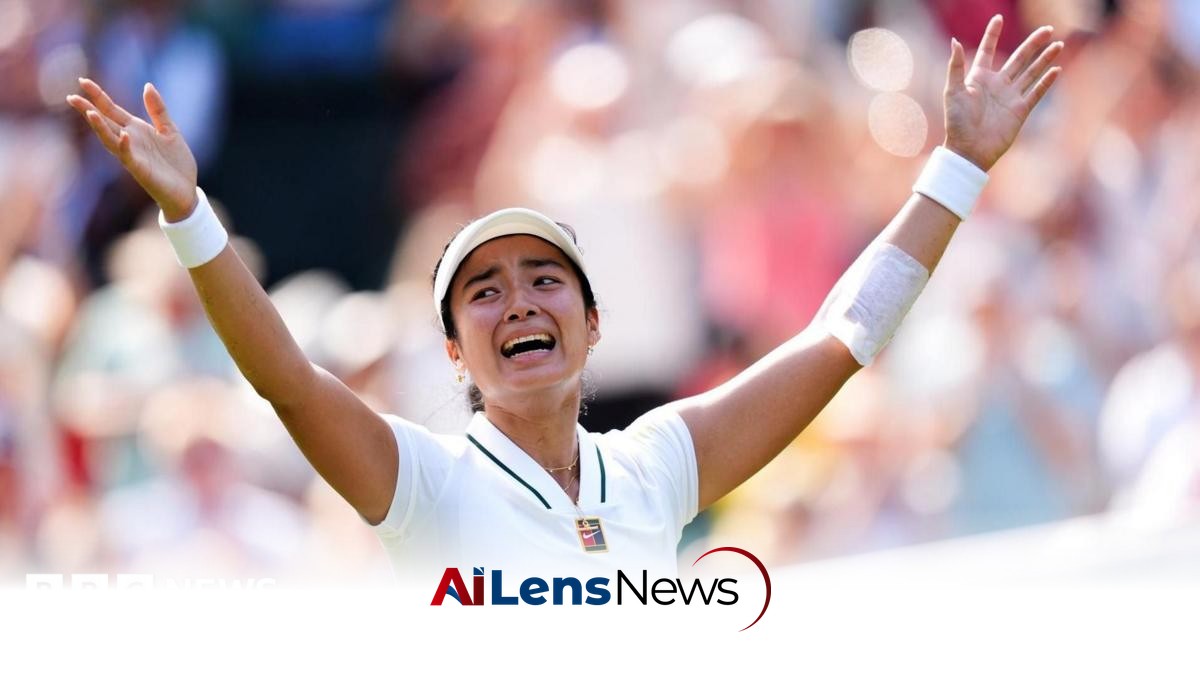


Teen athlete Maristella Torrecampo's inspiring journey reflects the growing passion for in the Philippines, ignited by Alex Eala's historic Wimbledon run.
New Delhi, India Jul 26, 2026 ALN: Chasing her dream of becoming a world champion, teen athlete Maristella Torrecampo and her father took a gruelling 13-hour bus from her sleepy hillside hometown for her latest match in Manila.
The 14-year-old's mum and four siblings could not join to watch her play; her crowdfunded budget was only enough for two round-trip bus tickets and a few days' worth of meals.
Barely rested from the long journey, and with only her father cheering her on, Torrecampo crushed her Omani opponent in straight sets 6-1, 6-1 on that sweltering Tuesday afternoon at the Rizal Stadium, keeping alive her dream of following in the footsteps of Alexandra Eala, the country's newest star.
Torrecampo competed in Manila in July as the Philippines was celebrating Eala's historic Wimbledon run - one that Torrecampo and the entire nation followed on streaming and social media.
Eala, 21, went the farthest any Filipina had gone in a Grand Slam event, reaching the fourth round and eliminating defending champion Iga Swiatek of Poland along the way.
Since her breakout semi-final performance at the Miami Open last year, Eala has re-ignited interest in in the Philippines, a country obsessed with the three B's - basketball, boxing and beauty queens.
To young players like Torrecampo, Eala is an inspiration.
"Like Ate Alex, I want to win at Wimbledon, WTA, and various tournaments around the world," Torrecampo said, referring to Eala with the Filipino word for elder sister.
"She inspired me so much. I looked up to her since I was little," said Torrecampo, who has competed in the Philippine National Games, and in tournaments in Cambodia and Sri Lanka.
"I like her attitude off and on court. Off court, she is really humble. There are a lot of kids like me who look up to her."
Eala came home from London to a hero's welcome, with President Ferdinand Marcos hosting a reception in her honour at Malacanang Palace in Manila.
"I'm so grateful that I am able to share my triumphs, most especially my recent run at Wimbledon, with the country," Eala said at the reception.
"As we say, this is our victory. I cannot begin to describe how overjoyed I am to see how my progress has been received by the Filipino people."
Such recognition from her compatriots, Eala added, made her feel "very seen".
A rich man's is an elite pastime in the Philippines, an archipelago nation of 112 million people.
Decades of American colonial rule bequeathed the nation with a passion for basketball. Every village has a basketball court and Filipinos are more likely to recognise LeBron James than Roger Federer.
Filipinos' love for rags-to-riches underdog stories and big personalities have also made boxing and beauty pageants just as popular. Boxing legend Manny Pacquiao is still the country's most popular athlete.
has historically been much less popular - until Eala burst onto the scene.
But this has also exposed how difficult it is for everyday Filipinos to take up the . courts are usually found in rich enclaves and equipment is expensive.
Court rentals in Manila cost around 2,000 pesos ($32; £19) per hour, meaning half a day's play costs half the minimum wage. Even for higher income earners, that's equivalent to a month's worth of groceries.
Coach Jovy Barce knows how hard it is to start playing from scratch, especially for the underprivileged.
Barce told the BBC he started as a ball boy picking up balls on the court as a six-year-old in Caloocan city, on the capital's outskirts. He said players would pay him 100 pesos or roughly two dollars, which he would split between himself and his mum for their household's groceries.
Then, when he was eight, Barce picked up a racket from the bin and started practising. Later, one of the players on the court gave him his old racket.
"Up until this day, I couldn't explain how happy I was when I got it. I used it over and over until I became so confident," Barce said. "No one taught me. I never had a professional coach. It was all self-study."
Barce put himself through college on a s scholarship. He worked at a hotel and as a motorcycle delivery man, but eventually pursued a career in coaching, starting with just 40 balls.
"I started from nothing, but I tried my best to learn everything because I really wanted to become a coach," he said.
"I practised every day. I was always focused. I did not have the chance to compete abroad since I do not have the money or big sponsors. I only competed in Metro Manila and provinces nearby."
Eala, meanwhile, has been criticised for her elite background. She studied at the Rafael Nadal Academy in Spain. Her mother is a former telecommunications executive while her father is a businessman from a prominent family.
Eala was also seen dancing onstage with Bad Bunny during the Puerto Rican star's concert in Sweden.
But she has taken such criticisms in stride, saying critics fail to see her hard work behind the scenes.
Eala's homecoming from Wimbledon showed how big a star she has become.
Big name sponsors mounted fan events, including a meet-and-greet at a shopping mall in Metro Manila's business district of Makati. Many came with their families.
Some, like Federico Perez and his wife Gilia, drove hours from nearby provinces. The couple booked a hotel to get to the event early and secure the best possible view, even though they didn't have tickets.
"We hope to see Alex in person and hopefully she can sign this. Even if this magazine was published a year ago, I still bought it because it has Alex on the cover," Gilia Perez said.
She said her husband never fails to watch Eala's Wimbledon matches, even if they air in the Philippines late at night.
Eleven-year-old Luca Ong, a young fan, came with his parents.
"My goal in the future is to become the next Alex Eala or Rafa Nadal so that I can represent the Philippines in the future," he said.
Eala's hot streak has also energised hobbyists.
At a Manila court, Celso Mugot said his determination to learn the had intensified because of Eala's success. The 33-year-old accountant has been training for three months to keep fit and unwind after work.
"I was definitely inspired by Alex Eala. I saw her progress. I watched her when she was still in a low rank until she climbs up," Mugot told the BBC.
Rafael Santos, a 29-year-old information technology professional, also recently took up . He said booking courts had been difficult since Eala's breakout Miami Open run last year.
"There are only a few courts in Manila while there are a lot of people who wanted to play and train. That's a bit of a let-down," Santos said.
He said shoes and apparel were also either sold out or in short supply, and some stores had jacked up racket prices.
Felino Palafox, a renowned Filipino architect and urban planner, told the BBC that space was a major challenge in building more courts. Metro Manila is home to close to 16 million people and is one of the world's most densely populated urban centres.
Meanwhile, every village in the Philippines has a basketball court that is easily converted into a beauty pageant runway, and boxing gyms run by prizefighters are spread across major cities.
"Ideally, every barangay (village) should have a court, not just basketball courts," Palafox told the BBC.
"We are fighting for (space for) activities."
Eala is now preparing for the US Open in August, seeking to raise the Philippines' status in even higher.
"That's a wrap on Manila. Thank you for welcoming me, my countrymen," she said in an Instagram story.
"Each and every one of your stories has touched me."
To learn more about the latest developments in Tennis, stay updated with our exclusive reports and analyses on AiLensNews.

