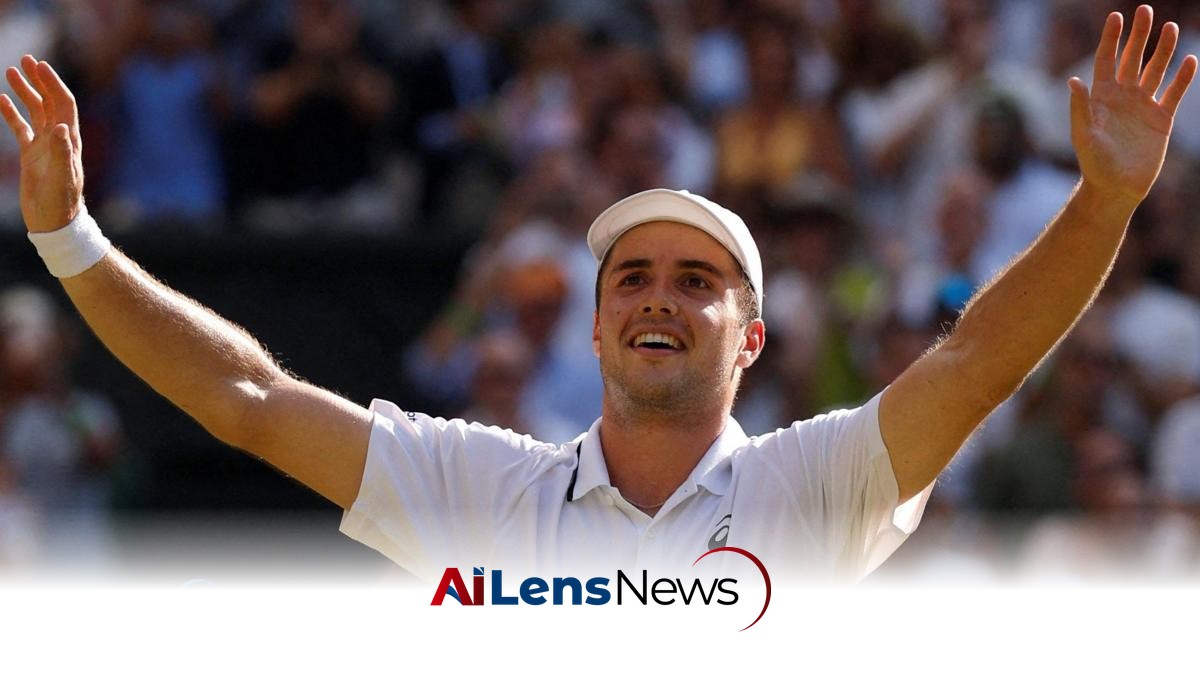


Arthur Fery, a British wildcard, defied the odds to reach the Wimbledon semi-finals, showcasing remarkable talent and composure throughout the tournament.
New Delhi, India Jul 9, 2026 ALN: By all tangible measures, Arthur Fery should not be in a Wimbledon semi-final.
The 23-year-old was given a wildcard into his home Grand Slam, having been ranked 114th in the world before the start of the tournament. Fery's entry into Wimbledon as a wildcard is a significant aspect, as it highlights the tournament's commitment to nurturing emerging talent and providing opportunities for players who may not have the ranking to qualify directly. Wildcards are often awarded to players based on their potential, past performances, or even as a means to promote local talent, and Fery's case is a perfect example of how this system can lead to unexpected and thrilling outcomes.
Fery had never gone beyond the second round at one of the major tournaments, while this is only his fifth appearance at a Grand Slam. His previous experiences at these high-stakes events were limited, which makes his current success even more remarkable. The pressure of competing at a Grand Slam can be overwhelming, with the eyes of the world on the players and the stakes higher than ever. Yet, Fery has managed to rise to the occasion, demonstrating not just skill but also mental fortitude.
But, with each remarkable victory, he is rewriting history at the All England Club. The journey of a player from the lower ranks to the semi-finals of Wimbledon is a narrative that resonates deeply with fans and aspiring athletes alike. It serves as a reminder that with hard work, dedication, and a bit of luck, anything is possible in s.
"This is one of the best feel-good stories of the year," Australia's former Wimbledon doubles champion Todd Woodbridge said on BBC TV. Woodbridge's sentiments reflect a broader appreciation for underdog stories in s, where the triumph of an unlikely hero can inspire and uplift fans around the world. In many ways, Fery's journey has become a symbol of hope for those who dream of achieving greatness against all odds.
"I'm not even British and I'm feeling that emotion! You just don't want Arthur Fery to wake up because he is just playing such extraordinarily well." These words encapsulate the universal appeal of Fery's performance. His ability to connect with audiences, regardless of nationality, underscores the power of to unite people through shared experiences and emotions.
Not since Goran Ivanisevic's memorable run to the title has a wildcard reached this heady stage of Wimbledon. Ivanisevic's victory in 2001 is etched in the annals of history, and Fery's achievement draws parallels to that iconic moment. Both players faced their own set of challenges and pressures, yet they managed to overcome them to reach the pinnacle of the .
The Croat delivered one of the tournament's most unforgettable moments 25 years ago by going on to win the title at SW19. Ivanisevic's win was celebrated not only for its rarity but also for the emotion and drama that surrounded it. Fery's current run has reignited discussions about the potential for wildcards to achieve greatness, challenging the notion that only top-seeded players can dominate in such prestigious tournaments.
Fery is also the lowest-ranked player to make Wimbledon's last four since Ivanisevic in 2001. This statistic adds a layer of significance to his achievements, as it highlights the rarity of such occurrences in the modern era of , where rankings are often seen as a predictor of success. Fery's performance challenges conventional wisdom and serves as a reminder that talent and determination can sometimes outweigh established metrics.
As he continues to captivate a nation on the tournament's centre stage, just a short walk from where he grew up, this Fery-tale run does not appear bound by precedent. The narrative of a local boy rising to prominence in his home tournament resonates deeply with fans and evokes a sense of nostalgia and pride. It serves as a reminder of the personal stakes involved in professional s, where players often carry the hopes and dreams of their communities with them.
"The man who grew up so close to Centre Court now seems to own it," said BBC commentator Andrew Cotter. Cotter's observation speaks to the emotional connection that players can develop with their home venues, and how that connection can enhance their performance. Fery's familiarity with the grounds may have contributed to his confidence and comfort on the court, further fueling his success.
On Wednesday, in scorching afternoon heat, Fery's sensational Wimbledon soared to even greater heights as he dismantled world number 10 and French Open runner-up Flavio Cobolli in straight sets. This victory was not just a personal achievement for Fery; it was a statement to the world about his capabilities and potential. By defeating a top-ranked player, he solidified his place among the elite and demonstrated that he is not merely a flash in the pan.
He dropped to the ground, almost in slow motion, as close to 15,000 supporters erupted in celebration and began chanting his name. The atmosphere at Wimbledon is often electric, and Fery's ability to elicit such a passionate response from the crowd speaks volumes about his charisma and the connection he has forged with fans. Moments like these are what athletes live for, and Fery's reaction underscores the joy and relief that come with achieving a hard-fought victory.
These were scenes his younger self could only have dreamed of when he would visit Wimbledon to watch matches as a child. The journey from spectator to participant is a common dream for many athletes, and Fery's story serves as an inspiration for young players everywhere. It illustrates the importance of perseverance and belief in oneself, even when the odds seem stacked against you.
"For someone that, totally unexpectedly, has made it this far, the moment hasn't seemed to overwhelm him in any matches," said seven-time Grand Slam singles champion John McEnroe. McEnroe's words highlight Fery's mental resilience, a crucial trait for success in high-pressure situations. The ability to remain calm and focused, regardless of the circumstances, is a hallmark of great athletes and is often what separates the best from the rest.
"For Cobolli, just to give in that way tells you something about the level he was playing at. This guy's just got to the French Open final. He went away because of what he was feeling from Fery's side." This comment from McEnroe sheds light on the psychological aspects of the game. Fery's performance not only showcased his skill but also had a palpable effect on his opponent, indicating that confidence and momentum can play a significant role in competitive s.
Fery achieved his latest, most impressive win to date in a style at complete odds with the journey that had taken him there. He dropped the opening set in his first two matches and then required match tie-breaks to overcome Zizou Bergs and Grigor Dimitrov in five-set thrillers. These experiences, while challenging, likely contributed to his growth as a player. Learning to navigate adversity is a vital part of an athlete's development, and Fery's ability to adapt and overcome has been a testament to his character.
Having twice been a set and a break down against Bergs in the third round - including going 4-1 down in the fifth set - he also had to take three medical timeouts after suffering a nosebleed. Such incidents can be disheartening for players, but Fery's determination to push through these setbacks speaks to his inner strength and commitment to his goals. The ability to maintain focus and composure in the face of adversity is a quality that many successful athletes share.
Making his first appearance on Centre Court, he twice went a break down in a must-win fourth set against Dimitrov, before the 35-year-old Bulgarian's own nerves appeared and Fery capitalised. This match showcased Fery's tactical awareness and ability to seize opportunities when they arise. In high-stakes situations, players must be able to read the game and adjust their strategies accordingly, and Fery's performance demonstrated that he possesses this critical skill.
But, at two hours and 14 minutes, his match against Cobolli was his shortest of the tournament so far. The contrast in match durations highlights the varying challenges that players face throughout a tournament. While longer matches can be physically and mentally exhausting, shorter victories can be equally significant, as they allow players to conserve energy for subsequent rounds.
Fery has spent 16 hours and 20 minutes on court in total - his match against Bergs lasted four hours and 39 minutes alone - yet he showed no sign of fatigue against his Italian opponent. This endurance is a testament to his physical conditioning and mental fortitude. Athletes often train for countless hours to build the stamina required for high-level competition, and Fery's ability to maintain his performance levels throughout the tournament speaks to the effectiveness of his preparation.
Roared on throughout by a partisan crowd, Fery demonstrated unshakeable composure as he picked apart the below-par Cobolli, who lost June's French Open final to Alexander Zverev in five sets and made the last eight at Wimbledon last year. The support of the crowd can be a double-edged sword; while it can provide motivation, it also brings increased expectations. Fery's ability to thrive under such conditions indicates a maturity beyond his years and a readiness to compete at the highest levels of the .
"What I've been so impressed with is Fery's belief," added former British number one Tim Henman. Henman's insights underscore the importance of self-belief in s. Confidence can significantly impact a player's performance, influencing their decision-making and execution during critical moments.
"When you go out on Centre Court for the first time and you are a British player, you have the hopes and expectations of a lot of people on your shoulders. He has good IQ, he is a phenomenal mover. The way he has handled the occasion is impeccable. When opportunities have been earned, he has taken them." These observations highlight Fery's tactical intelligence and physical prowess, both of which are essential for success in . His ability to read the game and respond accordingly has been a key factor in his impressive run.
Fery will now turn his attention to an upset even more monumental than the last. The pressure of facing a top player like Zverev presents a new set of challenges, but it also offers an opportunity for Fery to showcase his skills on an even larger stage. The prospect of competing against a formidable opponent can be both daunting and exhilarating for young athletes.
Germany's world number three Zverev, who ended his wait for a first major title in Paris, awaits on Friday. Zverev's recent success adds another layer of complexity to the upcoming match, as he will likely be riding a wave of confidence following his Grand Slam victory. The dynamic between an up-and-coming player like Fery and an established star like Zverev will be fascinating to watch, as it pits youth against experience.
The big-hitting 29-year-old, now free from his tag as arguably the best men's player never to win a Grand Slam, produced a dominant display to defeat American Taylor Fritz and reach his first Wimbledon semi-final. Zverev's journey has been marked by both triumphs and struggles, and his evolution as a player will serve as a compelling backdrop to the match against Fery.
Seven-time Grand Slam doubles champion Jamie Murray said: "Fery will have the unknown factor against Zverev. He needs to use that to his advantage. I'm sure Zverev will have seen him play a bit this week, but it is different to actually being on the court and facing him." Murray's insights reflect the unpredictability of s, where the element of surprise can often play a crucial role in determining the outcome of a match. Fery's relative anonymity compared to Zverev may work in his favor, allowing him to approach the match with a sense of freedom and creativity.
In conclusion, Arthur Fery's remarkable journey to the Wimbledon semi-finals serves as a testament to the power of belief, resilience, and the unpredictability of s. His story resonates with fans and aspiring athletes alike, reminding us that the path to success is often filled with challenges and surprises. As he prepares to face a formidable opponent in Zverev, the world will be watching closely, eager to see if Fery can continue to defy the odds and write the next chapter in his inspiring tale.
To learn more about the latest developments in Tennis, stay updated with our exclusive reports and analyses on AiLensNews.

