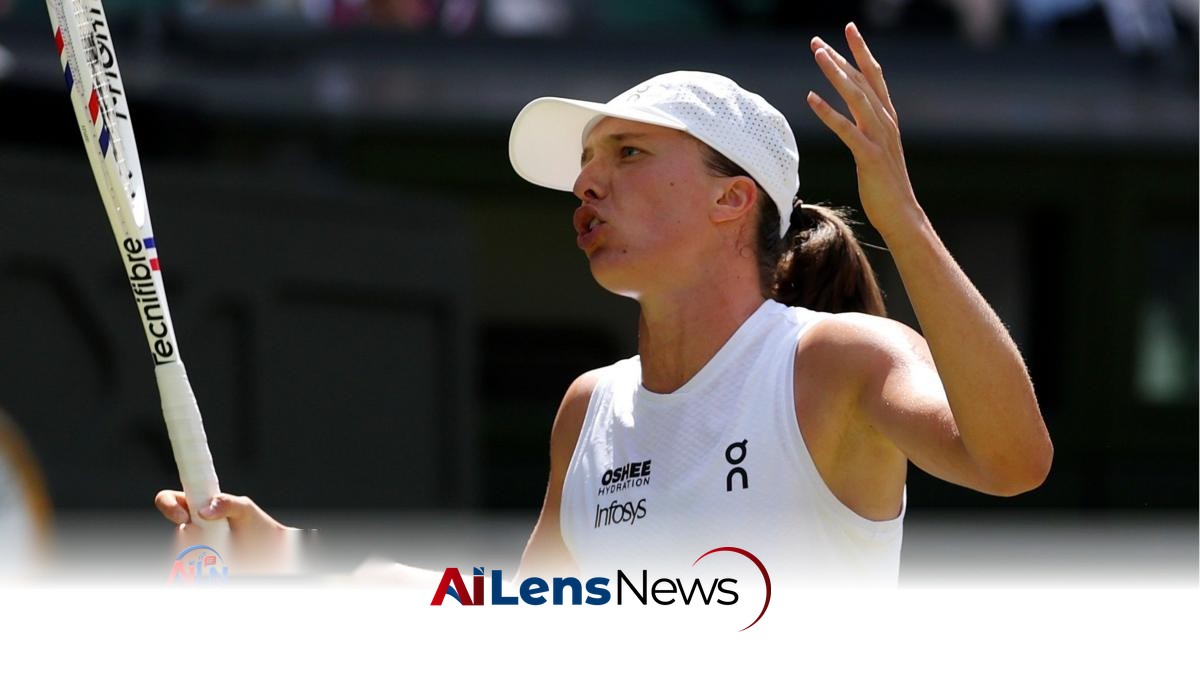


Defending champion Iga Swiatek and second seed Elena Rybakina exit Wimbledon in surprising third-round losses, paving the way for Aryna Sabalenka's continued reign as world number one.
New Delhi, India Jul 4, 2026 ALN: Defending champion Iga Swiatek followed second seed Elena Rybakina out of the door at Wimbledon on a day of upsets on Saturday.
Third seed Swiatek, a six-time Grand Slam champion, fell 7-6 (11-9) 6-2 to highly rated Filipina Alexandra Eala in an enthralling third-round match on Centre Court. The loss for Swiatek was particularly surprising given her status as the reigning champion and her previous success at the tournament. Her defeat marks a significant moment in the tournament's history, as it underscores the unpredictable nature of , especially in Grand Slam events.
That came an hour after 2022 champion Elena Rybakina was beaten 7-6 (7-4) 6-1 in the third round by Belgium's Elise Mertens. Rybakina, who has had a strong season, including her triumph at the Australian Open earlier this year, was expected to be a strong contender for the title again this year. However, her early exit raises questions about her consistency and ability to perform under pressure at Wimbledon, a tournament known for its unique grass surface and high-stakes atmosphere.
Rybakina's loss means Aryna Sabalenka will remain as the women's world number one, regardless of how deep into the tournament the Belarusian goes. Sabalenka's position at the top of the rankings is a testament to her impressive performances throughout the season, but Rybakina's defeat was a crucial moment that solidified Sabalenka's lead. The implications of this result extend beyond just the rankings; it highlights the competitive landscape of women's , where several players are vying for top positions.
Her defeat is arguably more shocking than Swiatek's, who has had a difficult run of form since winning Wimbledon last year. Swiatek's struggles have been evident in her inability to replicate her previous success, raising concerns about her mental and physical readiness for high-pressure matches. She had a shaky start to her title defense, ending up in tears after coming through a tight three-set opening match against Taylor Townsend. This emotional display suggested the immense pressure she feels as the defending champion, which may have contributed to her performance in subsequent matches.
But this match against Eala - who had her breakthrough moment with victory over Swiatek at the 2025 Miami Open - always had the potential to wrongfoot the defending champion. Eala, a rising star in women's , has garnered attention for her talent and determination. Her victory over Swiatek at Miami was a significant milestone, and it seems to have given her the confidence needed to challenge top players on the big stage. Eala threw herself to the ground and covered her face with her hands after saving four break points before converting her third match point in a lengthy final game. This emotional response underscores the pressure and significance of the moment for her, as she becomes a representative of her country on an international stage.
Swiatek's defeat means no woman has successfully defended the singles title at Wimbledon since Serena Williams in 2016. This statistic highlights the difficulty of maintaining peak performance in such a prestigious tournament, where the competition is fierce and the stakes are high. The inability of recent champions to defend their titles adds to the narrative of unpredictability in women's , making each tournament a fresh opportunity for new champions to emerge.
Last year's beaten finalist Amanda Anisimova also fell 3-6 6-2 6-3 to fellow American and former Australian Open champion Madison Keys later on Saturday. Anisimova's defeat adds to the list of upsets, as she was expected to build on her previous success and make a deeper run in the tournament. A tearful Anisimova said afterwards it was "really hard to see a silver lining" after struggling for form in an injury-disrupted year. Her candid reflection on her performance reveals the emotional toll that competitive s can have on athletes, particularly when they are unable to perform to their potential.
"For me, it wasn't enjoyable to play today with my being like that," said the 24-year-old. "I feel like I'm doing everything I can and working really hard. So for my game to still be at this point, it's really hard to take." Anisimova's struggles epitomize the challenges faced by many professional athletes, who must balance the pressures of competition with their mental and physical well-being.
Winning Wimbledon was a highlight of a difficult last season for Swiatek - a theme that has continued into this year. The expectations placed on her as a former champion and a top-ranked player have undoubtedly weighed heavily on her, and her inability to secure a title since her Wimbledon victory reflects the challenges of maintaining form in a where competition is continually evolving. She has not won a major since her SW19 triumph last year and has yet to win a title in 2026, raising questions about her future performance and strategy moving forward.
Eala, meanwhile, has been on the rise since Miami and won the WTA 125 title on the Birmingham grass courts in the build-up to Wimbledon. Her recent success indicates that she is a player to watch in the coming years, as she continues to develop her game and gain experience in high-pressure situations. A star in her home country, Eala has the pressure of her nation on her shoulders every time she walks on court - and she made a nervous start against the former world number one. However, her ability to overcome that initial anxiety and secure a historic victory is a testament to her talent and resilience.
The pair could not be separated in a tight first set after an early exchange of breaks, although momentum was with Swiatek as she stopped Eala serving the set out at 5-3 and forced a tie-break. The tension in the match was palpable, as both players fought for every point. Brilliant rallies were followed up with errors, but Eala, gesturing for more noise from the crowd following a superb rally, clinched the opener on a long Swiatek forehand. This moment of triumph for Eala was a turning point in the match, as it shifted the momentum in her favor.
Swiatek yelled at her box before going off court to reset, only to quickly find herself 4-0 down. This moment of frustration highlights the mental challenges that players face during matches, particularly when they are underperforming. Her quality dipped in and out as she rescued one of the breaks and gave it away in the next game, and then put Eala under pressure as she served for the match - only for the Filipina to be the braver of the pair on the break points. Swiatek finished the match with 44 unforced errors and five double faults to one ace, with the final point fittingly being a long forehand from the frustrated Pole. This statistic illustrates the level of inconsistency that plagued her performance throughout the match, ultimately leading to her early exit.
Eala - the first player from the Philippines to reach the fourth round of a Grand Slam in the Open era - will face 2024 runner-up Jasmine Paolini next. This upcoming match presents another opportunity for Eala to showcase her skills and continue her impressive run at Wimbledon, while also serving as a reminder of the potential for new talent to rise in the world of .
It is the second successive year that Kazakhstan's Rybakina - who was crowned Australian Open champion in January - has failed to reach the second week at Wimbledon. This pattern of early exits raises questions about her adaptability to the grass surface and her ability to perform consistently at major tournaments. With just 947 points separating Sabalenka and Rybakina in the world rankings prior to the start of the grass-court Grand Slam, 27-year-old Rybakina had to reach at least the quarter-finals to stand any chance of challenging for top spot. The pressure to perform in such a high-stakes environment can be overwhelming, and Rybakina's struggles highlight the intense competition among the top players.
She was taken to a deciding set by France's Lois Boisson in her opening match but faced no such issues against American Caty McNally in the second round, dropping just three games on her way to a comprehensive victory. However, Mertens proved her undoing, and after a tight opening set went in the Belgian's favor on the tie-break, Rybakina failed to recover. Mertens won nine points in succession in a dominant second set before defying late jitters on serve - which led to two wasted match points - to clinch victory with an ace. This sequence of events illustrates the unpredictable nature of , where momentum can shift rapidly, and even the most seasoned players can falter under pressure.
Overall, the early exits of Swiatek and Rybakina from Wimbledon serve as a reminder of the fierce competition in women's and the ever-changing dynamics of the . As new players like Eala emerge on the scene, the landscape of women's continues to evolve, presenting both challenges and opportunities for established stars. The implications of these upsets will resonate throughout the remainder of the tournament and beyond, as players reassess their strategies and prepare for future competitions.
To learn more about the latest developments in Tennis, stay updated with our exclusive reports and analyses on AiLensNews.

