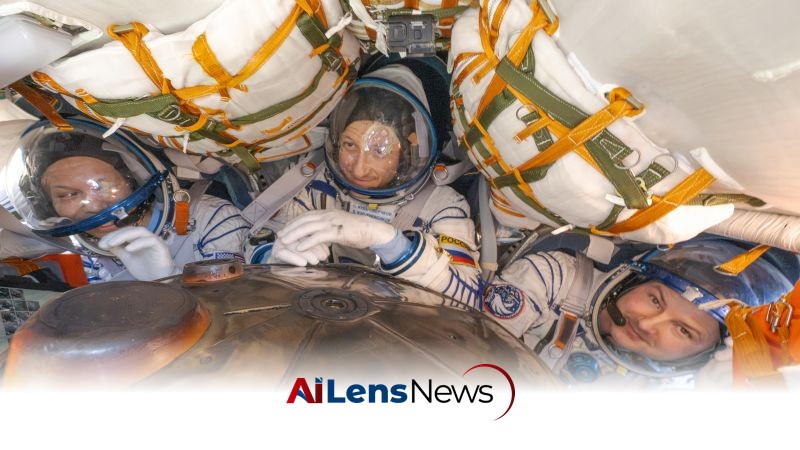


A US-Russian crew has successfully landed in Kazakhstan after an eight-month stay on the International Space Station, marking a significant collaboration in space exploration.
Washington DC, United States Jul 26, 2026 ALN: A US-Russian space crew landed safely in the steppes of Kazakhstan on Sunday after an eight-month stint on the International Space Station (ISS). This return marks a significant milestone not just for the crew members but also for international cooperation in space exploration, particularly between two nations that have a complex history.
The crew, which included NASA astronaut Chris Williams and Russian cosmonauts Sergei Kud-Sverchkov and Sergei Mikaev, touched down in their Soyuz MS-28 spacecraft. The landing was executed smoothly by parachute in a designated area southeast of Dzhezkazgan, a city that has become a familiar location for returning space crews due to its proximity to the Baikonur Cosmodrome, from where many missions are launched. The successful landing is a testament to the rigorous training and preparation that both NASA and Roscosmos crews undergo prior to their missions.
Williams and Mikaev completed their first space missions, while Kud-Sverchkov returned for his second mission. The crew's 241-day stay aboard the ISS involved conducting a variety of scientific experiments and maintenance tasks critical to the ongoing operations of the space station. The ISS serves as a unique laboratory where research can be conducted in microgravity, and the data gathered from these experiments can have far-reaching implications for science, technology, and even medicine on Earth. This mission included experiments in various fields such as materials science, biology, and technology demonstrations that aim to improve life on Earth and support future deep-space exploration.
Following their landing, the crew will be flown by helicopter to Karaganda, a city that serves as a hub for returning astronauts and cosmonauts. From there, Williams will board a plane to return to NASA’s Johnson Space Center in Houston, Texas. Meanwhile, Kud-Sverchkov and Mikaev will take a flight to their training base in Star City, located just outside Moscow. This process of returning to familiar ground after a long mission is crucial for the crew to undergo debriefings and medical evaluations, as well as to reconnect with their families and colleagues. The transition back to life on Earth can be challenging for astronauts, as they must readjust to gravity and the routines of everyday life after spending months in a microgravity environment.
The relationship between the United States and Russia in space exploration has evolved significantly since the Cold War era, which was characterized by fierce competition and rivalry. The two nations were engaged in a space race that saw monumental achievements, such as the launch of Sputnik by the Soviet Union in 1957 and the Apollo moon landings by the United States in the late 1960s and early 1970s. However, the end of the Cold War opened the door for collaboration, leading to joint missions and shared research aboard the ISS, which has been continuously inhabited since November 2000. This collaboration has not only advanced scientific research but has also fostered a sense of camaraderie among astronauts and cosmonauts, who often work side by side on the ISS regardless of their nationalities.
Despite the ongoing geopolitical tensions, particularly following Russia's military actions in Ukraine in 2022, cooperation in space has largely persisted. Both the U.S. and Russia have maintained a commitment to working together on the ISS and other scientific endeavors. This partnership is underscored by the fact that both nations have continued to send crews to the ISS using each other's spacecraft. Such collaboration highlights the importance of science and exploration as a means to bridge divides and foster dialogue, even in challenging times. The ISS has become a symbol of what can be achieved when nations put aside their differences and work towards common goals.
The ISS is not only a testament to what can be achieved through international cooperation but also serves as a platform for future endeavors in space exploration. The arrival of new crews, such as the one that launched on July 14, consisting of NASA astronaut Anil Menon and Roscosmos cosmonauts Pyotr Dubrov and Anna Kikina, signifies the ongoing commitment to maintaining a human presence in low Earth orbit. This crew joined NASA astronauts Jessica Meir and Jack Hathaway, European Space Agency astronaut Sophie Adenot, and Roscosmos cosmonaut Andrei Fedyaev as part of Expedition 75, further contributing to the scientific output of the ISS. The continuous rotation of crews ensures that the station remains active and that research can continue uninterrupted.
The continuous rotation of crews aboard the ISS allows for a diverse range of scientific research, including studies in biology, human physiology, physics, and Earth sciences. The experiments conducted in microgravity can lead to breakthroughs that are not possible under normal Earth conditions. For instance, research on the effects of microgravity on muscle atrophy and bone density has implications for understanding aging and health on Earth, as well as for long-duration space missions to destinations like Mars. Additionally, the ISS has been instrumental in testing technologies that will be essential for future missions to the Moon and beyond, including life support systems and habitat designs.
As the ISS approaches the end of its operational lifespan, discussions about its future and the next steps for human space exploration are becoming increasingly important. The collaboration between the U.S. and Russia, alongside contributions from other international partners, will play a vital role in shaping the future of space exploration, whether it be through the establishment of a lunar base, missions to Mars, or the development of new technologies that can facilitate deeper space travel. The Artemis program, which aims to return humans to the Moon and establish a sustainable human presence there, relies heavily on the lessons learned from the ISS and the collaborative efforts of various international space agencies.
In summary, the safe return of the US-Russian crew marks not only the end of another successful mission aboard the ISS but also highlights the resilience of international cooperation in space despite geopolitical challenges. As humanity looks toward the stars, the lessons learned from joint missions and the shared pursuit of knowledge will undoubtedly pave the way for future exploration and discovery. The ISS remains a beacon of hope and a reminder of the potential for collaboration in the face of adversity, inspiring future generations to continue exploring the unknown and expanding our understanding of the universe.
To learn more about the latest developments in Space & Astronomy, stay updated with our exclusive reports and analyses on AiLensNews.

