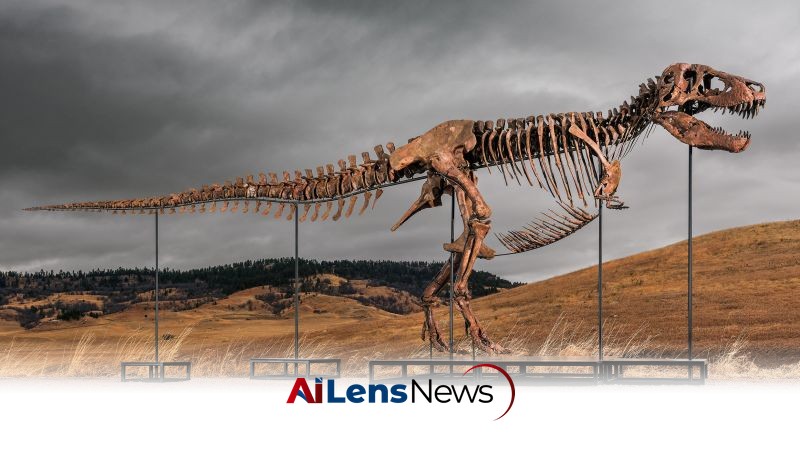


A T. rex skeleton named 'Gus' from South Dakota is poised to become the most expensive fossil ever sold, raising concerns about private ownership and scientific access.
Washington DC, United States Jul 14, 2026 ALN: Before he became the namesake of one of the largest predators that ever lived — or made it into the footnotes of an auction catalog — the late Gary “Gus” Licking, a cattle rancher in South Dakota, had always suspected his land was hiding something big.
The Licking ranch sits within the Hell Creek Formation, a legendary geological boneyard that stretches across Montana, Wyoming, and the Dakotas. It’s the most important place in the world for the most famous of dinosaurs, Tyrannosaurus rex. One of the first skeletons of T. rex was found there in 1902, and the name T. rex was given to the species based on fossils unearthed in this area.
Stan, an almost-complete T. rex skeleton discovered miles up the road from Licking’s place, sold at auction in 2020 for $31.8 million, a record at the time.
Now, the rancher’s 6,500-acre property in Harding County is writing its own chapter in Hell Creek history, having yielded a fossil near the magnitude of Stan. Named Gus in honor of Licking, the newer skeleton is set to be auctioned Tuesday at Sotheby’s in New York City, when it could become the world’s most expensive fossil.
But Gus’ sale, likely into private hands, is also bound to spark controversy because of what it represents: a paleontological predicament in which experts say ownership and stewardship are increasingly at odds — and science is usually the loser.
In Gus’ case, this conundrum began with a chance encounter. Licking had found dinosaur teeth and bones over the years, only dreaming of a bigger find until he met a stranger who would make it a reality. “I was passing by the ranch randomly one day and Gary was checking a watering trough near the road, so I stopped and introduced myself,” said Thomas Heitkamp, a commercial paleontologist and founder of Theropoda Expeditions, a Texas-based company that specializes in excavating fossils on private land.
“The Licking ranch had been on my radar because of its location within the Hell Creek formation. Gary had always been interested in fossils and artifacts, and he had quite a good collection of things he had found in his home,” Heitkamp told CNN in an email. “I think he knew how fossil-rich his property was from spending so much of his life there, and he believed if it was hunted thoroughly enough, a specimen might be found someday. I’m happy we were able to give him that experience.”
Heitkamp and his team discovered Gus on Licking’s land in 2021. Licking singled out the skeleton’s approximate location, but he died before the team completed the excavation and never saw the specimen in its full glory.
At 38 feet in length and 12.5 feet tall, with a skull measuring 54 inches, Gus is one of the largest T. rexes ever found, according to Sotheby’s. It includes 183 fossil bone elements, making it about 61% complete by bone count, or 75% to 80% complete by mass.
The auction house said Gus is one of the most complete T. rex fossils ever found, but the specimen is less complete than both Stan, which is about 70% complete by bone count, and Sue — the first dinosaur fossil sold at auction in 1997. The latter skeleton set the standard with its impressive 90% completeness. Gus also reportedly shows bite marks and evidence of fractures that the dinosaur survived, which Sotheby’s said may add to its scientific significance.
However, no scientific work has been published on Gus, because most researchers will refuse to formally study a privately held specimen. Heitkamp said that “several independent researchers” have already seen Gus informally, but the sale — perfectly legal because the fossil comes from private land — is destined to reignite the debate about fossil auctions and the potential disappearance from the public realm of T. rex skeletons, the majority of which are already in private hands.
“If this specimen goes to a private individual, it may or may not ever be seen by the public again,” said Stuart Sumida, a professor of biology at California State University, San Bernardino, and president of the Society of Vertebrate Paleontology, or SVP, an organization that firmly opposes fossil sales. When a fossil ends up in private hands, its future is uncertain. Some fossils are loaned to institutions such as museums, while remaining privately owned, while others wind up in private collections and disappear from the public realm.
“Not only that, it will never be subjected to actual proper scientific study — no reputable journal in the world will publish a scientific study based on something that’s not held in the public trust,” Sumida added.
SVP mandates its members study only specimens held in publicly accessible collections. Doing so is the only way that other scientists can access the same specimens for further study — something that can’t be guaranteed with private ownership.
“If you sell something, it’s generally lost to science,” Sumida said. And there are few clear ways to turn back the clock.
Heitkamp said his team had been hiking around Licking’s ranch for a year before finding Gus in a small valley with little visible bedrock, which is why it had been missed earlier. “It was immediately clear that the fossil material was from a T. rex, which is always exciting to see,” he said.
Heitkamp, who started his career cataloging fossils at Bonhams auction house in Los Angeles before founding Theropoda Expeditions in 2012, excavated the Licking site over the course of three field seasons, from 2021 to 2023. He and his team could only work for about five months each year when the ground wasn’t frozen.
“We hand dug an area of roughly 7,000 square feet to collect all of the material,’ he said. “The site had several natural faults, which made tracking the fossil layer more difficult. The sheer number of bones over that wide of an area definitely provided its technical challenges.”
After the excavation, an equal amount of lab work followed to properly isolate, identify and clean up the bones, as well as fill in gaps left by missing bones using sculpted pieces made of epoxy resin, and finally mounting the skeleton in a “predatory pose” on a custom steel armature, according to Sotheby’s.
Apart from its large size, Gus has other aspects that make it desirable. The skull has about 82% of the original bones represented, and the skeleton includes rarely found components such as the wishbone, a complete pelvis, and both feet. Sotheby’s said only one other specimen is known to have two well-represented feet.
Sotheby’s estimates that Gus will go for up to $30 million, but that amount is likely a conservative number. The current record holder for a fossil auction — Apex the Stegosaurus, bought in 2024 by billionaire Ken Griffin — had a presale estimate of up to $6 million but went for $44.6 million.
To learn more about the latest developments in Research & Discoveries, stay updated with our exclusive reports and analyses on AiLensNews.

