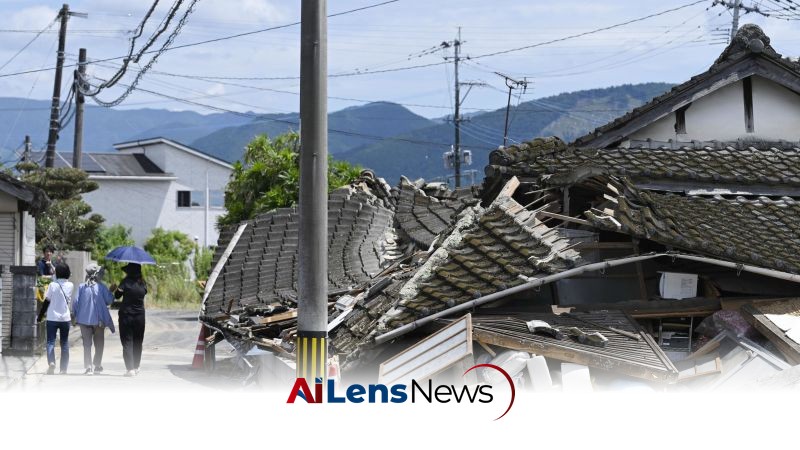


Japan, situated on the boundary of four tectonic plates, experiences frequent and devastating earthquakes. Recent events highlight the country's preparedness and ongoing risks.
Washington DC, United States Jul 30, 2026 ALN: Almost no other country in the world is rocked by such frequent and damaging earthquakes as Japan – an island nation that sits on the boundary of four tectonic plates, the constantly-shifting slabs of the Earth’s crust. This geographical positioning makes Japan one of the most seismically active regions on the planet. The tectonic plates involved include the Pacific Plate, the Philippine Sea Plate, the Eurasian Plate, and the North American Plate, all of which interact in complex ways, leading to frequent seismic activity.
Japan also lies on the “Ring of Fire,” a 25,000-mile arc that stretches around the Pacific, where the world’s most active volcanoes are located – and where the most earthquakes take place. The Ring of Fire is a direct result of tectonic activity, as it is the site of numerous subduction zones where one tectonic plate is forced under another. This subduction process not only triggers earthquakes but also leads to volcanic eruptions, making the region one of the most geologically dynamic areas in the world.
The impact of these quakes was on full display this week after a deadly 6.8-magnitude earthquake hit Japan’s southern Kumamoto prefecture, prompting thousands of emergency responders to mobilize in search, rescue, and relief efforts. The rapid response is indicative of Japan's well-established disaster preparedness protocols, which have been honed over decades of experience with seismic events.
Speaking Thursday, Prime Minister Sanae Takaichi reported that 30 people had died as a result of the earthquake. Earlier, Chief Cabinet Secretary Minoru Kihara stated that some deaths were being investigated to confirm their link to the disaster. This highlights the ongoing challenges faced by authorities in accurately assessing the full impact of such disasters in the immediate aftermath.
Japan is well-prepared for disasters like these, having invested billions of dollars into cutting-edge quake detection technology, response and evacuation systems, and quake-proof infrastructure. The country’s commitment to disaster preparedness is evident in its strict building codes, which mandate that new structures be designed to withstand significant seismic forces. Additionally, public education campaigns ensure that residents are aware of the risks and know how to respond in the event of an earthquake.
For residents, quakes are a regular part of life – children start practicing earthquake and evacuation drills from kindergarten. This ingrained awareness contributes to a culture of preparedness, yet the threat looms large in the public imagination, especially with the government regularly warning that Japan could eventually experience a once-in-a-century “megathrust earthquake.” Such a catastrophic event could result from the buildup of stress along the subduction zones, where immense tectonic forces are at play.
Tuesday’s earthquake struck around 4:30pm local time in Uki, a city with a population of 56,000 people, located south of the Kumamoto prefecture. The earthquake was significant enough to cause widespread panic, with residents reporting intense shaking and structural damage. A wave of aftershocks has since struck the region, with the strongest measured at 5.4-magnitude further south, according to the United States Geological Survey (USGS). Authorities have warned that similarly strong tremors could shake the region in the coming days, keeping residents on high alert.
Rescuers are still working to locate people trapped beneath the rubble – the quake brought down buildings, and a shopping mall in Kumamoto was partially destroyed after a suspected gas leak and explosion. The immediate aftermath of such earthquakes often sees a race against time to find survivors, with emergency services deploying advanced technology and trained personnel to assist in rescue operations.
Five individuals died in the Aeon Mall Kumamoto, while several others were killed when a chimney collapsed at a paper factory in Yatsushiro. The loss of life underscores the devastating impact of the quake, and the challenges faced by first responders in navigating hazardous conditions to save lives.
High temperatures are making the rescue efforts increasingly difficult. Authorities have warned residents about the dangers of heatstroke and are reminding people to stay hydrated, especially as temperatures are expected to pass 35 degrees Celsius (95 degrees Fahrenheit) from Thursday. The combination of an earthquake and extreme heat creates a challenging environment for both victims and rescuers alike.
The Kumamoto region had just recovered from a larger quake that hit in 2016, causing widespread damage and killing more than 270 people. The memory of that disaster still looms large in the community, and many residents are grappling with the psychological impact of repeated seismic events. “Why? Why does this keep happening around us here in Kumamoto?” local resident Shoji Yonemitsu expressed, reflecting the sentiments of many who have experienced the trauma of living in a quake-prone area. “The shaking back then was on a whole different level. But yesterday’s quake was still pretty terrifying,” he said, emphasizing the ongoing fear that accompanies life in such a volatile region.
Japan’s history is littered with devastating quakes. Throughout its classical and feudal eras, quakes regularly swept through cities and towns, wiping out structures made of wood and paper that were acutely vulnerable to fires breaking out in the aftermath. One particularly damaging quake in 1498 is thought to have killed more than 30,000 people, though estimates differ. Such historical events have shaped Japan’s approach to disaster management and urban planning.
The Great Kanto earthquake of 1923 was another devastating moment, laying waste to swathes of the capital Tokyo and killing some 140,000 people. This disaster had profound implications for urban development and disaster preparedness in Japan, leading to significant changes in building regulations and emergency response protocols.
Japan began introducing stronger building codes in the 1980s, which demonstrated their effectiveness in the 1995 Kobe earthquake, which killed more than 6,000 people. Nearly all of the collapsed buildings were built prior to the new codes, kickstarting a major drive to improve the country’s quake resilience, emergency response systems, and retrofitting older buildings with new standards. These efforts have significantly reduced the vulnerability of new constructions to seismic events.
As one of the world’s wealthiest nations, Japan was in a strong position to embrace technology and spending to fortify itself against the threat of tectonic catastrophes. Investments in sophisticated early warning systems, seismic monitoring networks, and public education programs have made Japan a global leader in earthquake preparedness. However, technology can only go so far in mitigating the risks associated with natural disasters.
The 2011 Tohoku disaster remains the worst in living memory – a magnitude-9.1 earthquake and tsunami that triggered the Fukushima nuclear meltdown and killed nearly 20,000 people. Thousands more were never found. It remains one of the strongest quakes of this century and serves as a stark reminder of the unpredictable and often devastating nature of seismic activity.
Smaller quakes can still routinely bring death; a magnitude-7.1 earthquake killed more than 700 in Noto in 2024, western Japan. Such incidents illustrate that while Japan has made significant strides in earthquake preparedness, the threat remains ever-present. The country’s experiences can serve as valuable lessons for other nations that share similar tectonic vulnerabilities.
Other countries such as Chile, Indonesia, the Solomon Islands, and the west coast of the United States all lie on the “Ring of Fire” on either side of the Pacific Ocean. It’s where the Pacific Plate – the oceanic plate that lies beneath the water – meets surrounding continental tectonic plates. When these plates move against each other and produce friction, energy builds up and is released through earthquakes. Understanding these tectonic processes is crucial for improving earthquake prediction models and enhancing global preparedness efforts.
To learn more about the latest developments in Environment & Climate, stay updated with our exclusive reports and analyses on AiLensNews.

