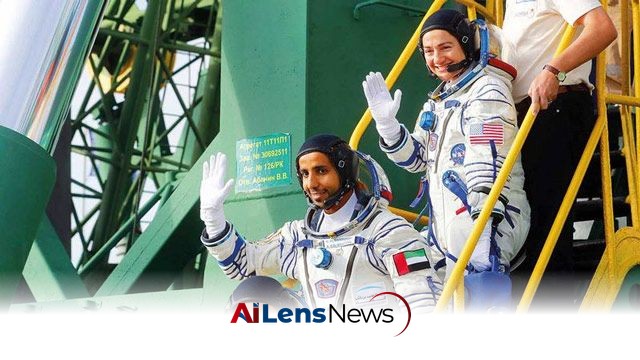


Hazzaa Al Mansoori, the first Emirati astronaut, shares insights from his groundbreaking mission aboard the International Space Station, emphasizing the importance of preserving Earth.
Abu Dhabi, United Arab Emirates Jan 6, 2020 ALN: The UAE Astronaut Programme was officially launched in April 2017, a significant milestone that reflects the United Arab Emirates' aspirations to contribute to the global space exploration narrative. This initiative was spearheaded by His Highness Sheikh Mohammed bin Rashid Al Maktoum, the Vice President, Prime Minister, and Ruler of Dubai, alongside His Highness Sheikh Mohamed bin Zayed Al Nahyan, the Crown Prince of Abu Dhabi and Deputy Supreme Commander of the UAE Armed Forces. The primary objective of this programme is to train and prepare a cohort of Emirati astronauts who would be dispatched into space to undertake various scientific missions that would not only enhance the UAE’s scientific capabilities but also position it as a significant player in the international space community.
Among the first batch of astronauts selected for this groundbreaking programme were Hazzaa AlMansoori and Sultan AlNeyadi. Their selection marked a pivotal moment in the UAE’s journey towards space exploration, as they were the first Emiratis to be trained for missions beyond Earth's atmosphere. The training took place at the Yuri Gagarin Cosmonaut Training Centre in Moscow, a well-respected institution known for its rigorous astronaut training programs. This training was made possible through a collaborative agreement between the Mohammed bin Rashid Space Centre and Roscosmos, the Russian space agency, which facilitated the astronauts' preparation for a mission to the International Space Station (ISS) scheduled for September 25, 2019. In this mission, Hazzaa AlMansoori served as the primary astronaut while Sultan AlNeyadi acted as his backup.
The training regimen for both astronauts was extensive and demanding, encompassing more than 90 courses and over 1,400 hours of rigorous preparation. This training was not limited to physical conditioning; it included a wide array of subjects such as spacecraft systems, emergency procedures, and scientific research methodologies. The astronauts also engaged in practical simulations and learned how to operate various equipment that would be used during their mission. The training was conducted under partnership agreements with several leading space agencies, including NASA (United States), ESA (European Space Agency), JAXA (Japan Aerospace Exploration Agency), and Roscosmos, across multiple locations including Moscow, Dubai, Houston, and Cologne.
Upon completing their training, Hazzaa AlMansoori embarked on his historic space mission. During his time aboard the ISS, he shared valuable insights and lessons learned from his experiences in space. One of the most significant challenges he faced was adapting to life in the unique environment of the ISS, where microgravity alters the way daily activities are performed. AlMansoori also highlighted the importance of maintaining a spiritual connection while in space, sharing that he was able to perform prayers, a practice that holds deep significance in his culture.
Reflecting on his mission, AlMansoori expressed pride in his accomplishments, stating that this mission symbolizes the beginning of the UAE's involvement in human spaceflights. He recognized his role as a pioneer and a role model for future generations interested in space exploration. The mission also served as a platform for conducting scientific research; AlMansoori executed 16 scientific experiments in collaboration with various international space agencies, including the European Space Agency (ESA), JAXA, Roscosmos, and NASA.
Among the experiments he conducted, six were specifically designed to take advantage of the microgravity environment of the ISS. These experiments aimed to study the human body's vital indicators and included projects such as Brain DTI, Osteology, motor control, time perception in microgravity, Fluidics (fluid dynamics in space), and DNAm-Age. Each of these studies contributes valuable knowledge that could have implications for both space travel and health science on Earth. For instance, understanding how the human body adapts to microgravity can inform future long-duration space missions, which are crucial for plans to explore Mars and beyond.
During his time in orbit, AlMansoori was captivated by the beauty of Earth as seen from space. This perspective instilled in him a profound sense of responsibility regarding environmental conservation. He emphasized the importance of preserving the planet and advocated for continued investment in clean energy and research on climate change, underscoring the need to improve human life on Earth. His reflections resonate with a growing global consciousness about sustainability, particularly in light of the challenges posed by climate change.
The successful launch of Hazzaa AlMansoori aboard the Soyuz MS15 spacecraft from the Baikonur Cosmodrome in Kazakhstan represents a landmark achievement not only for the UAE but also for Arab and Islamic nations as a whole. This mission marks a significant step towards realizing the vision of the late Sheikh Zayed bin Sultan Al Nahyan, the founding father of the UAE, who dreamed of a nation that would play a leading role in shaping the future. The accomplishment aligns with the UAE’s broader ambitions to diversify its economy and invest in advanced technologies, positioning itself as a leader in innovation and scientific research.
In conclusion, the journey of Hazzaa AlMansoori is more than just a personal achievement; it reflects the UAE’s commitment to advancing its capabilities in space exploration and scientific research. The implications of this mission extend beyond national pride, as it fosters international collaboration and inspires future generations to pursue careers in science, technology, engineering, and mathematics (STEM). As the UAE continues to develop its space program, the experiences and lessons learned from AlMansoori's mission will undoubtedly play a crucial role in shaping the future of Emirati space exploration.
Photos: AP/Reuters/WAM/Dubai Media Office/Twitter
To learn more about the latest developments in Space & Astronomy, stay updated with our exclusive reports and analyses on AiLensNews.

