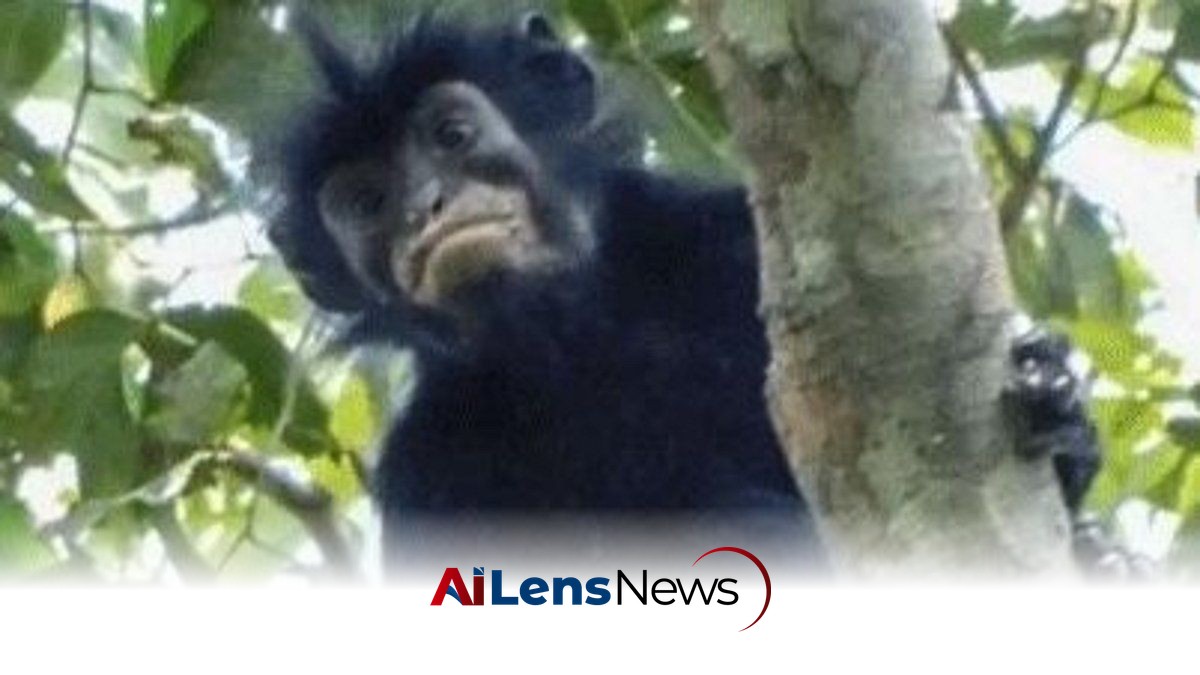


The recently identified Colobus congoensis, known as Likweli, is a significant addition to Africa's primate diversity, found in Lomami National Park.
Riyadh, Saudi Arabia Jul 16, 2026 ALN: A black-furred monkey with striking orange-pink lips that has remained hidden for years in the rainforests of the Democratic Republic of Congo (DRC) has been confirmed as a new species, marking one of Africa’s most significant primate discoveries in decades. This revelation not only highlights the rich biodiversity of the region but also underscores the importance of conservation efforts in one of the world’s most vital ecosystems.
The monkey, officially named Colobus congoensis, was first photographed in 2008 high in the canopy of Lomami National Park in eastern DRC. The image was too blurred for scientists to determine whether it belonged to a known species, and the mystery remained unsolved until another sighting a decade later prompted a dedicated search. The initial photograph, taken by a researcher during a routine survey, sparked interest but also frustration, as the lack of clarity left the scientific community with more questions than answers.
An international team of researchers from the DRC, the United States, and Germany spent several years studying the elusive primate through field observations, photography, sound recordings, and genetic analysis before confirming it as a distinct species. Their findings have been published in the journal PLOS One, which serves as an important platform for disseminating scientific research. This collaborative effort reflects the growing trend of international cooperation in biodiversity research, particularly in regions that face significant environmental challenges.
The discovery makes Colobus congoensis only the fifth new species of African monkey to be formally identified in the past 75 years. This statistic highlights both the rarity of new primate discoveries and the pressing need for continued exploration and study in Africa’s rainforests, which are often overlooked in favor of more accessible ecosystems.
Species: Colobus congoensis
Common name: Likweli
Found in: Lomami National Park, Democratic Republic of Congo
Distinctive features: Black fur, orange-pink lips, mask-like face, and deep roaring calls
First spotted: 2008, but confirmed as a new species after further studies
Why it matters: Only the fifth new African monkey species identified in 75 years
Conservation concern: Scientists want it assessed for the IUCN Red List because of its small range and habitat pressures
Known locally as Likweli, the monkey is easily recognised by its glossy black coat, vivid orange-cream lips, and long facial hair that gives it a mask-like appearance. Researchers say it also produces a deep, roaring call that often reveals its presence long before it is seen high in the forest canopy. This vocalization is not only a means of communication among the monkeys but also plays a role in territorial displays and mating rituals.
Junior Amboko, a PhD student at Florida Atlantic University who helped lead the research, told the BBC that encountering such a little-known animal was “an amazing feeling.” He said the monkeys were extremely shy and usually remained hidden high in the trees. This shyness is a common trait among many forest-dwelling primates, which often rely on stealth and camouflage to evade predators.
“As part of our search, we interviewed people in 52 villages close to where the animals live. And only people in eight villages had ever seen them,” he said. This statistic underscores the elusive nature of the Likweli and the challenges researchers face when studying species that inhabit remote areas. Local knowledge is invaluable in such endeavors, as residents often have insights into animal behavior and habitat preferences that can guide scientific inquiry.
Researchers note that while local communities had long known of the animal and referred to it as Likweli, formally identifying it as a separate species required scientific evidence showing it was genetically distinct from other monkeys. This process of validation is crucial in taxonomy, where genetic analysis plays an increasingly vital role in confirming species distinctions that may not be immediately apparent through physical characteristics alone.
The newly identified monkey belongs to the colobus family, a group of leaf-eating African primates that lack thumbs and play an important role in maintaining forest ecosystems by dispersing seeds. This ecological function is critical, as seed dispersal is essential for forest regeneration and biodiversity. The colobus monkeys’ specialized diet, primarily consisting of leaves, allows them to thrive in environments where other primates may struggle to find adequate food sources.
Genetic analysis showed the species diverged from its closest known relative, the black colobus monkey, between four and five million years ago. This long evolutionary history highlights the complex relationships among primate species in Africa and the significant evolutionary pressures that have shaped their adaptations to specific habitats.
Researchers believe the species has a limited distribution. Between 2018 and 2022, they recorded 114 sightings across an estimated range of about 1,700 square kilometers in the Lomami region. This small range raises concerns about the species' vulnerability to environmental changes, including deforestation, climate change, and human encroachment, which threaten the delicate balance of the rainforest ecosystem.
Although local communities do not appear to target the monkey specifically, scientists say habitat loss and the species’ small range make it vulnerable. They have proposed that Colobus congoensis be assessed for inclusion on the International Union for Conservation of Nature (IUCN) Red List of Threatened Species to help secure protection. The IUCN Red List is a critical tool for conservationists, providing information on the global conservation status of species and guiding policy decisions to protect biodiversity.
Researchers plan further surveys to estimate the monkey’s population and better understand its behavior, hoping the discovery will also draw attention to the rich but still poorly understood biodiversity of the Congo Basin. The Congo Basin is one of the world’s largest tropical rainforest regions, home to a vast array of wildlife and plant species, many of which remain undocumented. The findings related to Colobus congoensis may serve as a catalyst for increased conservation efforts and funding aimed at protecting this vital ecosystem, which is under constant threat from logging, mining, and agricultural expansion.
In conclusion, the discovery of Colobus congoensis not only enriches our understanding of primate diversity in Africa but also serves as a reminder of the urgent need for conservation action in the face of ongoing environmental challenges. As researchers continue to explore the complexities of the Congo rainforest, it is hoped that more hidden species will be uncovered, further illuminating the intricate web of life that exists within this critical habitat.
To learn more about the latest developments in Research & Discoveries, stay updated with our exclusive reports and analyses on AiLensNews.

