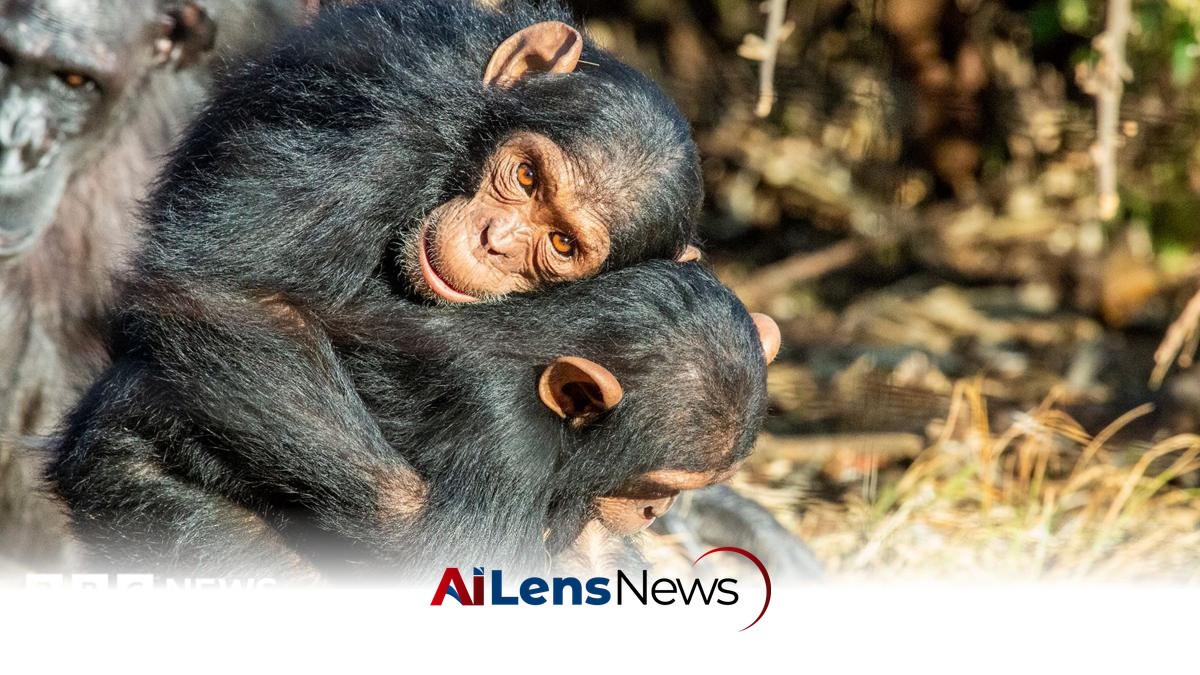


A new study shows that chimpanzees and bonobos engage in physical contact like hugging and kissing to foster trust before stressful situations, shedding light on the evolutionary roots of social behavior.
New Delhi, India Jul 22, 2026 ALN: Touching, embracing and kissing before stressful events may be an ancient way of building trust, according to scientists studying the behaviour of our closest ape relatives.
Researchers at Durham University studied chimpanzees and bonobos using physical contact to reassure each other ahead of conflicts over food. This research sheds light on the complex social interactions of these great apes and provides insights into the evolutionary roots of human social behaviour.
One of the most surprising findings was that chimpanzees, despite their reputation for aggression, engaged in close contact, including placing fingers in one another's mouths. This behaviour challenges the common perception of chimpanzees as solely aggressive creatures, revealing a softer side that emphasizes social bonding and cooperation.
"Before stressful events, they come together, they reassure each other, they touch each other, they hug each other," said Prof Zanna Clay, one of the lead researchers. She described the behaviour as "a rallying cry" before a stressful event, much like a football huddle before a big match. This analogy highlights the significance of social cohesion in preparing for challenges, whether in the animal kingdom or among humans.
"It's like a 'we' rather than a 'me,'" she said, underscoring the collective nature of these interactions. The emphasis on group dynamics is crucial, as it illustrates how social bonds can influence outcomes in competitive situations.
The experts studied chimpanzees and bonobos living at two great ape sanctuaries in the Democratic Republic of Congo and Zambia. These sanctuaries provide a controlled where researchers can observe the apes' natural behaviours without the interference of human activities or external stressors that might alter their interactions.
The researchers designed an experiment to mimic natural feeding in the wild - using peanuts as a food source. This choice of food is significant because it is a common item that can trigger competition among the great apes, thereby allowing researchers to observe how they manage potential conflicts over resources.
The apes were observed during the five minutes before the peanuts arrived, when they knew food was coming. This pre-feeding period was critical, as it allowed the researchers to capture the dynamics of social interactions just before a potentially stressful situation. By closely monitoring the apes during this time, the team was able to gather data on instances of reassuring physical contact, including touching, embracing, and kissing.
The findings revealed that individuals who touched and hugged were more likely to access food and eat alongside each other peacefully. This suggests that physical contact plays a vital role in reducing tension and fostering cooperation among the apes. More tolerant groups showed higher levels of reassuring touch, including what researchers described as "reassurance trains," in which multiple apes embraced one another in succession. This behaviour indicates a complex social structure where bonds are reinforced through physical interaction.
"Comparing bonobos and chimpanzees - our two closest relatives - offers fascinating insight into the evolutionary roots of social behaviour and how they, and we, manage tension, competition, and cooperation," said Dr. Jake Brooker, another researcher involved in the study. This comparison is particularly valuable as it highlights the differences and similarities between the two species, which have evolved distinct social strategies in response to their s.
Dr. Brooker pointed out that social touch is one of the oldest forms of communication and likely predated language. This assertion is supported by the observation that many animals, not just great apes, use touch as a primary means of social interaction. The implications of this research extend beyond the immediate findings; they suggest that the roots of human social behaviour may be deeply intertwined with the behaviours observed in our primate relatives.
The researchers say the use of touch to build trust and cooperation may date back at least seven million years, before humans, chimpanzees, and bonobos split from a common ancestor. This timeline provides a fascinating perspective on the evolution of social behaviours, suggesting that the need for social bonds and cooperation has been a fundamental aspect of primate life for millions of years.
So when humans gather in a football huddle, hug a teammate, or offer a pat on a shoulder before a stressful event, they may be drawing on a social toolkit that is millions of years old. This connection to our evolutionary past raises important questions about the role of physical touch in human societies and how it shapes our interactions and relationships.
The research is published in the journal, Proceedings of the Royal Society B: Biological s. The findings contribute to a growing body of literature that seeks to understand the evolutionary basis of human behaviour by exploring the social lives of our closest relatives. As scientists continue to study the nuances of great ape behaviour, they are likely to uncover further insights that can inform our understanding of social dynamics, conflict resolution, and cooperation in both animals and humans.
Moreover, this research could have implications for conservation efforts aimed at protecting these species. Understanding the social structures and behaviours of chimpanzees and bonobos can help in creating strategies that foster their natural behaviours, thereby improving their chances of survival in the wild. As human activities continue to encroach on their habitats, insights from studies like this one may become increasingly vital in efforts to preserve these remarkable animals and their complex social systems.
The importance of social bonds in non-human primates cannot be overstated. In many species, including chimpanzees and bonobos, social structures are complex and deeply rooted in relationships formed through physical interactions. These relationships often dictate not only individual behaviour but also group dynamics, influencing everything from foraging strategies to reproductive success. Understanding these dynamics can provide critical insights into how social structures evolve and adapt over time, especially in the face of al changes.
Furthermore, the findings from this study may prompt further research into how similar behaviours manifest in other species. For instance, studies on elephants, dolphins, and even domesticated animals have shown that physical touch plays a significant role in social bonding and conflict resolution. Exploring these behaviours across different species could lead to a broader understanding of the evolutionary significance of touch and its implications for social structures in both wild and domesticated contexts.
As we continue to grapple with the challenges posed by climate change, habitat loss, and human encroachment, understanding the social lives of great apes becomes increasingly critical. Not only do these insights enhance our knowledge of primate behaviour, but they also inform conservation strategies that prioritize the welfare of these species. By fostering s that allow for natural social interactions, conservationists can help ensure that chimpanzees and bonobos continue to thrive in their natural habitats.
In conclusion, the study conducted by Durham University researchers highlights the intricate social lives of chimpanzees and bonobos, showcasing the importance of touch in building trust and cooperation. These findings not only challenge preconceived notions about aggression in chimpanzees but also illuminate the deep evolutionary roots of social behaviour that we share with our closest relatives. As we move forward, it is essential to consider these insights in both scientific research and conservation efforts, ensuring that the legacy of these remarkable species continues for generations to come.
To learn more about the latest developments in Biology & Life Sciences, stay updated with our exclusive reports and analyses on AiLensNews.

