

Indian-origin NASA astronaut Anil Menon has embarked on an eight-month mission aboard the ISS, focusing on groundbreaking research in health and technology.
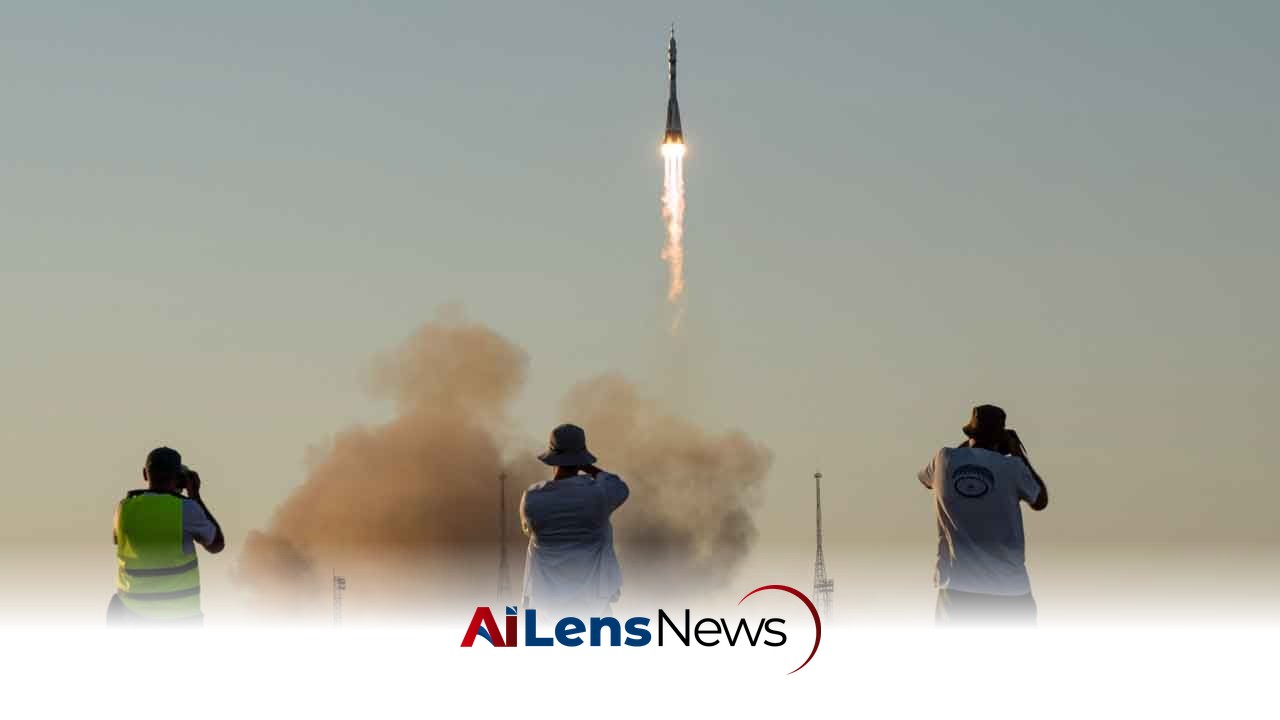
New Delhi, India Jul 15, 2026 ALN: Washington: NASA astronaut Anil Menon, along with two Russian cosmonauts, launched aboard the Soyuz MS-29 spacecraft from Kazakhstan on an eight-month mission to the International Space Station (ISS). The spacecraft lifted off from the Baikonur cosmodrome at 8:17 PM IST, marking a significant moment not just for Menon but for international cooperation in space exploration.
This mission represents a historic first for Menon, who is embarking on his inaugural journey into space. In contrast, the two Russian cosmonauts, Pyotr Dubrov and Anna Kikina, are on their second flight, showcasing the increasing experience and capabilities of the crew. After a two-orbit, three-hour trip, the spacecraft is scheduled to dock automatically at the Prichal module at 11:56 PM IST, a critical step in ensuring the crew's safe arrival at the ISS.
Menon's family, including his astronaut wife Anna Wilhelm, and NASA Administrator Jared Isaacman, were present at the launch site to witness this historic event. The presence of family and leadership underscores the personal and professional significance of this mission, highlighting the support systems that astronauts rely on as they undertake such challenging endeavors.
Upon arrival at the ISS, Menon and his fellow crew members will join a diverse team that includes NASA astronauts Jessica Meir, Jack Hathaway, and Chris Williams, as well as European Space Agency astronaut Sophie Adenot and Russian cosmonauts Sergey Kud-Sverchkov, Sergei Mikaev, and Andrey Fedyaev. This collaboration among astronauts from various countries exemplifies the spirit of international cooperation that is essential for the future of space exploration.
The mission, lasting approximately eight months, will see Menon and his team return to Earth in April 2027. During this time, they will conduct scientific research and technology demonstrations aimed at enhancing human space exploration and benefiting life on Earth. The ISS serves as a unique laboratory for research that cannot be conducted on Earth, and this mission will contribute valuable data and insights into the effects of long-duration spaceflight on human health and performance.
Yelena Remizova, head of Russia’s agency for international humanitarian cooperation, mentioned that the rocket is carrying drawings made by Indian schoolchildren. These artworks are part of the ‘First Forever’ competition, commemorating the 65th anniversary of Yuri Gagarin's historic flight and celebrating the collaboration between Russia and India in space exploration. This initiative not only fosters a sense of connection between the nations but also inspires the next generation of scientists and explorers.
Born in Minneapolis to Ukrainian and Indian immigrants, Menon is an emergency medicine physician and a colonel in the US Space Force. His diverse background reflects the melting pot that is modern America, and his journey to becoming an astronaut is a testament to the opportunities available in the United States. Menon has previously served on the frontlines in Afghanistan and worked with the Himalayan Rescue Association, providing care for climbers on Mount Everest, experiences that have undoubtedly shaped his resilience and adaptability.
Menon’s father, K P Shankaran Menon, hails from Ottapalam in Kerala, while his mother, Elizabeth, is a Ukrainian immigrant. This rich cultural heritage has influenced Menon’s perspective and approach to his work in space medicine and exploration. At 49 years old, Menon has also spent a year in India as a Rotary Ambassadorial Scholar, focusing on polio vaccination initiatives, which demonstrates his commitment to public health and community service.
He began his NASA career as a flight surgeon in 2014, working with astronauts aboard the ISS, where he gained invaluable experience in the unique challenges of space travel. In 2018, he joined SpaceX, where he initiated the company’s medical program and contributed to the development of the Starship rocket for future missions to the Moon and Mars. His work at SpaceX exemplifies the growing partnership between private companies and government agencies in advancing space exploration technologies.
Selected as a NASA astronaut in December 2021, Menon underwent a rigorous two-year training program that prepared him for the challenges of living and working in space. His wife, Anna, previously traveled to space in September 2024 as part of Polaris Dawn, a private crewed spaceflight by SpaceX, further emphasizing the personal and professional intersections that characterize the lives of those in the aerospace industry.
During his time on the ISS, Menon will conduct experiments to study the physiological effects of long-duration spaceflight, including how microgravity impacts blood flow and composition. Understanding these effects is crucial for future missions to Mars and beyond, where astronauts will face extended periods away from Earth. He will also test technologies for producing intravenous fluids using the station’s potable water system, which could be vital for future deep-space missions where resupply options are limited.
Additionally, Menon will refine in-space production of semiconductor crystals, essential for high-performance computing and medical devices. This research could lead to advancements in technology that benefit both space missions and life on Earth. He will also perform ultrasound investigations using augmented reality and AI methods, potentially reducing the need for medical support from Earth on future missions. This innovation could revolutionize how astronauts manage health issues during extended missions, increasing their autonomy and safety.
This mission not only represents a significant milestone in Menon's career but also highlights the growing collaboration between nations in the field of space exploration. As humanity pushes the boundaries of what is possible in space, the importance of international partnerships becomes increasingly clear. The ISS serves as a model for how countries can work together to achieve common goals, fostering peace and cooperation through shared scientific endeavors.
In conclusion, Anil Menon's launch aboard the Soyuz MS-29 is a landmark event that encapsulates the spirit of exploration, collaboration, and innovation that defines modern spaceflight. As he embarks on this eight-month journey, the scientific discoveries and technological advancements that emerge from his mission will not only enhance our understanding of space but also have far-reaching implications for life on Earth. The mission serves as a reminder of the power of human ingenuity and the potential for international cooperation in addressing the challenges of our time.
To learn more about the latest developments in Space & Astronomy, stay updated with our exclusive reports and analyses on AiLensNews.

