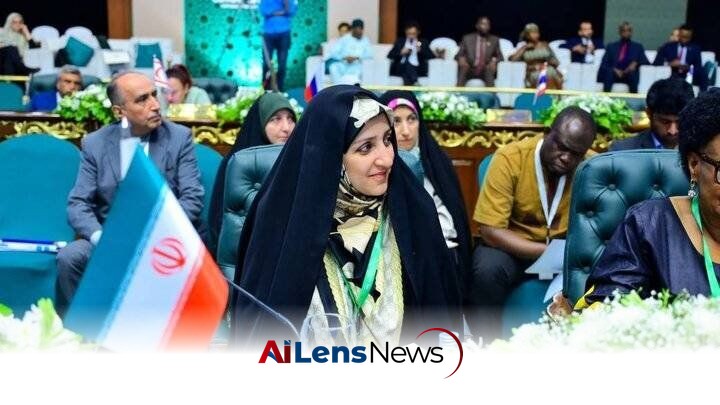


At the OIC Ministerial Conference, Iran's Vice-President Zahra Behrouz-Azar proposed initiatives to enhance collaboration among member states for women's empowerment.
Tehran, Iran Jul 14, 2026 ALN: TEHRAN – The Vice-President for Women and Family Affairs, Zahra Behrouz-Azar, has put forward two initiatives to boost collaborations among member states of the Organization of Islamic Cooperation (OIC) for empowering women. This proposal comes at a time when women's empowerment is increasingly recognized as a crucial factor for achieving sustainable development, social stability, and economic growth in many countries. The OIC, comprising 57 member states, represents a significant portion of the global Muslim population and has the potential to influence policies that can enhance the status of women across diverse cultural and socio-economic contexts.
Addressing the ninth Ministerial Conference on Women of the OIC, held in Islamabad, Pakistan, on July 12 and 13, Behrouz-Azar proposed the establishment of an ‘OIC female rescue network’ and a ‘single brand for products made by Muslim women’, as reported by Mehr news agency. These initiatives are designed to create a supportive framework for women in member states, facilitating their contributions to society and the economy. The notion of a female rescue network is particularly pertinent given the various crises that many OIC member countries face, including natural disasters, armed conflicts, and socio-political upheaval. Women often bear the brunt of these crises, and their unique perspectives and experiences are essential in formulating effective responses.
Behrouz-Azar also expounded on Iranian women's experiences in scientific, social, and crisis management fields. Iranian women comprise over 56 percent of academic communities, around 46 percent of PhD graduates, and more than 68 percent of specialists in basic sciences, while representing a significant share of faculty members, inventors, and knowledge-based companies’ managers, the official noted. This data underscores the critical role that women play in advancing education and innovation in Iran, and serves as a model for other OIC nations aiming to enhance gender equality in education and workforce participation.
Highlighting the country’s experiences in managing natural hazards and wartime crises, she said women and children suffer disproportionately during crises, but their voices are often unheard. However, women’s contributions in Iranian Red Crescent Society (IRCS) relief services have proved that the ‘women-for-women’ approach can play a key role in supporting those affected by crises. This approach not only addresses immediate needs but also fosters a sense of community and solidarity among women, which can be instrumental in rebuilding societies post-crisis.
Accordingly, Iran’s initial proposal is to establish a ‘network of female relief workers of the Islamic World’ to connect female physicians, nurses, psychologists, social workers, and relief workers from Islamic countries, and benefit from their capabilities to provide more effective support for women and children during crises and strengthen preparedness and cooperation among member states. This network could serve as a platform for sharing best practices, training, and resources, ultimately enhancing the capacity of women to respond to emergencies in their communities.
The second proposal calls for ‘developing a single brand for products made by Muslim women’ to facilitate access of women’s products to markets in Islamic countries, enhance consumer confidence, expand digital markets, hold collaborative exhibitions, and develop training in exports and branding. This initiative recognizes the economic potential of women entrepreneurs and aims to create a unified identity that can elevate the visibility of their products. By fostering an environment where women can thrive as business leaders and innovators, the OIC can contribute to the economic empowerment of women across its member states.
These two proposals are grounded in the shared values of the Islamic world—including human dignity, justice, cooperation, family, and social responsibility—which pave the way for boosting synergy among Islamic nations in supporting women. The emphasis on collaboration reflects a growing recognition that collective action is essential for addressing the multifaceted challenges women face in various contexts. By pooling resources and expertise, OIC member states can create a more equitable environment for women.
The ninth Ministerial Conference on Women of the OIC, titled “Socio-Economic and Political Empowerment of Women in the Organisation of Islamic Cooperation Countries: Challenges and Way Forward”, brought together some 190 delegates from the 57 OIC member states. This gathering provided a platform for dialogue and exchange of ideas on how to enhance women's empowerment across the Islamic world. The conference aimed to boost cooperation among member states on women’s empowerment by enhancing greater socio-economic and political participation across OIC member countries.
It is built on the outcomes of previous OIC ministerial meetings on women, particularly the one held in Cairo in 2021, which focused on women’s empowerment, protection frameworks, and enhancing their socio-economic participation. The continuity of these discussions underscores the commitment of OIC member states to prioritize gender equality and women's rights as integral components of their development agendas.
On the sidelines of the ninth conference, Behrouz-Azar and Pakistan’s Minister of Law and Justice, Azam Nazeer Tarar, held a meeting and highlighted the need to enhance collaborations between the two countries in areas related to women. Both parties agreed to develop the historic, religious, cultural, and brotherly relations between Pakistan and Iran and to undertake joint initiatives to promote women’s rights and empowerment. This bilateral cooperation is particularly significant given the shared challenges faced by both nations in advancing women's rights within their respective socio-political contexts.
Lauding Iran’s achievements in empowering women, Nazeer Tarar voiced Pakistan’s readiness to develop cooperation with Tehran and benefit from the country’s expertise in this sector. The acknowledgment of Iran's efforts in women's empowerment is indicative of a broader recognition within the OIC of the need to learn from successful models and best practices. This collaborative spirit is essential for fostering a collective response to the challenges that women face in the Islamic world.
The official highlighted Iran’s role in advancing OIC objectives, which aim to support women in addressing shared challenges, noting that “We need to work together to counter the Western media’s biased portrayal of women in Islamic nations.” This statement reflects a growing concern among OIC member states regarding the representation of Muslim women in global media narratives. The portrayal of women in Islamic countries is often skewed and fails to capture their resilience, agency, and contributions to society. By promoting a more accurate representation of Muslim women, the OIC can help to combat stereotypes and foster a greater understanding of the diverse experiences of women in its member states.
He called for the enhancement of ties between the two countries to convey the voice of women living under oppression, from Gaza, Palestine, Afghanistan, to Kashmir, to the international community. This call to action highlights the importance of solidarity among Muslim nations in advocating for the rights of women who face systemic oppression and violence. By amplifying these voices, the OIC can play a crucial role in raising awareness and mobilizing support for women's rights on a global scale.
For her part, Behrouz-Azar commended Pakistan’s unwavering support for the country during the US-Israeli imposed war, and said that the West constantly seeks to incite hatred against Islamic countries and portray a negative image of Muslim women; hence, we need a unified and coordinated strategy to restore the status of women in the Islamic world. This sentiment reflects a broader critique of Western narratives that often overlook the complexities of women's experiences in Islamic societies. By fostering a unified approach, OIC member states can work towards reshaping the discourse surrounding women in the Islamic world.
She also elaborated on Iran’s accomplishments in supporting women, their capacity, and their empowerment in various fields, highlighting their participation in the political, economic, educational, health, and social sectors. The emphasis on women's multifaceted contributions underscores the need for comprehensive policies that recognize and support women's roles in all aspects of society. By addressing the barriers that hinder women's participation, OIC member states can create a more inclusive and equitable environment.
The vice president also met the Pakistani Minister of State for the Ministry of Federal Education and Professional Training, Wajiha Qamar. The Pakistani official lauded the country’s achievements in empowering women and supporting them across various sectors of society, particularly in education and professional activities, saying that Pakistan is willing to benefit from Iran’s expertise in this sector. This willingness to learn from each other’s experiences is crucial for fostering mutual understanding and collaboration among OIC member states.
She proposed to promote interactions through empowering women in digital education and economy and sharing knowledge and experiences. The digital economy presents a significant opportunity for women in the Islamic world to engage in entrepreneurship and innovation. By investing in digital education and skills training, OIC member states can equip women with the tools they need to thrive in an increasingly digital landscape.
For her part, Behrouz-Azar suggested enhancing cooperation in AI, digital, and vocational training, as well as granting scholarships and exchanging students. This focus on education and skill development is essential for building a future where women can actively contribute to their societies and economies. By fostering educational exchanges and collaborations, OIC member states can create a network of empowered women who can drive change in their communities.
In conclusion, the initiatives proposed by Iran at the OIC conference highlight the importance of collaborative efforts in empowering women across member states. By addressing the unique challenges faced by women in various contexts and fostering a spirit of cooperation, the OIC can play a pivotal role in advancing gender equality and women's rights in the Islamic world. The commitment to enhancing women's socio-economic and political participation is not only a matter of justice but also a critical component of sustainable development and social progress for all member states.
To learn more about the latest developments in Islam, stay updated with our exclusive reports and analyses on AiLensNews.

